I still think all people of Earth should watch Gravity Falls.
…And when they’ve done that, they should watch Steven Universe. I’m just saying.
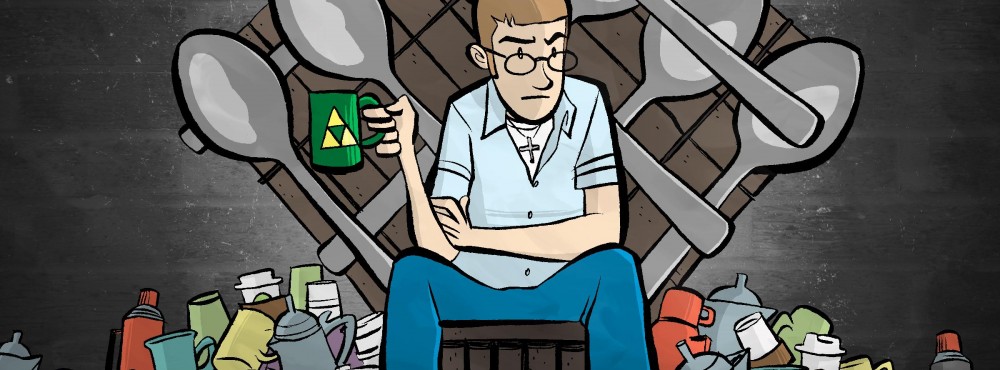
I still think all people of Earth should watch Gravity Falls.
…And when they’ve done that, they should watch Steven Universe. I’m just saying.
I’m no expert, but I’ve noticed a difference between armor for men and women in fantasy fiction: men wear more of it.
I’m no feminist, but I do believe in treating people with decency and respect. I’m also fairly pragmatic. Most female armor in fantasy fiction isn’t respectful or decent, and pragmatic it most certainly is not.
Here, for example, are male and female warriors from one of the Dragon Quest video games. In the game, they have exactly the same role on the battlefield. Is unreasonable to expect them to wear roughly the same armor?
 In the picture above, the male warrior gets a padded tunic over mail hauberk, along with leather gauntlets, a sturdy helm, a kite shield, and articulated armor plating for his legs. The female warrior, by contrast, gets a tiny mail blouse, half a mail skirt, and random bits of plate armor on her arms and legs.
There are several problems here.
The most glaring issue is sexism, of course. It just ain’t fair for male characters to be fully armored while female characters wear swimsuits. (I’ve touched upon this before.) It exemplifies the concept known as the male gaze: the way visual arts often assume the viewer is male. The male gaze ogles female characters or puts them in revealing clothes, like the chain mail swimsuit above. It’s insulting to women.
(For those ready with the “fantasy fiction is not supposed to be realistic” arguments, I believe at least a small amount of realism makes fiction more believable. If a woman wears dangerously revealing armor, there had better be a good reason for it! For those ready with the “you should stop taking everything so seriously” arguments, I don’t believe fiction is a valid excuse for sexism or double standards.)
This is not, however, a blog post about sexism. Nah, today’s post provides a more pragmatic rationale for giving female characters better armor: the kinds of armor worn by most female characters in fantasy fiction would get them killed.
Let’s take armor styles one at a time.
The chain mail bikini
 It was challenging to find a picture illustrating this style of armor that wasn’t NSFTMTF. (For those who don’t know, NSFTMTF stands for Not Safe For Typewriter Monkey Task Force: a designation covering vulgar language, extreme violence, sexually explicit material, and any media related to Kristen Stewart or Justin Beiber.) Even the picture above pushes the boundaries of good taste.
The chain mail bikini describes any style of armor that (sometimes barely) covers only the naughty bits of a lady’s anatomy. I need hardly describe the practical difficulties of such armor. It exposes vital organs such as the stomach and lungs, providing practically no protection whatsoever. More often than not, what little armor is worn looks like it could fall off at any moment. High heels, which are often worn with chain mail bikinis, don’t allow for quick movement or proper balance.
Are there benefits to chain mail bikinis? I’m really reaching here, but I suppose they could offer good mobility, and might prove distracting to enemies.
Nah. Who am I kidding? Chain mail bikinis are completely useless.
The boob plate
 As the name suggests, the boob plate is a breastplate with breasts.
Opinions are divided on the usefulness of the boob plate, but the most logical view is that it would probably kill you.
You see, armor doesn’t merely shield the body from sharp or spiky things. It also deflects the force of blows from weapons. A blow from, say, a club will do far less damage if it glances off a breastplate than if it strikes it squarely. In other words, armor is meant to deflect blows, not to absorb them.
The problem with boob plates is that they wouldn’t necessarily deflect blows away from the chest. They could also deflect them inward, funneling them into the cleavage between the breasts—and right into the wearer’s breastbone. Even if a weapon didn’t penetrate the armor, it could fracture the wearer’s sternum. Flipping heck, even falling forward could slam the ridge of metal separating the breasts into the breastbone, breaking it.
As it happens, people who wore armor usually wore padding beneath it, so a woman’s chest would probably be wrapped or padded and wouldn’t require a form-fitting breastplate in the first place.
The battle dress
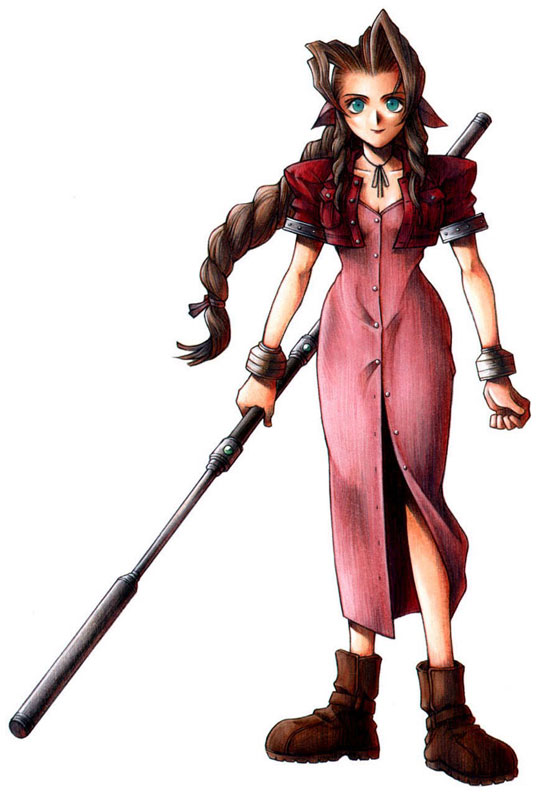
A battle dress is a dress worn into battle. Like the boob plate, it’s fairly self-explanatory.
I applaud the battle dress for being less blatantly sexist than other styles of female armor… but it still gets low marks for practicality. Long skirts and dresses have the same problem as capes in The Incredibles: they get caught on stuff. A woman can hardly run, ride a horse, or vault over bushes in a dress. Sooner or later, it will snag on something.
Besides, dresses offer no protection… unless they have chain mail or plate armor sewn into them. Then, unless the armored sections are kept close to the body, such weighted dresses are even more likely to snag on stuff. Besides, any heavy part of the dress left hanging, such as a skirt or long sleeve, impedes movement by swinging awkwardly.
The sensible armor
 The armor in the picture above isn’t perfectly practical—it should lose the flowing skirt, and the breastplate really ought to cover more of the abdomen—but it isn’t bad. (I would cut off the braid and add a helmet, but what do I know?) The shoulders, chest, and legs are protected, leaving the arms free and allowing bend at the waist for wielding so large an axe. The armor also looks awesome as all heck.
Women can wear more or less the same styles of armor as men, with minor adjustments for shoulder width. Even adding a slight outward bulge for breasts is fine, provided it doesn’t include the sternum-shattering cleavage mentioned above; a gentle convex curve can deflect blows as well as anything. Designing sensible female armor doesn’t have to be that difficult.
Is impractical lady armor ever appropriate in fiction? I suppose it has its place, such as in comedic tales and parodies of fantasy fiction. In more serious stories, styles of lady armor which would be useless in battle could be used for ceremonial purposes: parades, coronations, etc.
In the end, however, I think practical armor is definitely the best way to go.
The US Supreme Court recently legalized gay marriage nationwide. Today’s blog post actually has very little to do with that, and much more to do with the sudden, blinding proliferation of rainbows across the Internet.
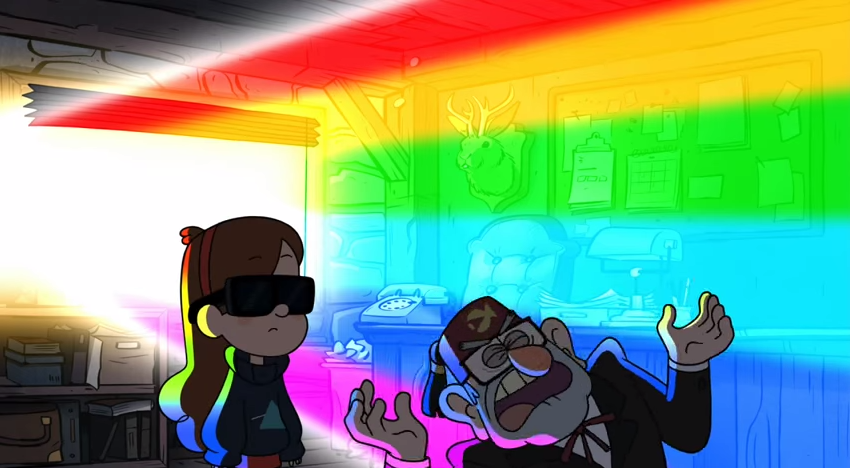
My eyes! MY EYES!
Rainbows are a symbol of the LGBT community. Following the Supreme Court’s decision, they began appearing everywhere on the Internet. Facebook was overrun by rainbows, and my Twitter feed would have given Joseph’s many-colored coat a run for its money. Flipping heck, even my blogging site, WordPress, replaced its usual monochromatic theme with a rainbow-colored one.
(On a vaguely related note, I recommend listening to the Rainbow Road soundtrack while reading the rest of this blog post.)
With rainbows suddenly popping up all over the Internet, I signed back on to Twitter to make a joke about them. I planned to say something goofy and innocent, something like: “The rainbows! They’re everywhere! Where are my shades? Ah, it’s too late! My eyes! MY EYES!”
However, as I typed out the joke, I hesitated. My comment wasn’t bitter or celebratory or controversial. It wasn’t anything but silly, but I couldn’t help worrying that it would ruffle someone’s feathers. Gay marriage is such a touchy subject that I was reluctant to mention it, even in the most lighthearted way. In the end, I remained silent.
(By the way, I thought about discussing the legalization of gay marriage in this blog post, but everything I want to say has been said much more eloquently by another blogger. Whatever your stance on gay marriage, I recommend reading her blog post; it’s a sensible, compassionate take on recent events. I’ve already discussed my own views on homosexuality on this blog, so I won’t repeat myself here.)
My reluctance to discuss gay marriage in even the most lighthearted way was an uncomfortable reminder that I selfishly want to be liked. I don’t want to offend anyone, even if it means keeping my views and thoughts and beliefs to myself. If being honest or insightful offends others, I’ll settle for being funny or clever.
This is a problem, because I am a follower of Jesus Christ, and he offends practically everybody.
In his lifetime, Jesus offended religious people; today, Jesus offends nonreligious people. The religious leaders in his day despised him every bit as much as many atheists do today. Jesus Christ has never been politically correct. He condemned not only sin and faithlessness, but pride and religious hypocrisy. In the end, the people who orchestrated his execution were religious authorities, not secular ones.
If I insist on following Jesus Christ, it will be only a matter of time before I offend someone. As a follower of Christ, I must believe that truth is absolute, even in our pluralistic, postmodern culture. I must believe that some things are not okay, however widely they may be accepted or celebrated. To wit, I must not compromise my beliefs, even when they offend people—and sooner or later, they will.
That’s hard for me to accept. I hate upsetting others. I really want to be liked by everyone. Offending others for any reason makes me feel like a deplorable jerk.
It all begs the question: Do I believe Jesus Christ is worth the risk of annoying, upsetting, or alienating people? Is the Christian faith, which is built upon loving others, worth offending some of them?
I believe it is.
Of course, I’ll do my best not to be a jerk. I can definitely be a jerk sometimes.

As it happens, this is one of my favorite shirts. I wonder what that says about me.
Jesus Christ offends people, but he is not a jerk. In his lifetime, even when flipping tables and railing against sin and hypocrisy, Jesus acted with the utmost of intentions. He loved people, all people, crooks and prostitutes included, without ever compromising his convictions or beliefs—and yes, he offended people. He still does.
I will offend someone at some point. I must come to terms with that fact, while doing my best never to be a jerk, and to be as kind and accepting as I can.
That said, after a week of seeing rainbows flipping everywhere on the Internet, my eyes are really starting to hurt. I’m thinking I should invest in some shades.
“What is the way to the abode of light? And where does darkness reside? Can you take them to their places? Do you know the paths to their dwellings? Surely you know, for you were already born! You have lived so many years!”
~ Job 38:19-21
I’m often sarcastic, but that’s okay. God is sarcastic, too.
In the book of Job, God allows a righteous man to be tormented as a test of faith. It’s a paradoxical book, at once uplifting in showing the ultimate power and benevolence of God, and disturbing in depicting a God who allows a good person to suffer without any explanation. I’ve already said a thing or two about Job, and there’s more I could say, but for now I’ll simply point out how the book of Job proves that God can be really sarcastic.
Job spends most of the book arguing with his friends, defending his innocence as they accuse him of wrongdoing. If Job were innocent, they reason, why would God allow him to suffer? Job isn’t impressed by their arguments, and he proves to be quite sarcastic himself: “How you have helped the powerless!” he snaps in the twenty-sixth chapter. “How you have saved the arm that is feeble! What advice you have offered to one without wisdom! And what great insight you have displayed! Who has helped you utter these words? And whose spirit spoke from your mouth?”
Job’s biting sarcasm is surpassed only by God himself, who shows up a few chapters later. God doesn’t offer explanations or answer Job’s questions. Instead, he emphasizes his own absolute power and wisdom. However incomprehensible God seems, he knows what he’s doing. It’s not a terribly satisfying answer, but it’s enough for Job, and the book ends on a happier note with Job’s life restored.
God’s response to Job seems really harsh, especially when the Almighty gets sarcastic. After asking Job a long series of unanswerable questions, he adds, “Surely you know, for you were already born! You have lived so many years!” His sarcasm only emphasizes how little Job—or any human being, for that matter—can comprehend of God’s nature.
There’s another lesson here: God uses sarcasm, which I cheerfully accept as license to be as sarcastic as I like. After all, Christians are commanded to be like God: Jesus Christ said, “Be perfect, therefore, as your heavenly Father is perfect.”
In other words, by being sarcastic, I’m obeying the all-important commandment to be like God. Sarcasm is my moral and religious duty.
No, I’m not being serious. Yes, I’m being sarcastic, but not from any sense of religious obligation. Please don’t bombard me with angry emails or heavy stones! After all, it’s important to have a sense of humor, for as Jon Acuff reminds us, “Laughter is a gift from God. If we take it for granted and act like Christians can’t be funny, he’ll take it back. Like the unicorns.”
 Typewriter Monkey Task Force