16. Voice Acting

I have a lot of odd obsessions, such as my fascination for video game music and love of British literature. One of my peculiar passions is voice acting.

For those unfamiliar with this noble profession, voice acting is the art of playing a role through the voice and the voice alone. A voice actor can’t rely on her own expression or body language; every nuance of her character must be represented by her voice.

The fun thing about voice acting is that a really good voice actor can make himself sound like pretty much anybody. Listening for familiar voice actors in movies and television shows is sort of like playing an audio version of Where’s Waldo? Familiar voice actors turn up in the most unexpected places, and there’s a thrill in hearing the voice of, say, Howl in Howl’s Moving Castle and crying out, “Aha! That’s the guy who plays Batman!”

There was a time in my life when my ambition was to become a professional voice actor. This glorious dream lasted about two weeks before it was brutally crushed by two realizations.

First was the fact that voice acting is a difficult field that’s already full to bursting with talented people. Second was the sad truth that most voice actors can’t pick and choose their projects. If I became a voice actor and could actually find work, I’d probably end up playing a minor character on some cartoon about talking ponies or—if I were truly fortunate—a dub of some obscure anime.

So in the end I exchanged my dream of voice acting for a sensible plan to teach English and write novels.

All the same, I sometimes wonder what might have been.

15. Video Game Music

I love video game music. As I’ve mentioned previously, video games have an unfortunate (and mostly unmerited) reputation for being lowbrow or even harmful. Video game music is not generally considered to be of much value.

This is sad, since much of the music from video games is absolutely superb.

In addition to the great music in video games, there are thousands of remixes created by musicians who rearrange, reinterpret and reinvent video game melodies.

There are four things I particularly like about video game remixes.

They’re creative

I’ve heard the main theme from Super Mario Bros. remixed as electronica, performed by a string quartet, scatted a cappella and played on a piano. A single song might be interpreted in a hundred different ways. It’s delightful to find a new perspective on a familiar melody—rather like looking at a painting in a museum and recognizing the view out of my own bedroom window.

They cover pretty much every musical genre

I’ve heard at least one song rearranged with bagpipes in the style of traditional Scottish music. Need I say more?

They’re often amazing

Composers of video game music have commented on the surpassing quality of remixes they’ve heard. David Wise and Christopher Tin, among others, have spoken positively about remixes of their music. (Christopher Tin, by the way, won a Grammy for a song he composed for a video game.) I’ve heard many remixes of professional quality, sometimes with vocals or live instruments.

They’re free

Most video game remixes are available for download—legally—for free. Because remixes are based on music owned by video game developers, those who make them aren’t usually able to sell them without breaking copyright law. The alternative is to distribute remixes for free, which is legal and totally awesome.

In order to demonstrate the quality, variety and grandeur of video game music, I’ve decided to give a few examples—or rather, one example remixed in several ways. The remixes are taken from OverClocked Remix, an organization “dedicated to the appreciation and promotion of video game music as an art form.”

First is the original song, “Valley of the Fallen Star” from Final Fantasy VII. The song has sort of a Native American feel to it, with muted percussion providing rhythm and a woodwind carrying the melody.

Next we have “Red XII Redux,” a straightforward rock remix—nothing fancy or extravagant, just a smooth arrangement of the song recorded live.

Moving from laid-back rock to frantic guitar shredding, “Lunatic Moon” combines rock and electronica in a song that practically radiates energy and aggression.

We finish with “Ascension to Cosmo Canyon.” The song is simply beautiful, every bit as peaceful as “Lunatic Moon” was frenetic, with piano and strings leading into a woodwind melody backed by drums and a male chorus. The song is lovely and has a decidedly cinematic feel.

These are just a few examples of how one song can be interpreted in many ways. Video game music is wonderful on its own merits—especially in these days when so many games include music from choirs and live orchestras—and remixes present endless interpretations and reinventions of video game melodies.

Remixes are also free. You can’t beat that!

14. Shameless Self-Promotion

I want to be a writer. I’m studying to be an English teacher, and I’ll probably spend much of my life in a classroom, but writing is my true passion.

Why become an English teacher instead of a professional writer? It’s extremely difficult to make a living as a writer, particularly a writer of fiction. Most novelists have full- or part-time jobs. As much as I’d love to spend eight hours a day writing fiction, it’s probably not going to happen.

Even so, I do hope to become a novelist. I’ve finished a novel, a wry fantasy about an Oxford student who is summoned to another world by a magician who had been trying to summon a completely different person. The novel, The Trials of Lance Eliot, is currently in search of a publisher, like a ship drifting through stormy seas in search of a safe harbor.

I’m tremendously excited about my novel, but there’s something else I’m not excited about at all: self-promotion.

Publishers expect authors to promote themselves through websites, book signings, public readings and so forth. Most authors must sell themselves in order to succeed. That bothers me. I can’t claim to be a particularly humble person—the truth is that I struggle with vanity and conceit—but I can honestly admit to being a modest person. I don’t like making a fuss about myself, my writing or anything remotely connected with me.

A few months ago a friend sent me a link to a quirky online graphic novel titled Ratfist. (It’s a zany superhero comic with surprisingly profound philosophical themes; if you’re interested, you can check it out here.) The cartoonist, Doug TenNapel, comments on each page of the novel, and one of his statements made me stop and think.

“I have no problem with shameless self-promotion. It’s not for my good, it’s for you. I like making stuff. It’s not as fun to make stuff if people don’t see it. Entertainers entertain.”

This comment helped me see self-promotion from a different perspective. There’s not much point in making stuff (in my case, novels and blog posts) unless people see it. People won’t see it unless someone promotes it. No one else will promote it unless I pay them. Since I’m a poor college student, that leaves me with only two options: be modest and write stuff that few people will read, or promote myself and write stuff that more than a few people will read.

That said, I’m going to ask a favor of you. Yes, dear reader, you. I’d be honored if you’d give TMTF a shout out. Do you like the blog? Awesome! Let us know what you like about it! Do you think the blog is the worst thing since Rebecca Black’s music? Slightly-less-but-still-somewhat awesome! Let us know what you don’t like about it! Whether you mention TMTF on your blog, your Facebook page, your Twitter account or in some other way, the Typewriter Monkey Task Force and I would be very grateful.

I write TMTF to share my passion for the things I’m passionate about: the goodness of God, the eccentricity of gaming culture, the humor of everyday life and a thousand other things. The purpose of this blog is to impart hope or understanding or inspiration—or at the very least a healthy laugh—to someone who needs it. I’m really excited about TMTF and my other writing projects. But there’s not much point in writing unless someone actually reads it. As that Julian Smith guy from YouTube so often says, “I made this for you!”

So please consider giving TMTF a good word on your blog or Facebook page or Twitter account! Always feel free to comment on blog posts! (My typewriter monkeys love comments on their work.)

You are the reason I write, dear reader. Whether or not you choose to give this blog a mention, thank you for being awesome and giving me a reason to write.

13. That Time I Was a Blacksmith

It’s been an introspective week here at TMTF. The last few days have been full of insights and epiphanies and moments when I threw up my hands and shouted “Eureka!”

Although I had initially planned to post another reflection about faith today, I decided against it because spiritual meditations are best taken a little at a time. Rather than overwhelm my dear readers with too much introspection, I’ve decided instead to save it for another day and write about That Time I Was a Blacksmith.

As the spring 2010 semester drew to a close at Bethel College, I made plans to work as a painter for the college’s maintenance department over the summer. I’d worked there during the previous two summers and felt confident I’d be hired. I was wrong. The maintenance department didn’t hire any student workers due to budget issues. I had four months before me and no job, no salary and no plans.

Then my sister-in-law’s parents contacted me. Her father is a blacksmith—a genuine, honest-to-goodness professional blacksmith, one of those mighty men who craft things out of iron and steel. They had heard from their daughter that I was looking for a job. Would I be interested in working for them over the summer?

Heck yeah.

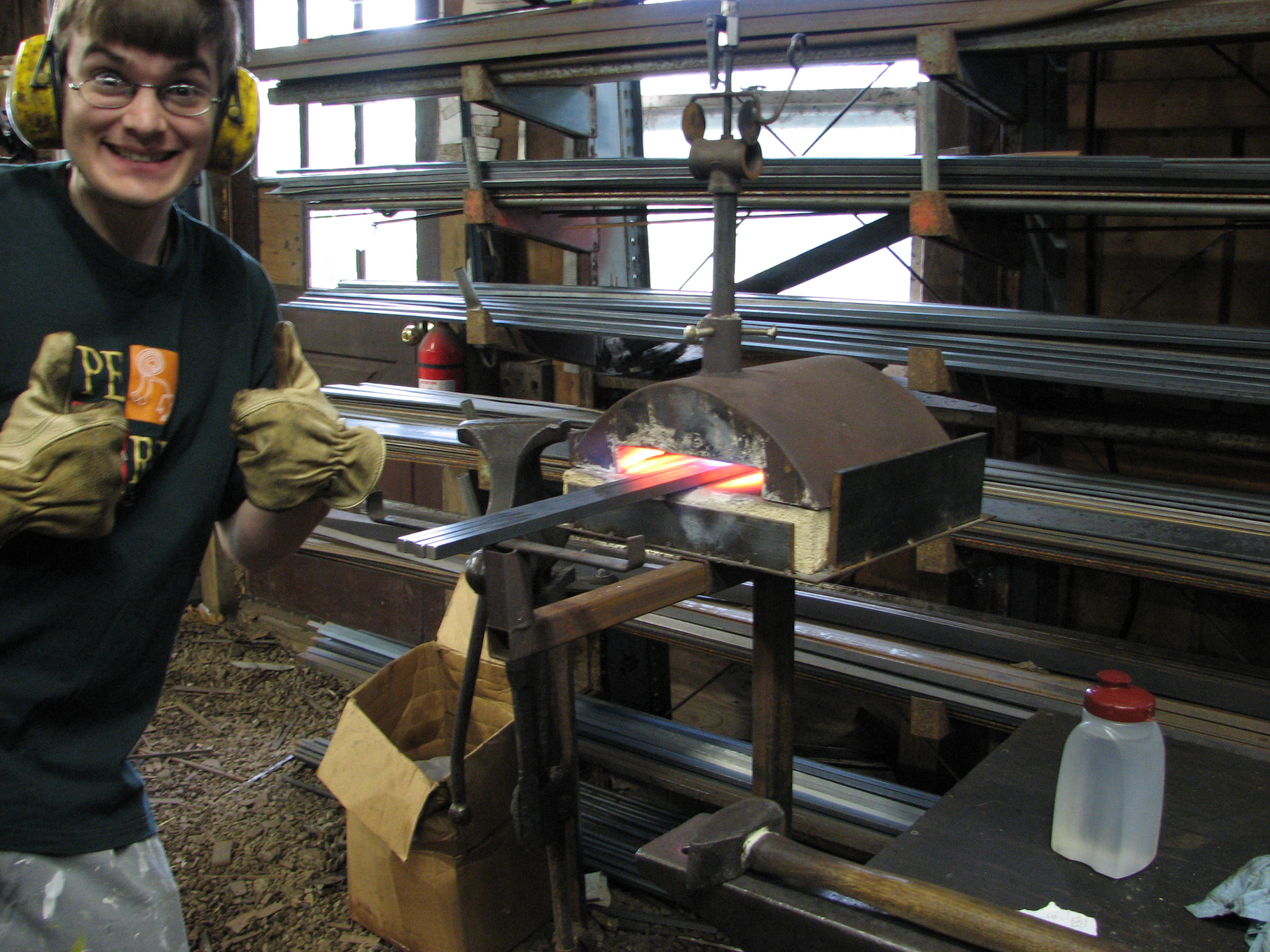
I packed up my things and moved into their home for about two and half months. (I spent the last month of that summer teaching English in South Korea, but that’s another story for another post.) When I went to stay with my sister-in-law’s parents, I didn’t know much about blacksmithing. Here are a few of the things I learned.

Blacksmithing is tough

Blacksmithing requires considerable physical fitness and strength. Whatever else I may be, I’m not physically fit or strong. I generally used the smallest hammer in the shop. My brother calls it “the girly hammer” because it was the tool his wife and her sisters used when they worked as blacksmiths. It’s a little embarrassing to admit, but they were all much better blacksmiths than me.

Making swords is very, very difficult

When I began working as a blacksmith, I had great ambitions to make an epic sword. It didn’t have to be a Buster Sword or even an Andúril. I simply happen to have a passion for sharp objects and wanted to make a sword that was uniquely mine. I was disappointed to learn that crafting swords is a career of its own. Which brings us to the next thing I learned.

There are different kinds of blacksmiths

I had just assumed blacksmiths made everything. Only after I began working did I realize there are knifesmiths, who make knives; swordsmiths, who make swords; farriers, who make horseshoes; and standard blacksmiths, who make miscellaneous items such as candlesticks and tent pegs and barbecue grills. My boss fit into the last category.

Blacksmithing requires a ton of mathematics

I would never have guessed it, but there’s much more to being a blacksmith than whacking things with hammers. A blacksmith must figure out how many two-and-three-quarter-inch lengths can be cut from a twenty-foot steel rod, and how many corresponding one-and-a-half inch lengths must be cut from a fifteen-foot steel bar. There are angles to be calculated and numbers to be added. This was a problem for me. I’m an English major, you see. Having assumed the math skills I picked up in high school were mostly useless, it was quite a shock to realize mathematics does have practical applications after all.

Many modern blacksmiths use machines

In the movies you see old-fashioned smiths banging away with hammers and pumping air into coal fires. In these high-tech days blacksmiths use propane-fueled forges, power hammers and electric saws. It was quite a surprise to walk into the shop and find antique anvils (my boss has anvils that are centuries old) sharing space with heavy machinery.

Apart from working in the shop, I also had the opportunity to accompany my boss to several rendezvous—reenactments of early nineteenth-century America. We set up a tent full of merchandise and spent whole weekends forging and selling items. My boss did the forging, hammering red-hot metal in front of a blazing coal fire in the summer heat for hours on end. It never seemed to bother him. I had the easy job of sitting on a stool and taking our customers’ money, and I still felt tired at the end of the day.

I met a lot of neat people at those rendezvous. A man who looked like a homeless person with a greasy beard and stained T-shirt turned out to be a professional swordsmith with multiple university degrees. Another man was the exact image of Benjamin Franklin. And at my first rendezvous, my boss and I stood in line for supper with folks dressed like people from different epochs of Earth’s history: ancient Romans, medieval knights, French noblemen and American colonialists. We did not merely stand in a line that night. We stood in a timeline.

I don’t plan on ever becoming a blacksmith again, but it was a very good experience. My boss and his wife were ridiculously kind, generous and hospitable. My boss was also very patient. A lesser man would probably have lost his temper and bashed in my head with a hammer, but he was always tolerant of my mistakes.

My only real regret is that I wasn’t able to make that sword.

12. When Life Doesn’t Make Sense

In my last post I expressed my belief that circumstances that seem hellish and horrible are sometimes part of God’s perfect plan.

Is this just wishful thinking?

As a certain Science Guy would say, consider the following.

The Bible is basically a story, an epic narrative woven of history and prophecy and poetry and one or two love songs. In the story of Scripture there are powerful examples of events that seemed utterly tragic, sickeningly futile and completely meaningless, but were used by God for good.

Job was a righteous and prosperous man who lost everything. His property was all stolen or burned to cinders. His children were killed. His body was racked with painful sores. His wife told him to curse God and die, his friends attacked him with false accusations—and God was silent. No matter how Job cried out in pain and confusion, his Maker did not answer.

The kingdom of Israel, God’s chosen people, built him a beautiful temple in the holy city of Jerusalem. They believed Israel, Jerusalem and the temple would last forever because God was with them. Then Israel split into two kingdoms, which bickered for centuries before suffering total defeat by the Assyrian and Babylonian empires. Jerusalem was ruined. The temple was destroyed. God’s chosen people were scattered across the world, and his promises of a coming king and an everlasting kingdom seemed to have been broken.

The ragged descendants of Israel believed Jesus was going to fulfill ancient prophecies, break the power of Rome and establish a kingdom that would never end. Then Jesus was betrayed, condemned, humiliated, flogged and executed. The one whom they believed to be God’s own Son, in whom they had invested their lives, their hopes, their dreams, was dead.

It’s easy to look at these situations and see only the happy endings we know are coming. But the people who lived through these situations couldn’t see those happy endings. All they saw was hellish, painful, meaningless tragedy, and a God who seemed to have abandoned them.

What happened to them?

Job was finally answered by God, who restored Job’s family, fortune, health and happiness.

Many of the descendants of the Israelites became part of a greater kingdom, the Church, and watched as God’s promises began to be fulfilled in ways that surpassed their wildest dreams.

Jesus didn’t stay dead.

These tragedies, which seemed beyond even the remotest chance of redemption, were used by God to bring about comfort, peace, grace, salvation and hope.

If God could redeem those tragedies, he can certainly redeem mine. I don’t know why I had to suffer through my Thursday Afternoon of the Soul, but God knows. I see only a few scattered pieces; God sees the whole puzzle. “Now I know in part; then I shall know fully, even as I am fully known.”

11. My Thursday Afternoon of the Soul

I hate it when life doesn’t make sense.

My life seems pretty reasonable most of the time. Sure, there are moments when I feel a little discouraged. But if I have a cup of tea and devote half an hour to a good novel or video game, I usually recover my cheerfulness and sense of humor.

Then there are times of darkness. Times when I’m suffocated by anxiety. Times when I’m too depressed to do anything but breathe. Times when the world seems broken, twisted and corrupted beyond all hope of redemption, recovery and repair. Times when life just doesn’t make sense.

Times of darkness are sometimes called Nights of the Soul. I personally don’t mind nights. If I’m depressed at night, I can go to bed and awake to a new day. When I was younger, however, I couldn’t stand Thursday afternoons. I was usually tired and discouraged on Thursday afternoons, when the week’s work had worn me out and the weekend seemed far away.

Although I’ve never had a Night of the Soul, I once suffered a horrible period of depression that lasted about a year and a half.

I call it my long, dark Thursday Afternoon of the Soul.

The worst thing about my Thursday Afternoon of the Soul was that nothing seemed to make sense. All I had to sustain me through anxiety and despair were a few dim memories of happier times. People around me were joyful and I couldn’t understand why. People around me were passionate about Jesus, and I was at a loss to understand how they could be so dashed cheerful about a God who seemed so far away and a faith that seemed so impossibly hard. Although I felt utterly unmotivated, I tried to justify myself by serving God in various ways—and failed. I failed over and over and over. And since it didn’t seem right to blame God for bad things, I blamed myself.

To wit, my Thursday Afternoon of the Soul was deuced awful.

(I was tempted to use much stronger language than deuced, but decided against it because my parents will probably read this post.)

I’m so thankful to God for bringing my Thursday Afternoon of the Soul to an end. I don’t know why he put me through it, but I know he had a good reason.

Is that naïve? Is it foolish to look for hope and meaning in circumstances that seem hopeless and meaningless?

I don’t think so.

Why not?

The answer is a little on the longish side, so it will have to wait until the next post.

10. Squirrels

It was fun to grow up in Ecuador for many reasons, but one of them was the way visitors to the country reacted in awe and amazement to everyday things. A missions team would come to Quito from the US and gape in wonder at llamas or street performers or the Andes Mountains, and I would feel a smug sense of pride at considering these miraculous wonders a normal part of my missionary kid life.

Then I came to Indiana and began doing the same thing as those visitors, except my awe and amazement were reserved for squirrels.

In my fourteen or so years in Ecuador, I only ever saw two squirrels. One was kept in a cage as an exotic animal at a beach resort. The other crossed my path while I was visiting a cloud forest with my high school biology class. Cloud forests are basically high-altitude rainforests, and the location we were visiting was renowned worldwide for its vast variety of bird species. My class was given the option of taking an early-morning bird-watching tour. Most of us agreed to try it.

So at about six o’clock in the morning we found ourselves stumbling along a jungle path, bereft of breakfast or coffee, clutching our binoculars and trying to stay awake as our guide pointed out toucans and parrots that were so far away they all looked alike. I was almost asleep on my feet when someone gave a sharp, sudden cry.

“Squirrel!”

We immediately abandoned whatever tropical bird our guide was pointing out and looked around eagerly for the squirrel. There it was! A squirrel! Running across our path just thirty feet away! We were fascinated. In the end, the most remarkable and memorable thing about that whole bird-watching tour was the squirrel.

Then I came to Indiana to attend college and realized there are squirrels everywhere. I immediately pointed this out to people.

“Squirrels!” I exclaimed. “Right there! Cute fuzzy furry squirrels!

People began giving me odd looks.

Squirrels are adorable. I don’t understand why people aren’t more excited about them.

9. I Can Do Everything through Him Who Gives Me Strength? Seriously?

Just a few days ago two of my housemates discussed over lunch what sort of psychological breakdown I might have. One of them thinks I would ramble incoherently and gesticulate wildly for about ten minutes, then slip into a catatonic state while clutching a cup of tea. The other thinks I would focus all of my concentration on a Legend of Zelda game, emerging from my video game-induced stupor only to sip tea.

I was gratified that both of my housemates recognize my passion for tea, and sincerely hope I never have to find out which of their theories is correct.

The truth is that I felt uncomfortably close to breaking down yesterday. There was never any danger of a genuine psychological breakdown, but I felt more than once as though I’d reached the end of my strength. It’s not a nice feeling.

I’m student teaching at a local high school, teaching two regular classes and assisting in a classroom with at-risk kids. Teaching can be wonderfully fun and rewarding. It can also be terribly exhausting and stressful. I sometimes find myself thinking wistfully of becoming a manuscript editor or pursuing some other career that doesn’t involve classroom management.

I was walking to a classroom today when a familiar quotation came to mind: “I can do everything through him who gives me strength.” That’s dear old Paul, of course. It’s one of those verses from the New Testament I’ve heard so many times that I no longer think about it.

Today, however, I paused and thought about it. Paul lived a stressful life. He faced excruciating hardships: “Five times I received from the Jews the forty lashes minus one. Three times I was beaten with rods, once I was stoned, three times I was shipwrecked, I spent a night and a day in the open sea, I have been constantly on the move. I have been in danger from rivers, in danger from bandits, in danger from my own countrymen, in danger from Gentiles; in danger in the city, in danger in the country, in danger at sea; and in danger from false brothers. I have labored and toiled and have often gone without sleep; I have known hunger and thirst and have often gone without food; I have been cold and naked. Besides everything else, I face daily the pressure of my concern for all the churches.”

My student teaching suddenly doesn’t seem so bad.

Paul suffered so much pain and discomfort and stress. What did he have to say for himself?

“I have learned the secret of being content in any and every situation, whether well fed or hungry, whether living in plenty or in want. I can do everything through him who gives me strength.”

Paul is writing about the Lord Jesus, of course.

It finally hit me today that I’ve been trying to do this thing on my own. I’ve been worrying about how I must survive the next six weeks and how I must teach these kids and how I must show them God’s love.

I don’t have to worry about the weeks and months and years ahead. I’m not alone. There is a secret to being content in any and every situation: I can do everything through Christ who gives me strength. It’s not some sort of trite religious propaganda or esoteric spiritual mystery. I need to stop trying to handle everything on my own, and trust that God will help me when I can’t help myself.

That’s an obvious lesson, right? The problem with obvious lessons is that they’re so easy to forget.

The Lord told Joshua, “Be strong and courageous. Do not be terrified; do not be discouraged, for the LORD your God will be with you wherever you go.”

It’s just as true for me today.

Do you know what else? It’s just as true for you today.

8. An Unapologetic Apology for Video Games

I like knives. To be honest, I like sharp objects in general: knives, daggers, sabers, katanas, broadswords, machetes, claymores and pretty much every other kind of blade devised by mankind.

(It would be more politically correct to say humankind, but in this case mankind is probably more accurate since men are the ones responsible for most of the blades in the world.)

Used correctly, knives can be useful for everything from peeling oranges to creating works of art. Used incorrectly, knives can kill and hurt and destroy. Knives are inherently neither good nor bad. Whether they’re good or bad depends on how they’re used.

I’ll return to the exciting subject of knives in a moment, but I should mention first that I’m student teaching at a local high school. The other day I glanced through a book for teachers about the problems of apathy and disrespect in the classroom. I was a little disheartened when the book blamed video games for the lethargy of unmotivated students.

Why was I disheartened?

Because it’s often true.

Video games can be addictive. Some are horribly violent. Many are painfully shallow or stupid. Finally, while I’m no expert in psychology, I think the satisfaction of accomplishing goals in video games can become an unhealthy substitute for the satisfaction of accomplishing goals in real life. Why bother working hard at school when you can save—or conquer—the world in a video game?

Video games can definitely be harmful. So can knives. But knives can also be beneficial, and I think video games can be too.

There are two kinds of apologies. First is an expression or remorse or regret. Second is a justification or defense. This post is the second kind of apology.

If you will, consider the following.

It’s not fair to judge an entire medium by a few bad examples

Yes, there are video games like Grand Theft Auto and God of War that glorify violence, profanity and sexual depravity. There are also books and films and songs that are just as bad or even worse. We don’t condemn all books or films or songs because some are bad. Why then do we assume all video games are harmful because some happen to be?

Video games are a unique form of storytelling

I’ve read many books and played many games. To be honest, some of those games are a lot better than some of those books. The Final Fantasy games, for example, consistently provide fantastic settings, clever plots, superb characterization, interesting themes and (in the later titles) good writing and acting.

Some games even give players the freedom to influence the story by their decisions: the player and the storyteller become partners in bringing the story to its conclusion.

Video games have artistic value

There are people—including some game developers—who would challenge this assertion, but I think video games can be a valid form of artistic expression. Graphic design, animation, writing, music and acting are acknowledged to be forms of art.

Video games bring together some or all of these artistic forms and add the unique element of gameplay, the finely-tuned mechanics that allow a player to interact with the game. How is that not artistic?

Video games are fun

‘Nuff said.

Video games can be thought-provoking

Although we expect them to be intellectually vapid, video games can be quite profound. Final Fantasy Tactics Advance, for example, has some fascinating moral dilemmas: Is a harmless illusion better than a painful reality? At what point does a person have the right to make decisions for another person?

The Final Fantasy series deals with all sorts of serious moral, political and ecological themes, and there are many other games that wrestle with issues of equal importance.

Video games bring people together

The stereotypical gamer is a lonely misfit with pale skin and no social experience. However, as is often the case, the stereotype is usually wrong. Most of the gamers I’ve met are cheerful, well-adjusted people. In my own experience, video games have actually strengthened friendships by giving friends something to do together. It’s hard not to enjoy spending time with other people when you’re tossing green shells at each other in Mario Kart or trying to knock each other off the screen in Super Smash Bros.

Is there more to a meaningful friendship than video games? Of course. Can video games be part of a meaningful friendship? Absolutely.

Video games inspire creativity

I’ve seen beautiful artwork inspired by video games and listened to amazing arrangements of video game music. There are many online comics centered on the oddities of games and gaming culture; some of them are really fun to read.

Video games have inspired many creative people to exercise their creativity, and that’s a very good thing.

What are your thoughts? Are video games a good thing? Are they evil? Let us know in the comments!
7. The Death Cupboard

Nobody takes my tea without my permission and lives.

That’s not to say I won’t share. I love sharing tea with friends, but woe to the fool who takes my tea without my consent!

All right, I’m exaggerating a little. I may not summon the full force of my mighty wrath if you take my tea, but I’ll certainly be a little irritated.

It’s not that I mind people drinking my tea. To be honest, I’m secretly pleased when people ask for tea; it’s always a pleasure to serve a fellow tea-drinker. It’s that I feel vaguely insecure when my possessions vanish without warning.

At the beginning of my sophomore year of college, I moved into a house with seven other young men and immediately realized my tea was in danger of falling into the wrong hands—by which I mean any hands that weren’t mine. I also had baking supplies and coffee and an emergency stash of ramen noodles, all of which would become public property unless I did something to defend them.

I promptly annexed a kitchen cupboard and filled it with my eatables and drinkables. But what was to keep bandits from raiding my cupboard and carrying off my cherished tea? I gave the problem considerable thought and devised an ingenious solution.

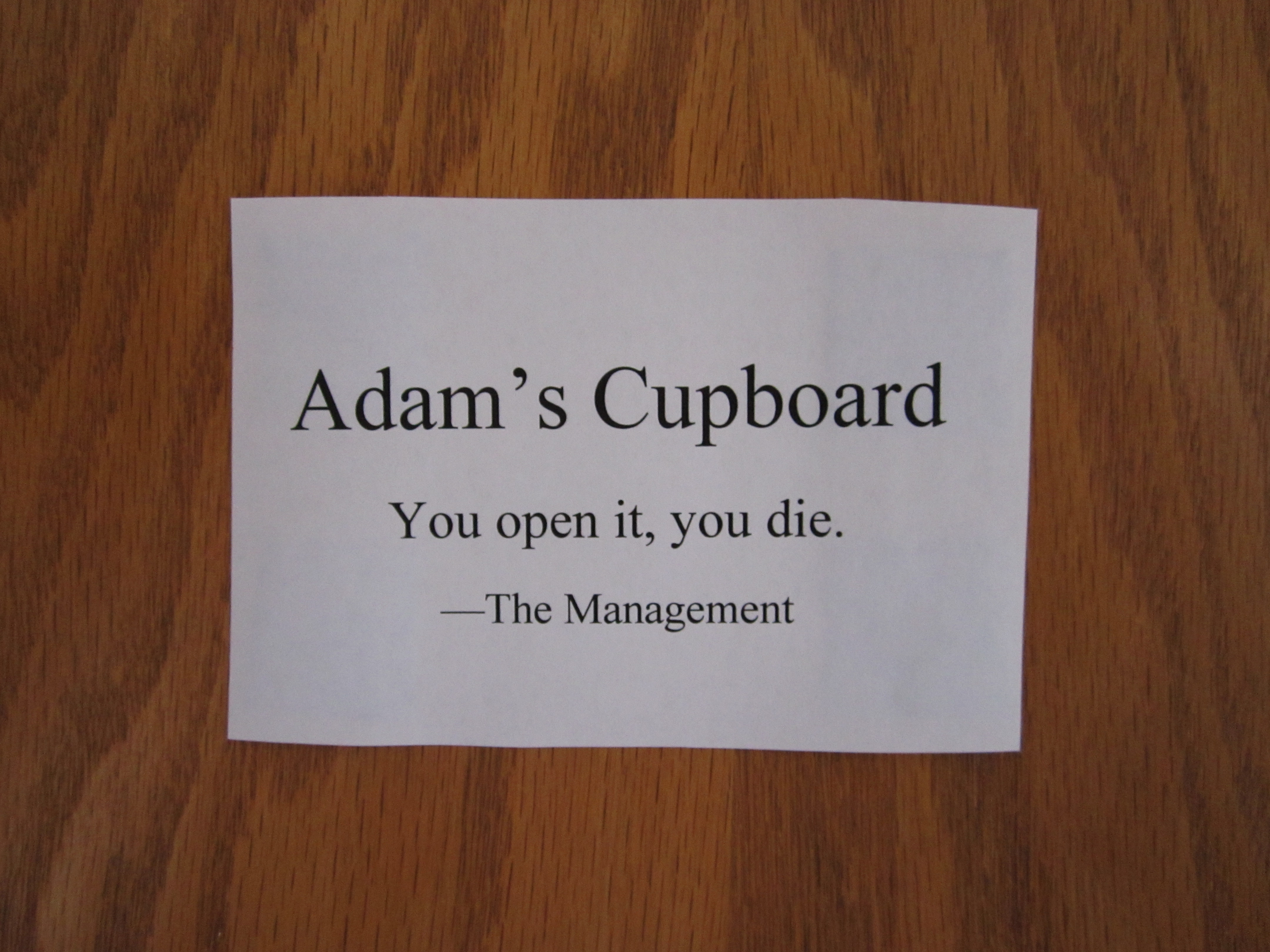
I put up a sign.

Well, that was a mistake.

Several of my housemates and a number of visitors made a point of opening my cupboard just to annoy me. It became known as the Death Cupboard. However, even though the cupboard was opened regularly, my plan was sort of a success. No one took my tea without asking permission.

Since death apparently wasn’t a convincing enough penalty to keep people from opening my cupboard, I later revised the sign to read, Adam’s Cupboard. You open it, Adam unfriends you on Facebook. –The Management.

Well, that didn’t work either. People continued to open the Death Cupboard and I never had the heart to unfriend them. No one took my tea, though, so I guess I can’t complain.

The people who opened the Death Cupboard were quick to point out they didn’t die. Little do they know the day of their doom is coming. They opened Adam’s Cupboard, and they will die.

Eventually. You know, in sixty or seventy years.

When that day comes, I’ll shake my old gray head and mutter, “Ah, if they hadn’t opened the Death Cupboard back in the fall of ’09 they might still be alive today.”