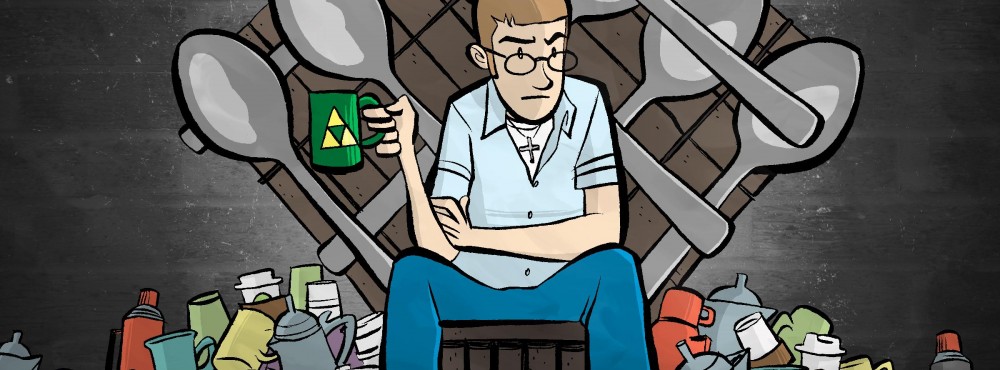
45. Give Us This Day Our Daily Schedule

An acquaintance of mine once uttered this profound insight: “Procrastination is just an extreme form of patience, and patience is a good thing.”

By this standard, I’ve been extraordinarily patient for the last two weeks.

In fairness, I’ve had a number of distractions: graduating from college, packing, traveling to Uruguay, unpacking and playing Skyward Sword. Before arriving in Uruguay, I had ambitious plans to write at least half a dozen posts for TMTF to spare myself the stress of desperately composing a post at the last minute. Within five or ten minutes of actually arriving in Uruguay, my plans to work ahead on my blog had been forgotten.

Now at last I’m resuming my sensible plan of working out a tentative schedule for TMTF a week or so in advance. Since I’m trying to figure out a schedule for the blog, this seems like the perfect time to mention the most unexpected strategy I’ve discovered for keeping in touch with God: scheduling.

I believe Christians are supposed to keep in touch with the Lord through prayer and reading Scripture—not as a requirement for salvation but as a response to it. Jesus said something clever about branches not being able to bear fruit unless they remain in the vine, meaning his followers won’t be productive unless they remain in a consistent relationship with him.

Fact of Importance: Prayer and reading the Bible aren’t part of a system to earn God’s favor. Christians don’t have to earn anything. Studying Scripture and praying are simply the best way to keep in touch with God: to honor him, learn from him, be encouraged, be corrected and be ready for action.

The other day I was reminded of a simple and decidedly unspectacular method for being consistent in praying and reading the Bible. I speak, of course, of the fine art of scheduling.

The more I procrastinate, the less motivated I become to pray or read the Bible. If I choose not to procrastinate—in other words, if I choose to pray and study Scripture early in the day while I’m refreshed from a night’s sleep and fueled by coffee—I’m able to face the rest of the day with greater motivation, enthusiasm and confidence.

(This also proves the potential spiritual benefits of coffee.)

Scheduling isn’t an impressive strategy, but it’s done more to help my relationship with God than almost anything else.

Are you a “patient” person? What strategies help you get things done? Let us know in the comments!

31. The Art of Blundering Hopefully

I like gloomy characters. Well, I like gloomy fictional characters; gloomy characters aren’t nearly as likable in real life as they are in fiction. There’s something strangely endearing about pessimists and their pessimism, so long as I don’t have to deal with them personally.

Puddleglum from C.S. Lewis’s The Silver Chair is one of my favorites. “Good morning Guests,” he says to the protagonists after they spend the night in his home. “Though when I say good I don’t mean it won’t probably turn to rain or it might be snow, or fog, or thunder. You didn’t get any sleep, I daresay.”

Then there’s Marvin the Paranoid Android from The Hitchhiker’s Guide to the Galaxy by Douglas Adams, and Eeyore from the Winnie-the-Pooh books by A.A. Milne, and Bernard Walton from the Adventures in Odyssey radio series, and a dozen more delightfully depressing characters from all sorts of stories.

The problem with pessimism is that it’s not nearly so pleasant in real life. It’s difficult to put up with pessimists—and it’s much worse to be a pessimist.

Some time ago I realized something important. (I was actually going to write about it weeks ago, but decided not to post too many serious reflections in a row.) What I realized was simple—so simple I couldn’t believe I had overlooked it for so long.

I had become a pessimist. Not a nice, lovable pessimist like Puddleglum or Eeyore, but a genuine, depressed pessimist.

I suspect my long, dark Thursday Afternoon of the Soul, a year and a half of intense depression and anxiety, had conditioned me to expect only the worst. I expected the worst from myself, wrestling with insecurity and self-doubt. I expected the worst from life, living in anxiety of whatever difficulties lay ahead. I expected the worst from God, struggling to believe he could really be as gracious, loving and generous as he claims. Every trial confirmed my belief that life was a dreary business, and every blessing made me suspect there were strings attached.

Since recognizing my tendency toward pessimism, I’ve been working to perfect the fine art of blundering hopefully.

We don’t have to live in perpetual fear of the future. It holds difficulties, true, but it also holds blessings. It’s certainly no good worrying about the difficulties. We can only deal with them as they come. In the meantime our business is to trust God and do our best: believing that his grace is greater than our mistakes, trusting that he will walk with us through our difficulties, holding on to his promise that his love endures forever—to wit, blundering hopefully.

So I’m doing my best not to burden myself with guilt for past mistakes or live in fear of future ones. By faith I blunder onward, trusting that God’s grace is sufficient for me.

God’s grace is sufficient for you too, in case you were wondering.

26. A Lesson from My Students

My monkeys and I now have a Twitter account. I suppose it was only a matter of time. Is it possible to tweet using typewriters?

I’m just a week away from finishing student teaching. I still have a few weeks of paperwork and seminars and whatnot, but seven days from this moment I’ll have finished my work in the classroom. The last ten weeks have been stressful, rewarding, exhausting and interesting.

Especially interesting has been my time with the MEC students, kids whom the school considers at-risk—in danger of dropping out of classes due to misbehavior or failing grades. I felt rather apprehensive about working with at-risk kids, but some of them turned out to be pretty awesome. Granted, others turned out not to be awesome at all. Most of them fell somewhere in between, alternating between diligence and laziness, respect and disrespect, cooperation and insubordination.

Friday was my last day in the MEC classroom; in the week to come I’ll be phasing out of my other classes. I was reflecting upon my time with the MEC students, and it occurred to me that working with at-risk students presented two major frustrations.

First was when the MEC students refused to accept the consequences of their actions. They would break a rule half a dozen times, ignoring all warnings, and whine about the unfairness of it all when they finally received the penalty for their misbehavior.

Second was when the MEC students complained about school: it was boring to read a short story, stupid to learn vocabulary instead of playing games on the computer, impossible to sit and work quietly for forty-five minutes. No matter how often we tried to explain that school is not pointless, that they need a high school diploma to qualify for most jobs, that they can’t spend the rest of their lives living with their parents and playing video games—in short, that school is actually meant to help them—they wouldn’t listen.

It would be pretty easy to judge the MEC students, except for one little point. It occurred to me a day or two ago that I do the exact same thing.

If I have a bad day, I tend to feel put upon. I wonder grumpily why God lets unpleasant things happen to me. What I forget is that many of those unpleasant things are the consequences of my own mistakes, and many more of those unpleasant things are actually helping me in the long run. Yes, I might feel tired and unfocused all day, but it’s because I was up so late the night before watching trailers on YouTube. True, I might be totally worn out by a rough day of student teaching, but it’s teaching me to handle the responsibilities of being an English teacher.

Not all bad things are the result of my own mistakes, but some are. Not all bad things are part of the painful process by which God makes me a better person, but some are. Instead of grumbling and groaning and griping, I need to endure patiently.

That’s a lesson from my at-risk students, and a lesson I hope they can learn too.

19. So, Um… What Do You Think Being a Hero Is All About?

I don’t generally search for profound wisdom in webcomics—especially not webcomics about video games.

Imagine my surprise, then, when I was reading my favorite webcomic way back in March and realized its writer had stumbled upon pretty much the most important lesson ever.

Brawl in the Family is a delightful webcomic by a couple of guys named Matt and Chris. It’s a funny, quirky take on video game characters, and I think it’s pretty awesome.

In one comic, two teachers are asked by their students, “So, um…what do you think being a hero is all about?”

The first teacher, a villain, replies, “Well, to put it simply: ambition.” He adds, “Remember, you are capable of great things.”

The second teacher, a kindly gentleman, replies, “Well, to put it simply: sacrifice.” He adds, “It is not about you. It is about everyone else.”

It is not about you. It is about everyone else.

I happen to be student teaching at the moment, and it’s so easy to become centered on myself. I have to survive the stress of teaching classes and grading papers. I have to keep up with the paperwork for my college’s Education Department. I have to be a good teacher.

It’s also so easy to become self-centered in regard to my writing. I want to become a successful novelist. I want to have a great blog. I want my writing to be excellent.

I is such a little word, but it represents so much. Ambition. Dreams of glory. Delusions of grandeur.

I’m ashamed to say it, but I become self-centered. Then things happen that jerk me back to reality. One of those things happened yesterday.

Yesterday we held parent/teacher conferences at my school. My supervising teacher and I had been assigned to hold conferences with the parents of our MEC students. The MEC students are the at-risk kids, the kids with low grades and behavior problems—the kids in danger of being expelled. For nearly eight hours, my supervising teacher, other teachers and I held conference after conference with the parents and guardians of our students.

Some of these parents and guardians were bright, cheerful and polite. Some were not. One came in with whiskey on her breath. Another came uncomfortably close to exploding into a fit of rage. Almost all of them told us directly or indirectly that they didn’t have much control over their kids, and a few of them maintained an attitude of nonchalance.

They didn’t seem to care that their children were failing classes or causing trouble. One mother was obviously in denial that her son is a borderline sociopath. Another mother cheerfully admitted to being aware of the fact her son smokes marijuana.

It was tragic. It was also very convicting. These are the students with whom I work almost every day—and I get so wrapped up in my plans and ambitions and personal projects that I forget how much my students need a loving, patient, diligent teacher.

It is not about me. It is about everyone else.

Jesus said the same thing when someone asked him about the great commandments—God’s greatest charge to humankind—the ultimate meaning of human life. Jesus replied, “‘Love the Lord your God with all your heart and with all your soul and with all your mind.’ This is the first and greatest commandment. And the second is like it: ‘Love your neighbor as yourself.’”

Webcomics, even webcomics about video games, can impart great wisdom.

It is not about you. It is about everyone else.

12. When Life Doesn’t Make Sense

In my last post I expressed my belief that circumstances that seem hellish and horrible are sometimes part of God’s perfect plan.

Is this just wishful thinking?

As a certain Science Guy would say, consider the following.

The Bible is basically a story, an epic narrative woven of history and prophecy and poetry and one or two love songs. In the story of Scripture there are powerful examples of events that seemed utterly tragic, sickeningly futile and completely meaningless, but were used by God for good.

Job was a righteous and prosperous man who lost everything. His property was all stolen or burned to cinders. His children were killed. His body was racked with painful sores. His wife told him to curse God and die, his friends attacked him with false accusations—and God was silent. No matter how Job cried out in pain and confusion, his Maker did not answer.

The kingdom of Israel, God’s chosen people, built him a beautiful temple in the holy city of Jerusalem. They believed Israel, Jerusalem and the temple would last forever because God was with them. Then Israel split into two kingdoms, which bickered for centuries before suffering total defeat by the Assyrian and Babylonian empires. Jerusalem was ruined. The temple was destroyed. God’s chosen people were scattered across the world, and his promises of a coming king and an everlasting kingdom seemed to have been broken.

The ragged descendants of Israel believed Jesus was going to fulfill ancient prophecies, break the power of Rome and establish a kingdom that would never end. Then Jesus was betrayed, condemned, humiliated, flogged and executed. The one whom they believed to be God’s own Son, in whom they had invested their lives, their hopes, their dreams, was dead.

It’s easy to look at these situations and see only the happy endings we know are coming. But the people who lived through these situations couldn’t see those happy endings. All they saw was hellish, painful, meaningless tragedy, and a God who seemed to have abandoned them.

What happened to them?

Job was finally answered by God, who restored Job’s family, fortune, health and happiness.

Many of the descendants of the Israelites became part of a greater kingdom, the Church, and watched as God’s promises began to be fulfilled in ways that surpassed their wildest dreams.

Jesus didn’t stay dead.

These tragedies, which seemed beyond even the remotest chance of redemption, were used by God to bring about comfort, peace, grace, salvation and hope.

If God could redeem those tragedies, he can certainly redeem mine. I don’t know why I had to suffer through my Thursday Afternoon of the Soul, but God knows. I see only a few scattered pieces; God sees the whole puzzle. “Now I know in part; then I shall know fully, even as I am fully known.”

9. I Can Do Everything through Him Who Gives Me Strength? Seriously?

Just a few days ago two of my housemates discussed over lunch what sort of psychological breakdown I might have. One of them thinks I would ramble incoherently and gesticulate wildly for about ten minutes, then slip into a catatonic state while clutching a cup of tea. The other thinks I would focus all of my concentration on a Legend of Zelda game, emerging from my video game-induced stupor only to sip tea.

I was gratified that both of my housemates recognize my passion for tea, and sincerely hope I never have to find out which of their theories is correct.

The truth is that I felt uncomfortably close to breaking down yesterday. There was never any danger of a genuine psychological breakdown, but I felt more than once as though I’d reached the end of my strength. It’s not a nice feeling.

I’m student teaching at a local high school, teaching two regular classes and assisting in a classroom with at-risk kids. Teaching can be wonderfully fun and rewarding. It can also be terribly exhausting and stressful. I sometimes find myself thinking wistfully of becoming a manuscript editor or pursuing some other career that doesn’t involve classroom management.

I was walking to a classroom today when a familiar quotation came to mind: “I can do everything through him who gives me strength.” That’s dear old Paul, of course. It’s one of those verses from the New Testament I’ve heard so many times that I no longer think about it.

Today, however, I paused and thought about it. Paul lived a stressful life. He faced excruciating hardships: “Five times I received from the Jews the forty lashes minus one. Three times I was beaten with rods, once I was stoned, three times I was shipwrecked, I spent a night and a day in the open sea, I have been constantly on the move. I have been in danger from rivers, in danger from bandits, in danger from my own countrymen, in danger from Gentiles; in danger in the city, in danger in the country, in danger at sea; and in danger from false brothers. I have labored and toiled and have often gone without sleep; I have known hunger and thirst and have often gone without food; I have been cold and naked. Besides everything else, I face daily the pressure of my concern for all the churches.”

My student teaching suddenly doesn’t seem so bad.

Paul suffered so much pain and discomfort and stress. What did he have to say for himself?

“I have learned the secret of being content in any and every situation, whether well fed or hungry, whether living in plenty or in want. I can do everything through him who gives me strength.”

Paul is writing about the Lord Jesus, of course.

It finally hit me today that I’ve been trying to do this thing on my own. I’ve been worrying about how I must survive the next six weeks and how I must teach these kids and how I must show them God’s love.

I don’t have to worry about the weeks and months and years ahead. I’m not alone. There is a secret to being content in any and every situation: I can do everything through Christ who gives me strength. It’s not some sort of trite religious propaganda or esoteric spiritual mystery. I need to stop trying to handle everything on my own, and trust that God will help me when I can’t help myself.

That’s an obvious lesson, right? The problem with obvious lessons is that they’re so easy to forget.

The Lord told Joshua, “Be strong and courageous. Do not be terrified; do not be discouraged, for the LORD your God will be with you wherever you go.”

It’s just as true for me today.

Do you know what else? It’s just as true for you today.

4. The Awful Problem of Pain

It’s Friday, and one of my students began singing Rebecca Black’s “Friday” in class today, and it made me think of the problem of pain.

The existence of pain is probably my biggest doubt about Christianity.

If I weren’t a Christian, I think I’d be an atheist with the existence of pain as my chief weapon against crazy religious people. “How can you claim,” I would thunder, “that God loves everyone and is all-powerful if he lets thousands of innocent children starve to death every day? Your God lets religious hypocrites hurt people in his name. Your God just watches instead of doing something as men and women kill each other. How can you say he’s good and almighty? You can’t have it both ways, you crazy religious person!”

(I’m actually really glad I’m not an atheist, because I’m pretty sure I’d also be kind of a jerk.)

It would be awesome if every Christian received The Complete Compendium of Answers to Every Moral and Theological Question Ever. That way, when perplexed by the problem of pain, I could just turn to page 374 and read God’s authoritative answer to the question of why bad things happen.

However, Christians don’t have The Complete Compendium of Answers to Every Moral and Theological Question Ever. (The Bible is God’s Word, but—as many dissenting theologians can testify—it doesn’t answer certain questions.) We’ve had to study the Bible and reflect upon our own experience in order to come up some possible answers.

One possible answer has to do with free will. If God gives us free will, the ability to do whatever the deuce we want, we can choose to ignore his good instructions and wreak havoc on his creation. Another possible answer has to do with personal growth. We do tend to shine our brightest when we’re dealing with our tragedies—or helping others deal with theirs.

Whatever God’s reason for allowing pain in the world, one thing is clear. It’s a good enough reason that he didn’t hesitate to suffer because of it. Jesus Christ came into the world and endured not only an excruciating death but every other pain, humiliation and discomfort known to humankind, from the pain of rejection and betrayal among his friends to the minor nuisances of blisters and bad breath. The problem of pain didn’t deter Jesus.

These reflections are abstract, but I still find them comforting—most of the time. The real problem comes when someone else is suffering and wants to know why God lets it happen. What answers can be given to someone in pain?

“I know you’re hurting, but God loves you.”

“Where’s the proof of that?”

“I know you’re hurting, but this tragedy is making you a better person.”

“So God’s punishing me because I’m not good enough, is that it?”

“I know you’re hurting, but Jesus suffered too.”

“Why the heck should I care?”

“I know you’re hurting, but you can’t blame God for human error.”

“Just shut up.”

What’s the conclusion of the matter? Why does God allow pain and brokenness and Rebecca Black’s “Friday” to exist in the world?

I wish I knew.