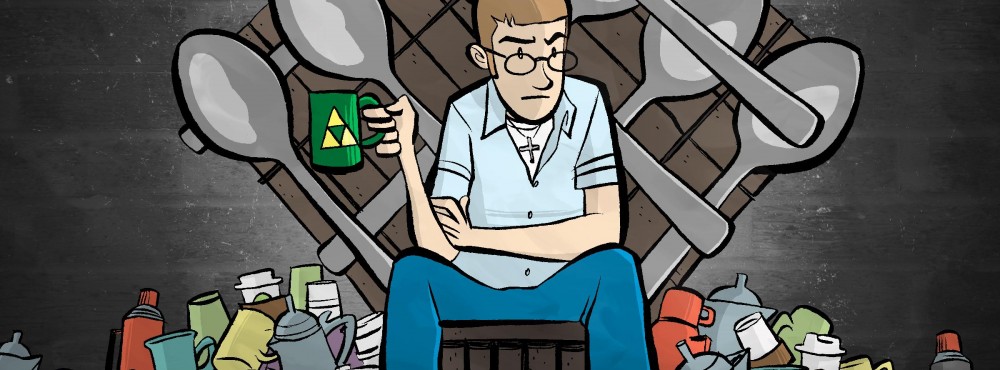
161. A Conversation with Myself

Hello, Adam.

Go away. Trying to write a blog post here.

Ah, yes. A post for your typewriter monkey blog—the one that’s read by tens of people. Some of them may even be mildly interested in what you have to say.

I happen to like my blog, thank you very much.

Of course. I suppose you must. I mean, who else will?

Seriously, go away.

Why don’t you take a break from your blog and work on your novel? Oh, that’s right. You’re still stuck on that chapter. The one you started six months ago.

Hey! The past six months have been crazy and busy and stressful. Survival comes before creative writing. To quote Louisa May Alcott, “First live, then write.”

Ah, it was only a matter of time before you quoted somebody. You really, really enjoy quoting people, don’t you? You think it makes you seem smart and bookish. I think it makes you sound like a pretentious twit.

Yes, I like quoting people. So what? I haven’t given up on my novel, by the way. This is the year I finish the deuced thing.

We don’t use words like deuced in America, son.

I like dated British idioms.

I know, and I think it’s really cute that you use them. Wait, did I say cute? I meant annoying.

Do you know what? I kind of hate you.

That’s funny, Adam, because you and I happen to be the same person. Therefore, if you dislike me, who is it you really dislike?

I wouldn’t mind so much if you were… you know… cooler. A shadow version of me with glowing red eyes, maybe. The Shadow Adam. The Anti-Adam. My evil doppelganger. But you’re not any of these things. You’re just annoying.

The truth is sometimes annoying, but that doesn’t make it any less true. I’m here to give you healthy doses of realism when you get drunk on excitement and optimism. I’m here, Adam, because I care.

You’re twisting the truth and you know it. You’re exaggerating the nasty facts and hiding the good ones and generally making things seem much worse than they are.

Just listen to you! I know you like big words, so here’s one for you to chew on: pontificating. More to the point, stop pontificating!

Would you kindly go away? I need to finish this blog post.

You’ll never be Jon Acuff, you know.

Go away.

You’ll certainly never be C.S. Lewis.

Go away!

You won’t make a difference.

That’s it. Listen here! I will make a difference. It may not be a big difference. It may be a very small difference, but even a small difference can cause a whole lot of good.

Why do I get the feeling I’m about to hear another one of your fancy quotes?

Well, you are. “Sometimes you can feel like what you have to offer is too little to make a difference, but today I learned that every pony’s contribution is important, no matter how small.”

Wait. Wait. Are you quoting that stupid cartoon about rainbow ponies? That’s pathetic, Adam.

Hey! You can’t blame me for being pretentious, and then fault me for being childish.

I can, because you’ve somehow managed to be both. Congratulations.

Dash it, at least I’m trying to do something worthwhile!

Yes, yes you are. Trying and failing.

“Next to trying and winning, the best thing is trying and failing.”

Ah! Do you never stop quoting people?

Shut up and listen. In the vast scheme of things, I might not have much to offer. Individually, few people can change the world. But what if everybody tries? What then?

What if everybody fails?

God used a little boy’s lunch to feed thousands of people. What might he do with a person who tries to be useful?

Fine. Keep trying. See how little difference you make.

I will. Now tell me something. What are you doing to make a difference?

That’s a stupid question.

You don’t have an answer, do you? That’s what I thought. Now go away. It’s too late for me to finish this blog post, so I guess I’ll have to improvise… or maybe not.

You’re going to post this conversation on your blog, aren’t you?

Yup.

Your readers will think it’s an awkward confession or a plea for attention or something. Besides, this has been a really lame conversation.

Hey! That’s as much your fault as mine! I have to post something today. This conversation is better than nothing. Who knows? Maybe it’ll encourage someone to make a difference—or at least to try. Now go make us some coffee, will you?


160. The Wonderful Weirdness of Life

If I were a preacher, I would use the geekiest sermon illustrations Christendom has ever known.

I once joked about using the Millennium Falcon as the basis for a sermon. As a pastor, I probably wouldn’t go that far… but then I might. I’m sure there are parallels between Han Solo’s dilapidated starship and the profound truths of Christianity. I just haven’t found any. At least not yet.

I was recently reminded of a great lesson by Doctor Who. The Doctor has become one of my favorite fictional characters, surpassing even literary greats like Anne Shirley and Bertie Wooster in my esteem.

One of my favorite things about the Doctor is the way he responds to commonplace things—humans, for example—with amazement.

“Look at these people, these human beings,” he exclaims. “Consider their potential! From the day they arrive on the planet, blinking, step into the sun, there is more to see than can ever be seen, more to do than—no, hold on. Sorry, that’s The Lion King.”

Pop culture allusions aside, the point is made: humans are pretty darn awesome.

At one point, the Doctor runs into a research team investigating an unprecedented phenomenon. Their curiosity delights him. “So when it comes right down to it, why did you come here?” he inquires. “Why did you that? Why? I’ll tell you why—because it was there! Brilliant! Excuse me,” he adds, beaming. “Just stand there, because I’m going to hug you.”

In his travels through space and time, the Doctor never fails to appreciate how weird and wonderful they are. Plain old people astound him no less than the greatest marvels of the universe.

Like the Doctor, G.K. Chesterton looked at ordinary things and pronounced them extraordinary. “I do not generally agree with those who find rain depressing,” he wrote. “A shower-bath is not depressing; it is rather startling. And if it is exciting when a man throws a pail of water over you, why should it not also be exciting when the gods throw many pails?”

Michael Card, my favorite songwriter, has this to add: “If you must see a miracle, then just look in the mirror!”

Too often, I live without thinking. I follow a mechanical routine of habits and repetitions without pausing to consider how brilliantly strange my life has been—and is.

With my computer and its microphone, I can carry on conversations with people thousands of miles away. With the flip of a switch or the touch of a button, I can summon light, heat or water instantly to my apartment. With a digital camera, I can create near-perfect images of anything: pictures that are stored securely in a tiny chip of metal and plastic.

My life is weird in ten thousand glorious ways—and I take it for granted. I shouldn’t. Thoughtless repetition leads to ennui, ennui to discontent and discontent to discouragement, ungratefulness and all kinds of nasty things.

How much better it is to appreciate the wonder of simply being alive!

158. A Personal Post

I struggle with two temptations as I write this blog.

The first is to be too vulnerable. I sometimes write about my struggles, mistakes, feelings and hopes, but I try not to overdo it. This blog wouldn’t be much fun to read if it were awkwardly personal. It would be even less fun to write.

The second temptation is to make the opposite error and make this blog impersonal. Being vulnerable is hard. It’s easier to ramble about vampires and cartoons and stuff.

Today is a good day for me to be personal.

After two months of working the overnight shift at my job, I revert to my old schedule today. I’ll be working during the day and sleeping at night like an ordinary person.

Starting today, I’ll no longer work peacefully through the night. I’ll no longer enjoy a structured schedule with straightforward responsibilities. I’ll no longer glance out the windows at starry skies and spectacular sunrises.

Starting today, I’ll be cringing as my coworkers lose their tempers and shout at the gentlemen with whom we work. I’ll be coming home exhausted and stressed from complicated, unpredictable workdays. I’ll be trying to stay awake through dull, dreary afternoons.

Working the overnight shift was wonderful, and it’s hard to return to my old schedule.

This time, however, things are different.

During the two months I worked the overnight shift, God put my life in order. My financial situation became much more stable. I picked up some healthy habits, such as eating more vegetables and spending more time reading. I made great progress on my personal projects—repairing and renovating this blog, for example.

I also learned some invaluable lessons. Well, maybe learned isn’t quite the right word. I finally understood some invaluable lessons.

It’s easy to learn the rules of tennis, but becoming a tennis champion takes experience. In the same way, some lessons are easy to learn but difficult to practice. Understanding such lessons can be hard. My time working the overnight shift made it a little easier.

I’m learning to spend my time intentionally, not aimlessly. I’m praying more consistent, meaningful prayers. I’m not overcommitting myself—at least, not as much.

In the past few years, I’ve struggled with an obsessive-compulsive tendency to overthink and overanalyze everything. I’ve also suffered from depression, anxiety and other dreadful things. My attempts to understand, classify, organize and control my feelings have failed. Depression does not listen to reason.

I won’t go into all the details, but my experiences working the overnight shift helped me to understand—not merely to know, but to understand—something fundamentally important: What matters isn’t how I think or what I feel, but what I do.

Instead of overthinking everything, I can focus on doing whatever needs to be done. Instead of getting tangled up in emotions, moods, impulses and all the rest of that wibbly-wobbly, feely-weely stuff, I can accept that it’s mostly beyond my control.

I’m finally beginning to understand these simple lessons, and they’re making all the difference in the world.

Today will be hard. I know that, but I feel oddly hopeful. God has brought me this far, right?

Now then, I’d better drink more coffee. It’s going to be a long day.

157. I Am Not a Jedi

I am not a Buddhist, Muslim, Hindu, Sikh, Rastafarian, Pastafarian, Shintoist or Jedi.

(Jediism is apparently a minor modern religion. Who knew?)

I feel obliged to reaffirm my faith in Christ because I recently replaced Christianity with Faith in this blog’s tagline. Christianity is a pleasantly specific word. Faith is vague, generic and ambiguous. It can be used to describe almost anything.

Honestly, I rather like Christianity. It’s a splendid word.

Why the change?

Well, Christianity is quite a mouthful. Seriously, it has five syllables. Replacing it with a shorter word like Faith makes for a catchier tagline.

More significantly, I once pointed out that Christianity has taken on some unpleasant connotations. It’s often associated with irritating, vaguely religious stuff. Consider “inspirational” Christian books, which inspire me to sigh and roll my eyes. Think of Christian parodies of commercial logos. Don’t even get me started on Christian video games.

To wit, many people associate Christianity with religious clutter that doesn’t have any meaningful connection to God or faith or grace.

This blog isn’t about vaguely religious stuff.

TMTF is a blog about everything that interests, fascinates, puzzles, amuses and amazes me. It’s how I share my passion for things about which I’m passionate: literature, video games, cartoons, writing—and faith.

I don’t like religious clutter. I don’t consider myself an evangelical Christian, but merely an orthodox one. TMTF isn’t a religious blog, but merely one about God and faith… and a lot of other stuff.

C.S. Lewis described mere Christianity: the Christian faith with all the unnecessary stuff stripped away. During his life on earth, the Lord Jesus had some harsh things to say about the religious traditions that had been tacked on to the teachings God gave Israel. I doubt he’s pleased with some of the things we’ve tacked on to Christianity.

That’s why I’ve changed this blog’s tagline. TMTF won’t change—at any rate, not more than usual. It shall continue to be often silly, sometimes serious, hardly ever religious and always merely Christian.

146. Grace Makes Sense

I’ve been meaning to write this post for a long time. The reason I’ve put it off is that it’s an important post, and those are always the hardest to write.

Occasionally, when I think I’ve discovered some amazing spiritual insight, I glance at one of C.S. Lewis’s books and realize he discovered it first. Since it’s hard to write blog posts about important things like grace, I’ll let Lewis handle the introduction.

Take it away, Jack!

Thus, in one sense, the road back to God is a road of moral effort, of trying harder and harder. But in another sense it is not trying that is ever going to bring us home. All this trying leads up to the vital moment at which you turn to God and say, “You must do this. I can’t.”

I know God has saved me by grace, but that hasn’t stopped me from trying to be good enough.

Then, some time ago, I began to understand.

I’m not good enough.

I’ve never been.

I shan’t ever be.

That’s okay.

God doesn’t expect me to be good enough. Nowhere in the Bible does God say, “Unless you meet my standards, I won’t love you.” I don’t deserve God’s love. Grace is a gift, and it’s finally making sense. I don’t have to earn anything.

Of course, that doesn’t mean I can stop trying to be good.

To quote C.S. Lewis again, living by grace doesn’t mean merely trying to do good things,

But trying in a new way, a less worried way. Not doing these things in order to be saved, but because He has begun to save you already. Not hoping to get to Heaven as a reward for your actions, but inevitably wanting to act in a certain way because a first faint gleam of Heaven is already inside you.

God isn’t commanding me to be good enough. He’s asking me to give him my best. When—not if but when—my best isn’t good enough, his grace covers the rest.

Christmas began as a celebration of Christ’s birth. Christ was born to die. He died and rose again to give us life, not to burden us with impossible demands. At its heart, Christmas is a celebration of grace.

We’re not good enough, but we don’t have to be. God’s grace is good enough, and that’s what matters. We must give him our best. The rest is up to him.

Happy Christmas, dear reader!

144. What Makes Christmas Special

Christmas.

What comes to your mind? Snow? Colored lights? Gift cards?

When I think of Christmas, what comes to my mind are palm trees, beaches at twilight and dusty houses built of cinder blocks.

Nothing says Christmas like a beach at twilight.

Nothing says Christmas like a beach at twilight.

As a missionary kid in Ecuador, I spent many Christmas vacations with my family at the beach. We’d pile into our car, crank up Adventures in Odyssey on our CD player and drive for hours: descending from the heights of the Andes, passing banana plantations, stopping at derelict gas stations for fuel and ice cream, winding among low hills and finally arriving at the beach.

Towns and villages are scattered across the Ecuadorian coast. Most of them are small, dirty, unimpressive places. Ecuador is a poor country. In December, however, these little communities are brightened with fake Christmas trees and cheap colored lights.

Not Relevant

Not relevant to this blog post, but adorable.

What really sticks in my memory is the way people celebrated. My old man and I once passed a merry gathering of children in a little town on Christmas Eve. Many were barefooted; most were dirty; nearly everyone was smiling. It was a scene Charles Dickens would have been proud to write.

In Ecuador, Christmas is a time for celebration. It’s a time for fireworks, family get-togethers and three-liter bottles of Coca-Cola. (Yeah, we’ve got those in Ecuador. Be jealous, Americans.) It’s a time for celebration.

Of course, in many ways, Christmas in Ecuador isn’t much different from Christmas in the United States of America. There are the same silly commercials. The same packed shopping malls. The same frenzied media trying to squeeze as much money as they can out of the holiday season.

All the same, when I see the extravagant displays of colored lights around my current home in Indiana, I miss the cinderblock houses on the Ecuadorian coast with tacky tinsel in the windows. The dusty Nativity sets in the corners of living rooms. The cheap ornaments hung from two-foot Christmas trees. The flimsy plastic cups of Coca-Cola.

Most of all, I miss the joy.

Today’s post is about Christmas as a holiday. There is a much deeper meaning to Christmas, and I’ll write about it later this month. For now I want to share what I believe makes the holiday special. It’s not the gifts or the decorations or the music or the food. Even the Grinch understands (eventually) that Christmas means more than stuff.

Joy and celebration and being together with loved ones are what make the holiday special. The other stuff is nice, of course. The holiday stuff is like pretty wrapping paper and shiny ribbons covering the gifts under the Christmas tree.

In the end, though, who wants just the ribbons and wrapping paper without the presents?

130. Grace? What’s That?

Just because I know something doesn’t mean I understand it. I sometimes know things without really knowing them.

God’s grace—his patient, undeserved help—is greater than my faults. I know that. Sometimes, however, when my life gets a little rough, it’s hard for me to know it. Grace is easy to acknowledge, but so hard to understand.

Last week was a rough one. I considered providing an exhaustive list of reasons why, but I’ll spare my readers the nasty details. By the time I awoke on Saturday morning, I felt truly awful.

Do you know who else spent a lot of time feeling truly awful? The Apostle Paul. He had it rough. Dash it all, did he have it rough. Paul was repeatedly mistreated, flogged, imprisoned and shipwrecked. He suffered from hunger, cold, sleep deprivation and unbearable stress. These are just a few of the sufferings he mentions in his letters, and there were probably some he didn’t mention.

Out of all these afflictions, Paul found one truly insufferable. He called it a thorn in his flesh. Whatever it was, Paul hated it. “Three times I pleaded with the Lord to take it away from me,” he wrote. The Apostle Paul, the legendary missionary, couldn’t take it anymore. He pleaded with God again and again to take away his problem.

At last, God replied, “My grace is sufficient for you, for my power is made perfect in weakness.”

I hate being weak. I’m a faulty, imperfect person adrift in a faulty, imperfect world, and I don’t like it. My usual response is to try to be perfect—or at least, to try to be good enough.

I’m not good enough. I’ve never been, and I’ll never be. I have rough weeks. I get tired and sick and worried and depressed. I make mistakes. No matter how I try, I can’t fit my life into clean, tidy little boxes.

On Saturday, I came closer to understanding something I’ve known for a long time. God’s grace is greater than my mistakes and weaknesses. When I’m not perfect, God is. When I can’t go on, God carries me.

That gives me hope.

I try to wrap up these spiritual blog posts with neat little lessons, but not this time. I haven’t resolved anything. After years of struggling with the same problems, I keep struggling. I’ve written blog posts about these issues and related ones—the same problems again and again and again and again.

I’ve been making mistakes for twenty-two and a half years. If God hasn’t given up on me yet, I mustn’t give up on myself—and I certainly mustn’t give up on him.

I sometimes don’t understand God’s grace, and I often don’t feel it. There are days and weeks when the universe seems particularly empty of meaning, peace or hope.

Even so, I believe God’s grace is sufficient for me. My business isn’t to be good enough, but to trust and to hope and to persevere.

Do I understand God’s grace?

No.

Does it often seem absent?

Yes.

Do I believe God’s grace is always there, and always sufficient for me?

Yes, yes I do.

127. Please, No More Advice!

Imagine a man dressed in rags and standing ankle-deep in snow, shivering in the gale blasting from a winter sky and peering through a window into a warm living room. On the other side of the glass, a man wrapped in a bathrobe sips hot chocolate and gazes curiously at the visitor outside his window.

“I have a question,” says the man in the bathrobe, speaking loudly enough for the man in rags to hear through the glass. “Would you please describe exactly how it feels to be cold?”

If you were the man in rags, how would you answer? Words like icy and frigid are meaningless to someone who has never felt cold, and adjectives like horrible and painful are too vague.

If you’ve never been severely depressed, I’m afraid I can’t describe it any more than the man in rags can tell the man in the bathrobe what cold feels like. The best explanation I can give is that depression is like lying on the very bottom of the ocean. Everything is cold and dark, and a suffocating pressure makes the simplest action ten times more difficult.

Not long ago, I read an article in which the writer described his struggle with depression, insecurity and suicidal thoughts. He has my utmost sympathy. If I ever met the man, I’d offer him a cup of tea and tell him how much I admire his courage in getting out of bed every morning.

Some of the people who commented on the article had other ideas.

“Depression. Who needs it. I say, if you’re upset and sad then own it.”

“Depression eh? Been there, done that years back. A large part of it is physical. My recommendation, eat fruits and veggies … Get some exercise … Join a gym.”

“You are what you are, you seem to accept you have issues, work on them and things will get better.”

The writer made himself vulnerable, confessing his personal struggles. Some of his readers responded by telling him, You’re obviously getting it wrong, so let me show you how to get it right. More vegetables! Better attitudes!

I suspect many of these readers are like the man in the bathrobe. They see, but they don’t understand. They look through the window at the man in rags, but they can’t begin to imagine how it feels to be cold.

To my relief, some of the people who commented on the article took a more compassionate approach.

“Thanks for sharing … Hopefully you’re also able to disregard all the ‘advice’ comments from people who don’t actually know what you’re going through.”

“I hope you win your battle. I have to say, I don’t understand it at all, but I know it seems to be very real for many people.”

“In a world filled with selfish, lazy, disgusting, and greedy [obscenities] that make all of us lose hope in the world, it is people like you that give me the strength to live on. Thank you for sharing a bit of yourself with us.”

Which kind of comment do you think the writer of the article found more helpful?

I need to make one thing very clear—advice can be compassionate, useful and awesome. In many circumstances, it’s the best thing you can offer. Advice can be a powerful, practical gift, even to people who may not want to hear it.

The reason I’m writing this blog post is that, in many circumstances, advice isn’t the best thing you can offer. It’s the worst.

In most cases, the person giving advice genuinely wants to help. However, there are times when advice—even wise, honest, well-meaning advice—isn’t helpful. Those who are humble, brave and honest enough to confess their struggles and mistakes deserve compassion, not lectures. If lectures must be given, compassion must come first.

What’s the best way of figuring out whether or not to give advice? In my experience, it’s one question.

Will this advice actually help this person?

If not, it’s probably best not to give it.

That’s my advice, and I hope it helps.

124. A Battle Won by Surrender

It’s only a matter of time before most of my personal struggles become blog posts.

My readers may not appreciate the posts in which I confess my faults and pour out my woes, but I write them anyway. Writing about my struggles helps me to organize my thoughts.

Besides, personal posts are cathartic to write, and I hope some reader somewhere finds them encouraging—or at the very least, amusing. You may not learn from my mistakes, but you’re welcome to laugh at them.

I often overthink and overanalyze things, cluttering my mind with useless thoughts and pointless worries. My obsessive-compulsive tendency to think too much has wasted a ridiculous amount of time—not as much as, say, YouTube, but a considerable amount nonetheless.

My circumstances are sometimes beyond my control. My feelings are often beyond my control. As a neat, tidy, logical, organized, borderline obsessive-compulsive person, I hate not having control over any part of my life. I think my chronic compulsion to overthink things is an involuntary attempt to extend the illusion of control over my entire life.

I don’t have complete control over my life, but I know someone who does.

In the end, life is too full of mysteries and subtleties and complexities for me to comprehend it fully. Sometimes, I must stop trying to understand life and simply live, trusting God and blundering hopefully onward.

Worry is a paradox, really. It’s the one problem that goes away when it’s ignored. Thinking about worry only makes it worse. The only way to win the battle is to stop fighting.

Now if you’ll excuse me, I have some living to do.

122. True Gentlemen

I have a friend named Socrates. (His name is actually Steven, but I’m obligated to call him Socrates because of this blog’s time-honored traditions.) Socrates and I met during our freshman year of college, and we became housemates in later years.

Socrates is a gentleman: a fedora-wearing, tea-drinking young man who looks good in a suit, knots neckties effortlessly and opens doors for ladies. He’s chivalrous, affable, old-fashioned and awesome.

The world needs more gentlemen.

I’m not speaking of outward appearances. It’s well enough for someone to look dapper in a suit, fedora or necktie, but anyone can wear nice clothes. I’m not referring to sophisticated tastes. Drinking tea is sometimes considered a sign of refinement, but anyone can sip hot liquid.

No, I’m speaking of the things that mark a true gentleman.

A true gentleman respects himself, taking pride in his personal appearance. A true gentleman respects other men, putting their needs before his own. A true gentleman respects ladies, listening patiently and serving humbly.

A true gentleman is a paradox: refined and sophisticated, yet humble and unpretentious; confident and assured, yet modest and gracious; patient and kind, yet strong and brave.

I know a number of true gentlemen. Most of them don’t fit the gentlemanly stereotype. Few wear nice clothes. (At least one gentleman of my acquaintance despises neckties.) Many play video games, watch Disney films and enjoy other unsophisticated pursuits. Some even dislike tea.

Their attitudes are what matters. They are gracious, sensible, kind, cheerful, chivalrous, humble and selfless. In the end, a fedora is just a hat, a necktie is just a noose and tea is just a hot beverage. Defying stereotypes and outward appearances, these men modestly serve those around them.

They are true gentlemen, and the world needs more like them.