145. Snow

There was once a man named Dante Alighieri. You may have heard of him. He wrote Inferno, a cheerful, lighthearted little poem about hell.

According to Dante, hell is packed full of horrors: demons, monsters, rivers of blood, blazing tombs and other awful things. His version of hell is divided into concentric circles, and each is more gruesome than the one before.

What is in the innermost circle, you ask? What dreadful torment afflicts Satan himself?

The answer, of course, is snow.

Well, the answer is technically ice, but snow is close enough. (Snow consists of ice crystals, right?) Dante apparently disliked cold weather as much as I do.

Snow is falling outside. Well, falling isn’t the right word. The snow outside is traveling more or less horizontally, driven along by icy blasts of wind. It’s the first blizzard of winter, and it makes me wonder why I decided to come back to Indiana. I could have gone anywhere on Earth. I could have settled in the Sahara. Why did I choose the American Midwest?

As I grew up in Ecuador, snow was something remote: splashes of white on distant mountain peaks. At this moment, snow is a cold, wet carpet just outside my front door. I prefer my snow on faraway mountaintops. Right now, it’s too close for comfort.

I must admit snow can be quite pretty. On a night with no wind, a gentle snowfall is one of the most lovely things I’ve ever seen. New snow sparkles in the sunshine. Individual snowflakes, examined carefully, are microscopic works of art.

Tragically, the beauty of snow often comes at the cost of bitter cold, biting winds, icy roads and dreary skies. Even snow loses its charm. It becomes dull and crusty as days go by, or else turns to muddy slush.

At times like these, when wind rattles the windows and snowflakes turn the world white, I love lounging in an armchair, listening to Christmas music and drinking tea. Sooner or later, however, I must don my duster, set my face like flint and venture forth into the maelstrom of howling wind and stinging ice. It is a harrowing thought.

I’ve never before considered hibernation, but I like the thought of sleeping through the winter and awaking in the spring. Alas, my employer would probably disapprove. C’est la vie.

136. Vampires

A few days ago, I received a call from my employer asking me to work the overnight shift for a week. I have become a creature of the night, sleeping away the daylight hours and awaking in the evening to revel in my reign of darkness—not unlike a vampire, albeit one who prefers coffee to blood.

As I was working a couple of nights ago, I stumbled upon a vampire picture book belonging to one of the men with whom I work. Early yesterday morning, a coworker rhapsodized about the new Twilight movie.

Vampires are everywhere, and there are so many kinds. Action movies star leather-clad vampires with silver pistols and cool shades. The Twilight series features Edward “Sparkles” Cullen, a pale, irritating excuse for a creature of the night. The novels of Anne Rice depict vampires whose bloody lives are marked by moral quandaries and existential crises, and classics like Bram Stoker’s Dracula give a more traditional interpretation of America’s favorite monster.

Why are vampires so popular? I think part of it must be that vampires are tragic. They live without hope, doomed to survive by draining away the lives of others, hiding from the day, lurking alone in the cold, dark night, unable to die any death but a violent one, forever separated from love and light and happiness.

We sympathize with vampires, especially the ones who seek redemption. Edward from the Twilight series is engaging—well, tolerable—well, not quite one hundred percent awful—because he clings to his humanity. Vampire Hunter D, a character in Japanese media, travels alone, protecting humans from his own kind, never asking for gratitude or recognition.

Characters like these are compelling. Although they’re cursed with the destiny of villains, they choose instead to be heroes. They persevere, alone and misunderstood.

Of course, vampires can also be great bad guys. There’s something truly horrible about a creature that drinks blood, and this brutal bloodlust is often balanced by a cold, refined politeness. A vampire can be both a monster and a gentleman. That duality makes vampires exceptionally sinister villains.

The problem with vampires is that they’ve been done to death. (No pun intended.) Like zombies, vampires are ubiquitous. They’ve lost their novelty. When I see a novel or film or television show featuring vampires, my first response is to think, “Dash it, not another one.”

As I hinted in a recent creative piece, “A Portrait of the Artist as a Performing Monkey,” I dislike most vampire fiction. The genre has become stale, and I detest the violence, sexual perversity and muddy morality often associated with vampires. I miss old-fashioned stories like Dracula, in which evil evokes disgust and good inspires hope.

I must work a few more overnight shifts, and then I shall no longer have to be a vampire. I look forward to seeing the sun again.

133. Sketches from the Workplace

My job is often satisfying, sometimes discouraging, occasionally hilarious and never boring.

I work in a group home for men with mental and physical disabilities. As a residential trainer, my job is to help these gentlemen—officially titled consumers—live as independently as possible. So many interesting things have happened in my workplace in the past few months that I can’t help sharing a few brief sketches.

(To protect their privacy, I’ve given the consumers false names.)

Mark Twain is a sweet guy with a fine mustache who informs me there are mummies lurking everywhere. The refrigerator, the bathroom cupboards, beneath the sofa—nowhere is safe from these menacing spooks, which will, Mark Twain cheerfully informs me, bite off my throat and eat my eyeballs.

Edgar Allan Poe is an old gentleman who loves Dracula and scary movies. Due to dementia, he’s prone to outbursts of verbal and physical aggression, including cursing and death threats. In his calm moments, however, Edgar Allan Poe is quite a gentle fellow.

Charles Dickens, the oldest consumer at the group home, spends his days lounging in a recliner and watching television, getting up at intervals to amble around the house and shake hands with staff members.

Mentally speaking, Anton Chekhov is baby. He spends much of his time in a wheelchair, but enjoys crawling around the house.

When he’s not roaming the house in a mechanical wheelchair, Jules Verne likes playing with toys and listening to country music on his radio.

Rudyard Kipling gets around the house with a walker. He often sucks meditatively on one finger and stares into space, presumably thinking deep thoughts.

James Joyce is unquestionably the most trying resident of the group home. He suffers from obsessive compulsive disorder and a decidedly obnoxious personality.

Victor Hugo is a short, portly gentleman who smiles, mumbles and speaks either English or Russian—I haven’t figured out which. He bears strong resemblance to both Benjamin Franklin (the American thinker) and Otis Cambell (the drunk from The Andy Griffith Show).

A few consumers have honored me with unique names. On the occasions he remembers my name, Mark Twain calls me “Ayum.” Although Charles Dickens occasionally pronounces my last name as “Took,” he usually addresses me as “Moe” or “Doug.” James Joyce very pragmatically calls me “Man With Glasses.”

They may not always remember my name, but Mark Twain and Victor Hugo never forget my love of coffee. Hardly a shift goes by that one or the other doesn’t smile and mumble, “You want some coffee?”

The simple process of brewing coffee is complicated by Edgar Allan Poe. He’s on a tight fluid restriction, which means he’s not allowed to drink coffee. (My heart aches for the poor man.) Having explained to Mark Twain and Victor Hugo that coffee makes Edgar Allan Poe sick, I conspire with them to keep it hidden. At the moment, the microwave is our most reliable hiding spot.

I’d previously hidden the coffeepot atop kitchen cupboards, but stopped because of James Joyce. Staff members have been warned to keep their drinks out of sight due to his alarming tendency to steal them. Although James Joyce’s behaviors are sometimes frustrating, they can be hilarious. A police siren once sounded while James Joyce was sitting at the table. Glancing warily out the window, he muttered, “The police, they’re comin’ for me.”

I’m fascinated by the unique movements with which consumers move around the house. Victor Hugo pushes his walker with quick, mincing steps. Charles Dickens clomps noisily. Anton Chekhov crawls like an enormous baby. Mark Twain shambles, Edgar Allan Poe prowls, James Joyce sidles and Rudyard Kipling shuffles. Jules Verne wanders vaguely from room to room.

Some of the consumers are cheerful. Victor Hugo, for example, smiles constantly. Only once have I seen him lose his temper. When I tried taking off his foot brace in order to check an injury on his shin, he frowned and threatened to break my neck. It took much self-restraint to keep from laughing.

Not all of the consumers are as cheerful as Victor Hugo. My heart aches for Jules Verne, who seems to be on the verge of tears about half the time. I also pity Anton Chekhov, whose mind isn’t developed enough to understand why people do cruel things like scrubbing him with washcloths and forcing toothbrushes into his mouth.

There are days when I love my work, and days when I simply want to go home, drink tea and never sweep another floor or fill out another document or deal with another human being ever again.

Although I plan eventually to become a writer, teacher or editor, I’m thankful for my job. It gives me opportunities to serve others, and also free coffee.

I can’t ask for much more than that!
129. Useful French Phrases…?

Mitigating circumstances is a flexible phrase, covering everything from vehicular breakdowns to medical emergencies to extraterrestrial invasions. Today, due to mitigating circumstances, my typewriter monkeys and I don’t have a regular blog post prepared.

However, as I was looking through some old files on my computer the other day, I stumbled upon a list of useful* French phrases. I think my mum sent them to me years ago. Where she found them, I haven’t the slightest idea.

This blog post presents each phrase in three parts. The first is the phrase in the original French. The second is a phonetic guide to pronunciation. The third is an English translation of the phrase.

Now, for the benefit of people everywhere, TMTF humbly presents thirteen French phrases for practical everyday use!

*Disclaimer: These phrases may not actually be useful. Do not use them in France.

Tu as grossi. (tu ah gro—si) “You’ve put on weight.”

La police, ne t’a pas encore trouvé? (la po—lees ne ta pa zen—cor troo—vay) “Haven’t the police found you yet?”

Voulez-vous cesser de me cracher dessus pendant que vous parlez! (voo—lay voo se—say de me cra—shay de—su pen—dan que voo parl—ay) “Would you stop spitting on me while you’re talking!”

Le réalité et toi, vous ne vous entendez pas, n’est-ce pas? (le ree—al—ee—tay eh twa voo ne voo zen—ten—day pah nes pah) “Reality and you don’t get on, do they?”

De quoi est mort votre dernier esclave? (de kwa eh mor votr der—nee—er es—klahv) “What did your last slave die of?”

Je vous aurais bien aide, mais je ne vous aime pas. (zhe voo zaw—ray bien ai—de may zhe ne voo zaim—e pah) “I’d help you, but I don’t like you.”

Vos enfants sont très beaux. Ils sont adoptes? (vo zen—fant son tray boh. Il sont a—dop—te) “Your children are very attractive. Are they adopted?”

Ça pourrait être joli si c’etait décoré avec goût. (sa poo—ray etr zho—li si se—tay de—cor—ay avec gu) “It could be quite nice if it were decorated with taste.”

Combien de vos clients sont morts? (com—byen de vo clee—ent sont moo—ree) “How many of your customers have died?”

Ces poissons, ils sont mort d’irradiation? (se pwu—son il sont mor di—ray—di—ay—shun) “Did these fish die of radiation sickness?”

Comme dessert, que me suggereriez-vous pour effacer le goût du plat de resistance de ma bouche? (com de—zert com—en ke me su—zhair—er—i—ay voo poor eff—ah—say le goo du pla de re—zi—stans de ma boosh) “For dessert, what would you suggest to get the taste of the main course out of my mouth?”

Ce restaurant n’est pas aussi bon que le McDonalds. (se re—staw—ran neh pas o—si bon ke le mac don—alds) “This restaurant isn’t as good as McDonald’s.”

Je préfére l’Espagne. (zhe pre—fer les—pan—ya) “I like Spain better.”

92. Impressions from a Cynical Traveler

My typewriter monkeys and I made it safely to Indiana, much to my own surprise. Things go wrong when I travel, you see. Missed flights, misplaced luggage, sleepless nights, broken boarding ramps, typewriter monkeys misdirected to Vietnam—as far as I’m concerned, the magic has gone out of international travel.

This time there was only one problem. The computers weren’t working in the Montevideo airport, which meant luggage was checked and boarding passes written without the help of machines. (I’ve typed out blog posts without help from my monkeys or their typewriters, so I know how hard it can be to do by hand what’s supposed to be done automatically.) My mum, a marvelously patient lady, stood in line with me as I waited to check my bags and receive a pass.

I checked my suitcases, commending them to God, and pocketed my boarding pass. The time had come to me to say goodbye to my mum, old man and younger brother. I did, wishing goodbyes weren’t so hard.

I spent part of the flight from Montevideo to Miami conversing with a nice old gentleman who works in the education department of a university in Philadelphia. We discussed the works of C.S. Lewis and J.R.R. Tolkien, the premise of my novel, his impressions of Uruguay and a few other things. I never did get his name, though.

After I arrived at the Miami airport, a customs official informed me that I look like Harry Potter. It wasn’t the first time I’d heard that comparison. I’ve taught three groups of students on three different continents, and each time at least one kid told me I looked like Harry. (In South Korea, a number of students addressed me as “Harry Potter Teacher.”) It’s a mystery to me how anyone can draw any connection between a skinny, black-haired, green-eyed Briton like Harry and a stocky, brown-haired, brown-eyed American like me. I suppose I should count my blessings. At least people aren’t comparing me to, say, Charlie Sheen.

From Miami I flew to Dallas, where I spent an eight-hour layover drinking coffee, wandering around the terminal and working on The Wanderings of Lance Eliot, the sequel to my novel. Although I was severely tempted to try out my Matthew McConaughey impression, I refrained. I’m pretty sure they shoot you for McConaughey impressions in Texas.

From Dallas I flew to Fort Wayne, where my older brother picked me up. My typewriter monkeys and I have taken up residence in his spare bedroom until I find an apartment of my own. Needless to say, my room smells strongly of bananas.

I’m glad to see my brother, sister-in-law and nephew again, and less glad to be used as a sidewalk by their cats. (Why the cats choose to walk all over me, when they have the whole house to roam, is a mystery.)

As usual, leaving loved ones and moving to a new place has been hard. It’s emotionally exhausting, with depression, excitement, homesickness, anxiety, hope and despair all taking turns. For now, I can only remember dear old Paul’s word’s in the twelfth chapter of Romans: “Be joyful in hope, patient in affliction, faithful in prayer.”

I also need to keep an eye on my typewriter monkeys. I’m afraid they’ll pick a fight with the cats if I’m not careful.

81. The Lunacy of My High School Teachers

One of my high school teachers was probably the closest thing to a lunatic I’ll ever meet.

This teacher, whom I’ll call Mr. Socrates, coached the soccer team and taught Physical Education. A full record of his insane exploits would take at least half a dozen blog posts, so I’ll limit myself to recounting just three of his misadventures.

(While I saw none of these events myself, I have the assurance of trustworthy witnesses that they are true.)

Mr. S was once rappelled down a cliff beside a waterfall in Ecuador called Pailón del Diablo—Devil’s Cauldron. As he lowered himself down, he slipped off his rappelling rope and plummeted into the abyss. Incredibly, he managed to grab a strong branch and climb up the rock face with his bare hands.

On another occasion, Mr. S decided his soccer team wasn’t running laps fast enough, so he borrowed a lawnmower vehicle from a school groundskeeper and chased his team around the field.

Once, while playing soccer, his son kicked him in the shin by mistake. Mr. S fell to the ground, clutching his leg. (For those of my readers who have never received a hard kick from a cleated foot, it ranks just above red-hot pokers on any dependable list of painful experiences.) After half a minute or so, Mr. S rose shakily, grabbed his son by the collar and shouted, “Why, you—you son of a great person, you!”

Apart from Mr. S, some of the most eccentric/awesome people I’ve ever met have been teachers at my high school.

My Spanish teacher regularly accused her students of being drunk, stoned, in love or under the influence of some other strong intoxicant. She also suspected her students of salacious behavior and told them, “I will have to send you to the school counselor so that she can take those perverse thoughts out of your head.” This same teacher once, upon looking at one of my baby pictures, exclaimed, “Aw, you were so cute. What happened to you?”

My history teacher, who once worked part-time as an Elvis impersonator, did amazing impressions of historical figures. He also reenacted presidential assassinations, leaping from a chair to represent John Wilkes Booth jumping from the theater box where Lincoln was killed, and rolling around the classroom in an office chair to represent John F. Kennedy’s vehicle just before the president was shot.

My biology teacher, a former employee of a shrimp farm, sometimes abandoned his lectures to describe the mating habits of shrimp. (This was the same teacher who took us to see the cadaver whose arm I held.)

In describing the lunacy of my high school teachers, this blog post has hardly scratched the surface of the tip of the iceberg, so to speak. I’ve had to leave many interesting stories left untold. Suffice it to say, some of my high school teachers were among the strangest/greatest people I have ever known.

78. Machetes and Sabers and Swords, Oh My!

I’ve previously mentioned my passion for swords, knives and other lethally sharp objects. Most male members of the human species have a predilection for bladed weapons, I suspect.

My family has a Mennonite background. Mennonites are known for their pacifistic beliefs (and really good cooking). In spite of our heritage, we’ve amassed a formidable collection of blades over the years.

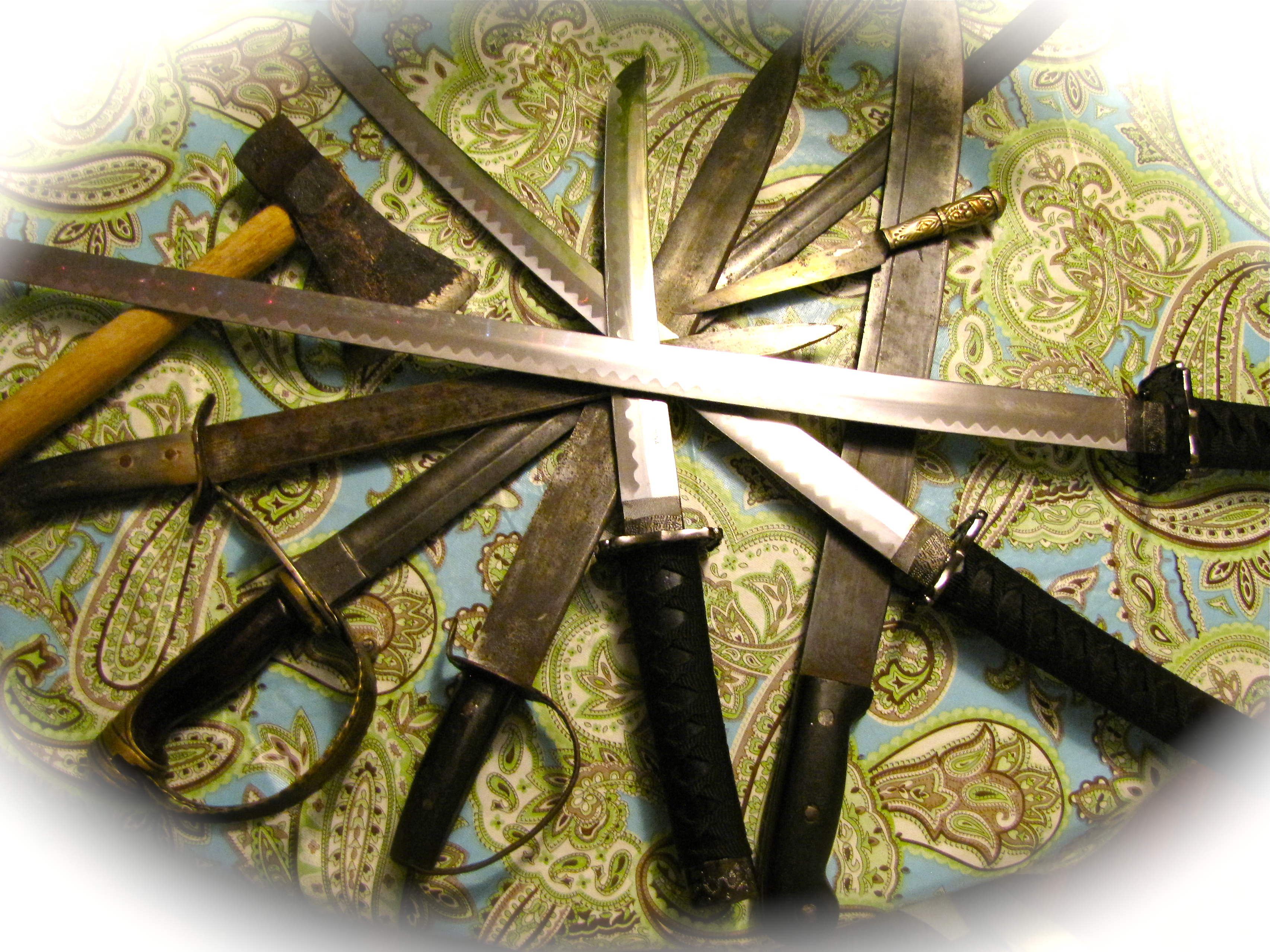
Our current assemblage includes several machetes, an antique cavalry saber, an antique gaucho knife, a set of samurai swords, a throwing knife, a hatchet and a replica of Bilbo’s sword Sting from the Lord of the Rings films. This collection doesn’t include a number of machetes and knives we’ve lost, left behind or given away over the years.

Some of the blades aren’t just for show. My old man uses the gaucho knife to slice apples. The machetes were used regularly in Ecuador, whether for cutting grass (we didn’t have a lawnmower) or chopping wood. The cavalry saber is no longer wielded in battle, but it gives whoever happens to be holding it an air of authority. It’s hard to argue with someone brandishing a cavalry saber.

My old man is particularly skilled with blades, able to snap a stick in half by throwing a machete from a distance of several feet. He says the technique is using for killing snakes in the jungle. I’ve never seen my old man kill a snake—such creatures are pretty rare in the urban areas where my parents have worked for the last decade—but woe to the foolish serpent who crosses my father’s path when he’s got a machete handy.

Our arsenal of blades was surprisingly inexpensive to assemble. The most pricey item was probably the cavalry saber, purchased from a fellow missionary for fifty dollars. Machetes are a dime a dozen—all right, more like twelve dollars for one—in Ecuador. I bought the samurai swords for twenty dollars from a college roommate.

I think we’ve spent our money wisely. The Lord Jesus himself advised his disciples to invest in bladed weapons.

(Disclaimer: I may possibly be taking the verse slightly out of its original context.)

I wanted to make a sword during That Time I Was a Blacksmith, but I never managed it. Making S-hooks and tent pegs was hard enough—a sword would have been practically impossible.

(I laughed bitterly during that episode of Avatar: The Last Airbender in which a character with no experience as a blacksmith forges a beautiful sword in a single night.)

Although I will never make my own sword, I will continue to enjoy and appreciate the blades my family and I acquire.

Swords are awesome. I’m holding a cavalry saber, so don’t even try to argue if you disagree.

73. Exotic Cuisine

Being a missionary kid can be both a blessing and a curse. MKs are privileged to enjoy all sorts of experiences unavailable to most kids, but they also suffer all sorts of difficulties most kids never have to endure.

For most MKs, the local cuisine can be either a blessing or a curse. Some exotic foods are awesome. Some are awful.

Regardless of whether or not they like international cuisine, missionaries and their children hold to a sacred missionary proverb: Where God leads me I will follow; what God feeds me I will swallow.

From the jungles of Ecuador to the suburbs of South Korea, I’ve been blessed to enjoy (and cursed to endure) all sorts of exotic foods. Fried leaf-cutter ants, stir-fried tapir meat, squid jerky, grilled squid, red bean ice cream—the list goes on and on.

If pressed, I’d probably name maracuyá juice as my favorite exotic fare. Maracuyá, also called passion fruit, is an ugly, often shriveled pomegranate-like fruit the size of a tennis ball. Despite its drab outer appearance and sour flavor, it makes an exquisite juice when prepared correctly.

My least favorite exotic fare might be kimchi, a popular dish in South Korea. I recorded my impression of kimchi in my novel. Here’s an excerpt:

The only thing I didn’t like was kimchi, a pungent dish consisting of cabbage soaked in some strong liquid (I suspected sulfuric acid) and fermented until its alcohol level equaled that of vodka. Had any of the kimchi fallen to the table, I would not have been surprised had the tablecloth caught fire.

While many MKs get to experience a vast range of unusual dishes, they miss out on a lot of treats most Americans take for granted: marshmallows, root beer and peanut butter cups, to name but a few. When my brothers and I were young, we viewed the United States of America not so much a country as the source of all the treats we couldn’t get in Ecuador.

There have been, I admit, certain exotic dishes I never had the opportunity to sample. I never tried cuy, an Andean specialty consisting of roasted guinea pig. I also missed out on chicha, a manioc- or corn-based alcoholic beverage popular in the jungles and highlands of Ecuador.

Someday, perhaps.

66. Taxes

As we all know, February is a month for love, romance and taxes.

Taxes wouldn’t be so bad if they were simpler to pay. I don’t mind giving money to the government. No, what bothers me is that giving money to the government requires so many hours of tedious paperwork.

Despite the complications, I continue to pay taxes every year. After all, Jesus paid his taxes. There’s a great story in Matthew 17 in which Jesus sends Peter fishing, promising that the first fish he catches will have a coin in its mouth with which to pay the temple tax.

My first reaction to this story is, “Of course Jesus paid his taxes, and so should I.”

My second reaction is, “Man, Jesus had it easy. I wish I could just hand over my tax money and be done with it. I wonder what miracle Jesus would use to pay his taxes today.”

Another reason I pay taxes is to prevent the US government from arresting me for tax evasion. There are many places in the world I’d like to visit, but prison isn’t one of them. Besides, if I were arrested and put on trial, the legal paperwork would be even worse than tax paperwork. It’s sort of like Scylla and Charybdis from The Odyssey. A person must decide which misery is less miserable.

When I pay taxes, the process typically involves a large amount of tedious fact-checking, a moderate amount of careful estimating and a small amount of wild guessing.

In addition to my usual federal and state taxes, I also pay the Federal Secretarial Animal Assistant Tax (also called the FSAAT) for my typewriter monkeys.

I never ask my monkeys to help me with my taxes. In addition to their other faults, they are extremely bad at mathematics. I’m much better at math than any of my typewriter monkeys, despite having an English degree. (For those who don’t know, an English degree is not so much a sign of being good at English as a sign of being bad at mathematics.)

Besides being poor mathematicians, my typewriter monkeys are also unmotivated to do tax paperwork. They have the stubbornness of mules and slothfulness of… well… sloths.

At least I don’t have the misfortune of employing typewriter sloths. Indeed, I must count my blessings.

I’d also better think about doing taxes soon.

47. Literary Gems

Every now and then while reading I happen to stumble upon a literary gem—a phrase, sentence or paragraph of dazzling literary quality. These are the passages that make me laugh, shudder or simply sit gaping in amazement.

For example, I was reading Titus Groan a few months ago. It’s a pretentiously stylish and relentlessly bleak novel by Mervyn Peake about a gloomy castle called Gormengast and its equally gloomy inhabitants.

In reading about the crumbling maze of weathered stone that comprises Gormengast, I was stunned by this description of a castle tower:

This tower, patched unevenly with black ivy, arose like a mutilated finger from among the fists of knuckled masonry and pointed blasphemously at heaven. At night the owls made of it an echoing throat; by day it stood voiceless and cast its long shadow.

Everything about this literary jewel screams gloomy and depraved. The passage uses evocative words like unevenly, black, mutilated, blasphemously, echoing, voiceless and shadow to give the impression of something erratic, dark, evil, ominous and silent—which pretty much sums up the atmosphere of the novel and most of its characters.

Moving on to something more cheerful, P.G. Wodehouse is one of those rare authors who throw out literary gems with casual abandon—practically every page of Wodehouse’s writing sparkles with brilliant passages.

For example, at a moment when the terrified narrator is trying to act confident:

I laughed lightly. At least, I tried to. As a matter of fact, the thing came out more like a death rattle.

Whether bleak or uplifting, heartbreaking or hilarious, terrifying or comforting, literary gems fill my bookish heart with wonder.

What are your favorite literary gems? Let us know in the comments!