25. Beards

I recently attended a production of “The Hobbit” by the Bethel College Theatre Department. It was a fine performance, despite the fact that most of the dwarves were played by women. Not enough actors tried out, so all but three of the dwarves were actresses in beards. Gandalf also had a beard. Almost everyone in the production had a beard. As much as I enjoyed “The Hobbit,” it was a painful reminder of a grave personal shortcoming: my lamentable inability to grow facial hair.

Oh, you may laugh. You may scoff at my woes and call them absurd. (You’d be absolutely right, but that’s not the point.) I wish I could grow a beard. Granted, facial hair hasn’t always been a good thing. Beards and mustaches have been the distinguishing marks of men whose ideas we hold in contempt or suspicion. Take Hitler and that silly excuse for a ’stache. Take Marx or Nietzsche or any of the other Dead European Thinkers With Strange Ideas And Facial Hair. Beards and mustaches clearly do not a virtuous man make.

All the same, I wish I could grow a beard.

Virtuous men sometimes have beards. Jesus had a beard. What, you don’t believe me? I have it on good authority. In a passage most commentators interpret as a prophecy about the Lord Jesus Christ, Isaiah clearly indicated that God’s Servant would have facial hair: “I offered my back to those who beat me, my cheeks to those who pulled out my beard; I did not hide my face from mocking and spitting” (Is. 50:6). Brethren, if we cannot trust Isaiah on the matter of the Servant’s beard, how can we trust him on any other matter?

(For the record, Jesus is the Son of God whether he had a beard or not.)

I suppose I should reserve my theological speculations for more important matters, such as the degree to which our salvation is predestined or whether people with spiky hair are holier than people without spiky hair.

No-Shave November is coming soon. I’m tempted to stop shaving my lack of facial hair and see what happens, but I’ll probably decide not to participate. I’ll leave No-Shave November to the pros. Perhaps some day I’ll be able to join them. We’ll see.

24. Cleaning Out Your Bible

Today’s post was written by my friend Robby Rasbaugh, renowned at Bethel College for his awesome hair and love for people. Check out his blog for profound and humorous insights into life at Bethel College, IN!

I fondly remember my pilgrimage to Israel a few summers ago with Bethel College, IN. I got the rare opportunity to climb sacred mountains, swim in the Sea of Galilee, walk the same trails that Jesus walked, and eat an authentic Israeli falafel, which I highly recommend (the falafel as well as the Israel experience).

Throughout the expedition, our group encountered a few live archeology sites. You could see the archaeologists hard at work, carefully excavating the dirt, examining the terrain, and measuring and documenting everything. A lot of historic artifacts, left intact for thousands of years and untouched by human hands, were finally discovered and used to learn more about ancient civilization.

If I wanted to, I could turn this into a beautifully woven sermon illustration about how if you dig deep enough into God’s Word, you’ll discover hidden treasures of deep insight and unfathomable knowledge. I could go on about how through careful study and examination of the Scriptures, you can unearth nuggets of profound truth for your spiritual life. But that’s a post for another day. I’m talking about cleaning out your Bible. Because over time, the average Christian’s Bible accumulates a certain amount of junk, transforming it into a holy time capsule littered with hidden artifacts from your spiritual past.

Here are the top three things Bible veterans are most likely to find hiding in their Bibles when they do choose to do a little excavation.

Ancient Church Bulletins

For some reason, you felt compelled on a certain obscure Sunday three years ago to stick the bulletin in the pocket of your Bible cover. There really was no significance tied to that Sunday. It was just like any other Sunday bulletin where you only sketched in half of the sermon fill-in-the-blanks before giving up, but did a good job at filling in all the os and bs and other bubble letters. Even with all the clues in the ancient bulletin, there’s not a chance in Sheol that you’ll be able to remember what your pastor spoke about that Sunday. Yet it is probably safe to assume that your church praise team did “Mighty to Save” for worship that day, considering that song was all the rage back in 2008. [Sniff] Sorry, I just had a moment of nostalgia.

Jesus Bookmarks

Maybe it features the Ten Commandments chiseled on stone tablets and embellished with lightning bolts. Maybe it has a Christian acronym that was totally rad in the 90s, like W.W.J.D. or F.R.O.G. Maybe it’s in the shape of a cross with an inspirational verse and dark clouds eclipsing brilliant rays of sunshine. No matter what it looks like, the question remains: How did this elusive Jesus bookmark stay hidden in your Bible for so long? It probably got buried in the Minor Prophets years ago, deep in the neglected part of your Bible somewhere near Habakkuk (which is a great book by the way).

Money

Am I the only one who does this? Do other Christians ever hide money in their Bibles with the intention of forgetting it’s there and finding it later? In the past, I know I’ve surreptitiously tucked a few bucks in my Bible, secretly wishing that God would multiply them when I wasn’t looking; that my money would grow thirty, sixty or a hundredfold what was sown, and that I would discover it in a season of need and praise God from whom all blessings flow.

What about you? What do you find when you clean out your Bible? Let us know in the comments!

13. That Time I Was a Blacksmith

It’s been an introspective week here at TMTF. The last few days have been full of insights and epiphanies and moments when I threw up my hands and shouted “Eureka!”

Although I had initially planned to post another reflection about faith today, I decided against it because spiritual meditations are best taken a little at a time. Rather than overwhelm my dear readers with too much introspection, I’ve decided instead to save it for another day and write about That Time I Was a Blacksmith.

As the spring 2010 semester drew to a close at Bethel College, I made plans to work as a painter for the college’s maintenance department over the summer. I’d worked there during the previous two summers and felt confident I’d be hired. I was wrong. The maintenance department didn’t hire any student workers due to budget issues. I had four months before me and no job, no salary and no plans.

Then my sister-in-law’s parents contacted me. Her father is a blacksmith—a genuine, honest-to-goodness professional blacksmith, one of those mighty men who craft things out of iron and steel. They had heard from their daughter that I was looking for a job. Would I be interested in working for them over the summer?

Heck yeah.
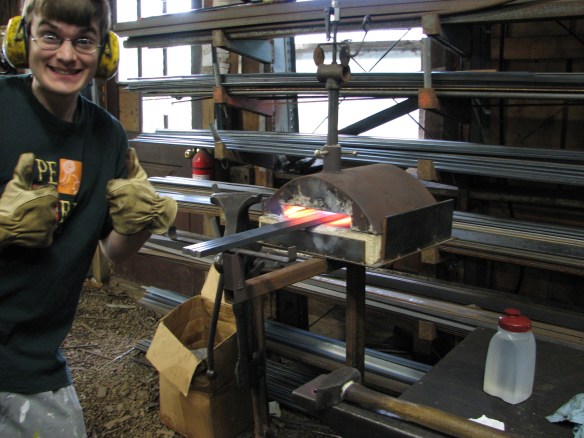
I packed up my things and moved into their home for about two and half months. (I spent the last month of that summer teaching English in South Korea, but that’s another story for another post.) When I went to stay with my sister-in-law’s parents, I didn’t know much about blacksmithing. Here are a few of the things I learned.

Blacksmithing is tough

Blacksmithing requires considerable physical fitness and strength. Whatever else I may be, I’m not physically fit or strong. I generally used the smallest hammer in the shop. My brother calls it “the girly hammer” because it was the tool his wife and her sisters used when they worked as blacksmiths. It’s a little embarrassing to admit, but they were all much better blacksmiths than me.

Making swords is very, very difficult

When I began working as a blacksmith, I had great ambitions to make an epic sword. It didn’t have to be a Buster Sword or even an Andúril. I simply happen to have a passion for sharp objects and wanted to make a sword that was uniquely mine. I was disappointed to learn that crafting swords is a career of its own. Which brings us to the next thing I learned.

There are different kinds of blacksmiths

I had just assumed blacksmiths made everything. Only after I began working did I realize there are knifesmiths, who make knives; swordsmiths, who make swords; farriers, who make horseshoes; and standard blacksmiths, who make miscellaneous items such as candlesticks and tent pegs and barbecue grills. My boss fit into the last category.

Blacksmithing requires a ton of mathematics

I would never have guessed it, but there’s much more to being a blacksmith than whacking things with hammers. A blacksmith must figure out how many two-and-three-quarter-inch lengths can be cut from a twenty-foot steel rod, and how many corresponding one-and-a-half inch lengths must be cut from a fifteen-foot steel bar. There are angles to be calculated and numbers to be added. This was a problem for me. I’m an English major, you see. Having assumed the math skills I picked up in high school were mostly useless, it was quite a shock to realize mathematics does have practical applications after all.

Many modern blacksmiths use machines

In the movies you see old-fashioned smiths banging away with hammers and pumping air into coal fires. In these high-tech days blacksmiths use propane-fueled forges, power hammers and electric saws. It was quite a surprise to walk into the shop and find antique anvils (my boss has anvils that are centuries old) sharing space with heavy machinery.

Apart from working in the shop, I also had the opportunity to accompany my boss to several rendezvous—reenactments of early nineteenth-century America. We set up a tent full of merchandise and spent whole weekends forging and selling items. My boss did the forging, hammering red-hot metal in front of a blazing coal fire in the summer heat for hours on end. It never seemed to bother him. I had the easy job of sitting on a stool and taking our customers’ money, and I still felt tired at the end of the day.

I met a lot of neat people at those rendezvous. A man who looked like a homeless person with a greasy beard and stained T-shirt turned out to be a professional swordsmith with multiple university degrees. Another man was the exact image of Benjamin Franklin. And at my first rendezvous, my boss and I stood in line for supper with folks dressed like people from different epochs of Earth’s history: ancient Romans, medieval knights, French noblemen and American colonialists. We did not merely stand in a line that night. We stood in a timeline.

I don’t plan on ever becoming a blacksmith again, but it was a very good experience. My boss and his wife were ridiculously kind, generous and hospitable. My boss was also very patient. A lesser man would probably have lost his temper and bashed in my head with a hammer, but he was always tolerant of my mistakes.

My only real regret is that I wasn’t able to make that sword.

7. The Death Cupboard

Nobody takes my tea without my permission and lives.

That’s not to say I won’t share. I love sharing tea with friends, but woe to the fool who takes my tea without my consent!

All right, I’m exaggerating a little. I may not summon the full force of my mighty wrath if you take my tea, but I’ll certainly be a little irritated.

It’s not that I mind people drinking my tea. To be honest, I’m secretly pleased when people ask for tea; it’s always a pleasure to serve a fellow tea-drinker. It’s that I feel vaguely insecure when my possessions vanish without warning.

At the beginning of my sophomore year of college, I moved into a house with seven other young men and immediately realized my tea was in danger of falling into the wrong hands—by which I mean any hands that weren’t mine. I also had baking supplies and coffee and an emergency stash of ramen noodles, all of which would become public property unless I did something to defend them.

I promptly annexed a kitchen cupboard and filled it with my eatables and drinkables. But what was to keep bandits from raiding my cupboard and carrying off my cherished tea? I gave the problem considerable thought and devised an ingenious solution.

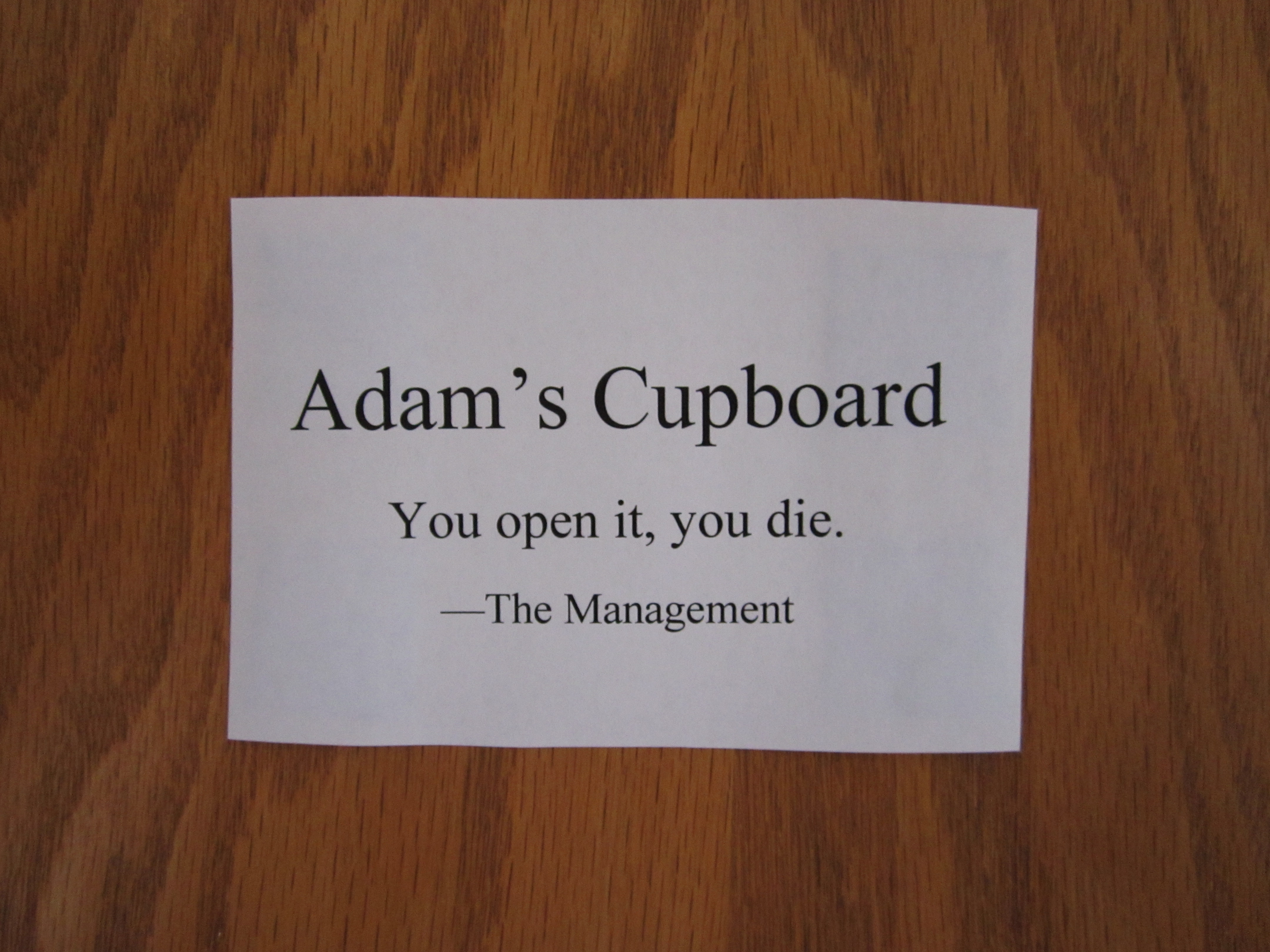
I put up a sign.

Well, that was a mistake.

Several of my housemates and a number of visitors made a point of opening my cupboard just to annoy me. It became known as the Death Cupboard. However, even though the cupboard was opened regularly, my plan was sort of a success. No one took my tea without asking permission.

Since death apparently wasn’t a convincing enough penalty to keep people from opening my cupboard, I later revised the sign to read, Adam’s Cupboard. You open it, Adam unfriends you on Facebook. –The Management.

Well, that didn’t work either. People continued to open the Death Cupboard and I never had the heart to unfriend them. No one took my tea, though, so I guess I can’t complain.

The people who opened the Death Cupboard were quick to point out they didn’t die. Little do they know the day of their doom is coming. They opened Adam’s Cupboard, and they will die.

Eventually. You know, in sixty or seventy years.

When that day comes, I’ll shake my old gray head and mutter, “Ah, if they hadn’t opened the Death Cupboard back in the fall of ’09 they might still be alive today.”

1. That Time I Was Attacked by a Tomato

The inaugural post of a blog is a great and sacred thing. It sets the standards and expectations for all of the posts to come. I gave considerable thought to this all-important first post. Perhaps, I mused, I should share some beautiful spiritual reflection, or a profound literary insight, or some glorious commentary on the meaning of life.

I decided instead to write about That Time I Was Attacked by a Tomato.

To be fair, the attack wasn’t unprovoked. I suppose it could even be called self-defense. During my time at Bethel College in Indiana, I’ve worked at a sandwich restaurant called the Acorn. It was my morning shift and I was slicing tomatoes without any suspicion that one of them might resist.

Workers at the Acorn use a slicer that shoves tomatoes through a frame of razor-sharp blades. The blades divide the tomatoes into even slices, which are stored in plastic containers and eventually put on sandwiches. Every now and then a tomato will be too mushy to be sliced neatly by the blades. Such tomatoes generally split open and send forth little jets of juice.

On the day of the incident, I tried to slice a tomato and it exploded.

I wasn’t expecting any of the tomatoes to go off like grenades, so I was rather stunned. One of my fellow workers described the scene thus: “I looked over at you, and there was juice and seeds dripping from your face!” Another worker just hopped up and down and exclaimed, “Eww! Eww! Eww!”

Tomatoes aren’t the only things that have attacked me at the Acorn. I never considered making sandwiches a dangerous job, yet my time at the Acorn has been fraught with violence.

For example, a friend whom I’ll call Socrates made a point of pretending to tear out my heart every time we worked together. He would then pretend either to take a bite out of the still-beating heart or to squeeze it into his drink.

Socrates once recruited another worker to assault me with crumpled-up papers as I was taking my supper break. A volley of paper balls pelted me as I sat innocently eating a sandwich, and I looked up to see Socrates and his accomplice preparing the next barrage of artillery. With only the table for cover, there wasn’t much I could do to defend myself.

I was also jumped by a raccoon. When I say jumped, I mean it both literally and figuratively. I was taking a stack of cardboard out to the recyclables dumpster when something like a furry gray basketball launched itself at me from an open hatch in the dumpster’s side. It landed at my feet and I realized it was a raccoon. It paused for a moment, peering up at me and presumably wondering whether I was worth the trouble of biting, and then sauntered away.

Why do things attack me at the Acorn? Why is making sandwiches so perilous?

I have no idea.