Help, I’m a Christian! – Church

A church is supposed to be a gathering of Christians who meet together to worship God and serve others. Simple, right?

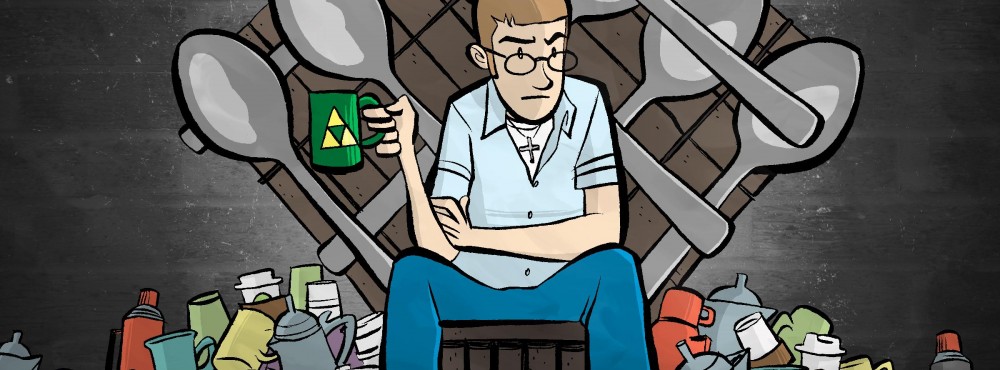
However, some churches have become cluttered, whether with hymnals and wooden pews or electric guitars and cinema-style padded chairs. The Christian faith is sometimes eclipsed by the traditions and cultures of its churches.

Another kind of clutter is the idea that churches are independent. There isn’t often much communication or cooperation between churches, even though they belong to the same God. We think of different churches as separate entities, not as parts of a single entity.

Worst, I think, is that churches are cluttered with prejudices. We Christians have a tendency to make two deadly mistakes: believing our opinions are infallible, and assuming anyone who disagrees must be a misguided sinner. I’m ashamed to say it, but Christians are often rude in God’s name.

There are so many empty traditions, so many dogmatic views, so many petty squabbles—to wit, so many kinds of clutter—filling churches everywhere that we can’t help but ask a question.

Is church worth it?

Yes, yes it is.

We can start by not giving up. I know people who have stopped going to church. They avoid the clutter, true, but they also miss the glorious blessings churches have to offer.

The Christian faith isn’t something we can live out individually. When we call God our Father, we acknowledge being part of a family—and we don’t get to choose our siblings, biological or spiritual.

Right from the beginning, Christians stuck together. Christ himself had disciples. After Christ’s departure from Earth, his disciples became a community.

Church gives us the opportunity to encourage each other, worship God together, serve our communities and learn from other believers.

We can choose not to lose sight of the big picture. In the midst of the details—the youth ministry events, the Wednesday Bible studies, the rehearsals for Sunday morning worship—we can remember why we do these things.

To repeat an invaluable lesson, we must understand the why of Christian living as we live out the how.

It’s important to recognize church as a community—not a social club, but a family. Some of my favorite congregations have met in houses, banquet halls and indoor soccer stadiums. There were no hymnals, no fog machines and hardly any formal programs. Members gathered simply to worship God and to encourage each other. It was awesome.

Being part of a community takes time, effort and patience. Church isn’t always what we want it to be. Sermons can be boring. Worship songs can be unbearably silly. Other Christians can be irritating.

However, church is sometimes even better than what we want it to be. Sermons can be useful. Worship songs can be beautiful. Other Christians can be loving, hospitable and kind.

In the end, church is worth it.

Next: Obedience and Service

48. Falling Asleep in Church

God loves the people who fall asleep in church.

This comes as a relief to me, since my thoughts sometimes wander to the ends of Earth during sermons. To borrow a phrase inadvertently coined by an acquaintance of mine, I tend to daze off during services—to slip into a blank state of mind somewhere between a daze and a doze in which I’m only vaguely aware of the message being preached.

I suspect the reason some churches serve coffee is to keep churchgoers awake during the sermon. Other churches, not quite so shrewd, make the mistake of serving real wine during communion services—there’s nothing like alcohol to make churchgoers drowsy.

One of my favorite stories in the Bible concerns a young man who fell asleep during church. Paul, the missionary who wrote about half of the books in the New Testament, was preaching in an upstairs room late at night. As Paul droned on and on, a young man named Eutychus fell asleep, plummeted from a third-story window and died.

It would have been awful if the story had ended there. The moral of the story would have been You fall asleep in church, you die. The story continues, however, and we learn two great things about God. First, he loves the people who fall asleep in church. Second, he has a sense of humor.

After Eutychus fell out the window, Paul rushed down to the street and put his arms around his dead body. “Don’t be alarmed,” he said. “He’s alive!” Eutychus revived, much to the delight of the people. Paul went upstairs, had something to eat—and kept preaching.

If I had been God, I might have considered not restoring Eutychus to life. “Let his death stand as a warning to all future sleepers in churches,” I might have said. Fortunately for churchgoers everywhere, the Lord is very merciful. Eutychus was revived and God’s love for all people—even people who fall asleep during church—was demonstrated.

(The story of Eutychus can be found in Acts 20:7-12.)

There are quite a number of funny things like that in the Bible.

There’s the poetic passage in which God described the stupidity of ostriches (Job 39:13-17).

There’s the tragicomic story of how King David’s murderous son Absalom was killed by soldiers after he rode beneath an oak tree, got his head caught in a branch and dangled helplessly in midair as his mule went on without him (2 Samuel 18:9-15).

There’s the account of how, during a contest between God and the false god Baal, the prophet Elijah taunted rival prophets with snarky remarks (1 Kings 18:22-29).

For all its seriousness—and it can certainly be serious—the Bible is sometimes pretty funny.

24. Cleaning Out Your Bible

Today’s post was written by my friend Robby Rasbaugh, renowned at Bethel College for his awesome hair and love for people. Check out his blog for profound and humorous insights into life at Bethel College, IN!

I fondly remember my pilgrimage to Israel a few summers ago with Bethel College, IN. I got the rare opportunity to climb sacred mountains, swim in the Sea of Galilee, walk the same trails that Jesus walked, and eat an authentic Israeli falafel, which I highly recommend (the falafel as well as the Israel experience).

Throughout the expedition, our group encountered a few live archeology sites. You could see the archaeologists hard at work, carefully excavating the dirt, examining the terrain, and measuring and documenting everything. A lot of historic artifacts, left intact for thousands of years and untouched by human hands, were finally discovered and used to learn more about ancient civilization.

If I wanted to, I could turn this into a beautifully woven sermon illustration about how if you dig deep enough into God’s Word, you’ll discover hidden treasures of deep insight and unfathomable knowledge. I could go on about how through careful study and examination of the Scriptures, you can unearth nuggets of profound truth for your spiritual life. But that’s a post for another day. I’m talking about cleaning out your Bible. Because over time, the average Christian’s Bible accumulates a certain amount of junk, transforming it into a holy time capsule littered with hidden artifacts from your spiritual past.

Here are the top three things Bible veterans are most likely to find hiding in their Bibles when they do choose to do a little excavation.

Ancient Church Bulletins

For some reason, you felt compelled on a certain obscure Sunday three years ago to stick the bulletin in the pocket of your Bible cover. There really was no significance tied to that Sunday. It was just like any other Sunday bulletin where you only sketched in half of the sermon fill-in-the-blanks before giving up, but did a good job at filling in all the os and bs and other bubble letters. Even with all the clues in the ancient bulletin, there’s not a chance in Sheol that you’ll be able to remember what your pastor spoke about that Sunday. Yet it is probably safe to assume that your church praise team did “Mighty to Save” for worship that day, considering that song was all the rage back in 2008. [Sniff] Sorry, I just had a moment of nostalgia.

Jesus Bookmarks

Maybe it features the Ten Commandments chiseled on stone tablets and embellished with lightning bolts. Maybe it has a Christian acronym that was totally rad in the 90s, like W.W.J.D. or F.R.O.G. Maybe it’s in the shape of a cross with an inspirational verse and dark clouds eclipsing brilliant rays of sunshine. No matter what it looks like, the question remains: How did this elusive Jesus bookmark stay hidden in your Bible for so long? It probably got buried in the Minor Prophets years ago, deep in the neglected part of your Bible somewhere near Habakkuk (which is a great book by the way).

Money

Am I the only one who does this? Do other Christians ever hide money in their Bibles with the intention of forgetting it’s there and finding it later? In the past, I know I’ve surreptitiously tucked a few bucks in my Bible, secretly wishing that God would multiply them when I wasn’t looking; that my money would grow thirty, sixty or a hundredfold what was sown, and that I would discover it in a season of need and praise God from whom all blessings flow.

What about you? What do you find when you clean out your Bible? Let us know in the comments!

17. Rampant and Irresponsible Capitalization

Christians like to capitalize things.

Don’t believe me? Let’s have a bet. Wait, we probably shouldn’t gamble about something related to Christianity. (I’m pretty sure there’s a passage in Hebrews that forbids gambling about religion.) How about I dare you instead of placing a bet? All right, I dare you to go to church next Sunday and see how many Christian words are capitalized.

A lot of people—even some non-Christians—capitalize divine pronouns (pronouns used to refer to God) in order to show reverence or respect. C.S Lewis, a man for whom I have utmost admiration, capitalized divine pronouns. He also capitalized Heaven and Hell because they are places, like London or New York City, and should therefore be capitalized as proper nouns.

C.S. Lewis was consistent in his capitalizations and could give good reasons for them. It seems many people, however, are guilty of rampant and irresponsible capitalization. I may just be cynical, and I’m definitely a literary snob, but it seems sometimes as though American Christians capitalize words related to Christianity just to make them seem holier.

For example, hymns and worship songs never refer to God and his mercy. It’s evidently more holy to capitalize the divine pronoun and refer to God and His mercy. And if we capitalize mercy, which is a divine attribute, it makes the hymn or worship song even holier. I mean, God and His Mercy is clearly holier than God and his mercy, isn’t it?

So sermons are full of Grace, Goodness, Predestination, Prophecy, Agape, Apostles, Epistles, Pre-Millennialism, Mid-Millennialism, Post-Millennialism and the Millennium Falcon. All right, maybe not that last one. At least not in any sermons I’ve heard.

Anyway, there have come to be so many capitalizations that capitalization is becoming meaningless.

If a word is capitalized, there should be a good reason for it. I capitalize Gospel to distinguish the good news of Jesus Christ from the music genre. I capitalize Church to set apart the worldwide community of God’s people from the fancy building down the street. I capitalize Prophets to differentiate between a section of the Old Testament and the plural form of a common noun.

Unlike C.S. Lewis, I don’t capitalize heaven or hell or divine pronouns. There’s absolutely nothing wrong with capitalizing these words, but it doesn’t seem necessary. I don’t think God cares much about capitalization. He cares more about love and obedience and mercy.

Should divine pronouns and spiritual words be capitalized? Should there be more sermons about the Millennium Falcon? Let us know in the comments!

2. Confessions of a Literary Snob

I have a confession to make: I’m a literary snob. This wouldn’t be so bad if my literary judgments were confined to the Twilight books, but my snobbishness goes where even angels fear to tread.

Yes, I’m talking about modern worship music.

It’s Sunday morning. Having quaffed my morning coffee and dressed less shabbily than usual, I’ve come to church to worship God and learn from Scripture. But I look at the bulletin and feel a pang of annoyance.

The first song on the list: “How He Loves Us.”

I stifle a groan. Not “How He Loves Us.” Not again.

The song begins.

“He is jealous for me, love’s like a hurricane, I am a tree bending beneath the weight of his wind and mercy.”

Bending beneath the weight of his wind? What is that even supposed to mean?

“When all of a sudden, I am unaware of these afflictions eclipsed by glory and I realize just how beautiful you are and how great your affections are for me.”

Dash it all, that’s got to be the worst poetry I’ve ever heard.

“So we are his portion and he is our prize, drawn to redemption by the grace in his eyes.”

That’s bad writing, but at least it’s coherent.

“If grace is an ocean we’re all sinking.”

That is not coherent. Drowning in an ocean doesn’t even come close to being an appropriate metaphor for divine grace.

“So heaven meets earth like a sloppy wet kiss and my heart turns violently inside of my chest.”

Something is turning violently inside me, but it’s not my heart. How exactly is heaven like a sloppy wet kiss? I haven’t seen such bad writing since Eoin Colfer likened sparks of magic to “mystical beavers repairing storm damage.”

Then, in a blinding instant, I realize I’m being a literary snob when I ought to be worshiping the Lord God Almighty.

Am I the only Pharisee guilty of literary snobbishness? Does anyone else have something to confess? Let us know in the comments!