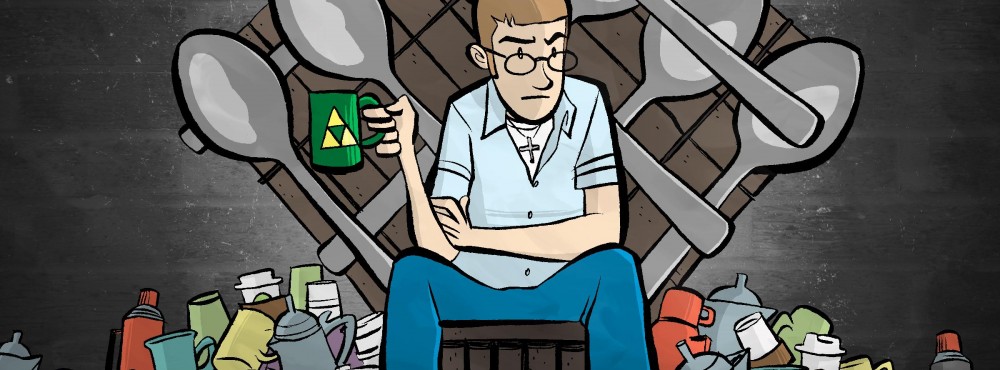
149. Why I Watch Cartoons

As many of my readers have probably noticed, I like cartoons.

Well, I like some cartoons. Others I would watch only on pain of death, and perhaps not even then. (I’m looking at you, SpongeBob SquarePants.) Besides loving many animated films—for example, classic Disney movies and everything directed by Hayao Miyazaki—I enjoy television shows produced for kids.

I also like literature, especially the classics. Explosions? Car chases? Sultry romances? Bah! Humbug! To blazes with such nonsense! Give me meaningful themes, compelling characterization and well-crafted plots.

Thus I decided to take no fewer than three literature classes in one semester when I was in college. (Where was Admiral Ackbar when I needed him?) For months, I was hammered by grim novels like Silence, a bleak story about the silence of GodOne Hundred Years of Solitude, a fantastical history of a disturbing, sordid society; The Penelopiad, a cynical postmodern perspective on The Odyssey; and several more depressing books.

It was not a happy semester.

Some notable literature is lighthearted—I thank God for cheerful authors like P.G. Wodehouse—but the good stuff is mostly depressing. Even stories by humorists like Mark Twain and James Thurber have tragic undertones. Thurber once wrote, “To call such persons ‘humorists,’ a loose-fitting and ugly word, is to miss the nature of their dilemma and the dilemma of their nature. The little wheels of their invention are set in motion by the damp hand of melancholy.”

I like cartoons because they’re innocent, bright and funny, and they’re unapologetic about it.

Do cartoons give a balanced view of the world? Of course not—but then, neither does much of the best literature. Cartoons remind me that the world can be a pleasant, cheerful place, even as literature reminds me that it can be a dreadful, hopeless one.

For me, cartoons are a kind of escapism.

Is escapism wrong? When balanced with realism, I don’t believe it is. To quote J.R.R. Tolkien, who is awesome, “I do not accept the tone of scorn or pity with which ‘Escape’ is now so often used. Why should a man be scorned if, finding himself in prison, he tries to get out and go home? Or if he cannot do so, he thinks and talks about other topics than jailers and prison-walls?”

A Farewell to Arms tells me there is suffering in the world. My Little Pony: Friendship Is Magic tells me there is good in it. The Great Gatsby tells me happiness can’t be bought with money or popularity. Phineas and Ferb tells me happiness can be found by two kids sitting in the shade of a tree on a summer day. Animal Farm tells me the good guys sometimes lose. Avatar: The Last Airbender tells me the good guys sometimes win.

The other reason I watch cartoons is because, well, they’re fun to watch.
107. Things I Don’t Talk About

There are things I don’t talk about.

Some of these things are trivial. I enjoy watching a television show about magical rainbow ponies, for example. I sometimes make faces at myself in the bathroom mirror. I also think Miley Cyrus’s “Party in the USA” is pretty darn catchy.

I’m not ashamed of these things, but they’re a little embarrassing, and so I keep them to myself.

Then there are the other things I don’t talk about—things that are anything but trivial.

I’ve suffered for years from serious depression. It comes and goes more or less at random, and robs me of the ability to do much of anything except breathe. When I’m depressed, all I can do is pray, retreat to my bedroom with a cup of tea and wait until my depression goes away.

I struggle with insecurity. Although I try not to let it show, I often wrestle with doubts and worries about my future, my faith, my writing and pretty much everything else.

I worry too much about my reputation, and show too little care or concern for the needs of other people.

I don’t feel particularly at home anywhere in the world. Even though I grew up in Ecuador, my Spanish is pretty weak. The culture of the United States is still strange to me. Every country feels like a foreign one.

Why don’t I ever talk about these things?

Well, it’s embarrassing and awkward. These things tear apart the bookish, cheerful, slightly eccentric impression I wish to make on people. Being vulnerable is hard. Sharing my insecurities feels too much like complaining or making excuses. It’s easier to reminisce about crazy high school teachers or grumble about how modern worship music is badly written.

I think other people would be more patient with me if they understood my struggles.

Do you know what else?

I would be a dashed lot more patient with other people if I understood their struggles.

My closest relationships are those in which the things we don’t talk about have been talked about. Some of the best discussions I’ve ever had were the ones in which the masks came off. These discussions were uncomfortable, but they built up stronger friendships.

There are times when revelations of a personal nature aren’t appropriate. There is a very, very fine line between being vulnerable and complaining about personal problems. It takes discernment to know when to speak and when to remain silent.

The problem is when I simply remain silent, hiding my struggles, refusing to acknowledge I’m not perfectly self-sufficient.

Uncle Iroh and the Apostle Paul—a fictional tea-drinker and a famous missionary, respectively—seem to agree on certain issues, and this is one of them.

Uncle Iroh once said, “There is nothing wrong with letting people who love you help you.”

The Apostle Paul wrote, “Carry each other’s burdens, and in this way you will fulfill the law of Christ.”

Maybe we should talk about the things we don’t talk about.

78. Machetes and Sabers and Swords, Oh My!

I’ve previously mentioned my passion for swords, knives and other lethally sharp objects. Most male members of the human species have a predilection for bladed weapons, I suspect.

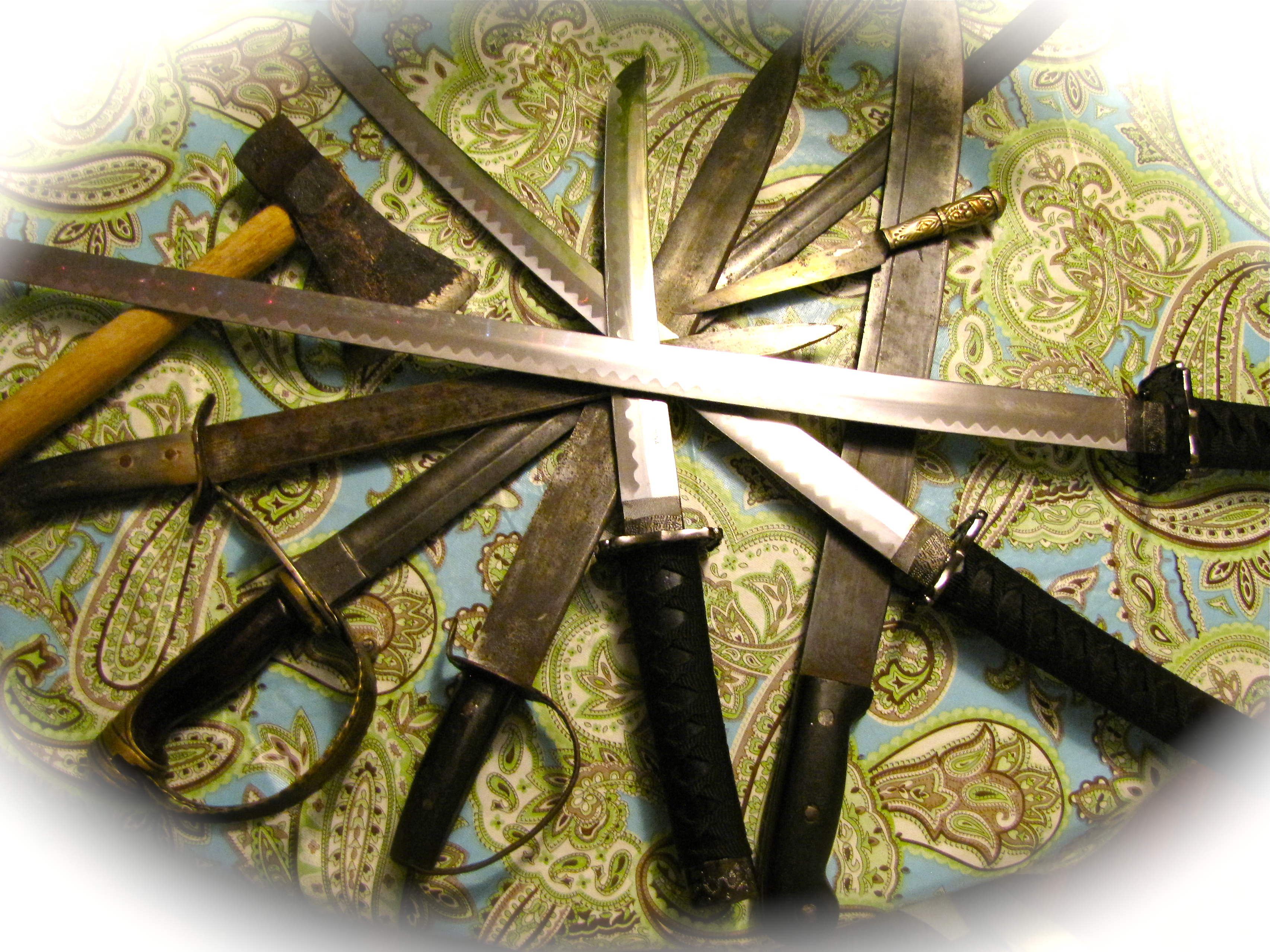
My family has a Mennonite background. Mennonites are known for their pacifistic beliefs (and really good cooking). In spite of our heritage, we’ve amassed a formidable collection of blades over the years.

Our current assemblage includes several machetes, an antique cavalry saber, an antique gaucho knife, a set of samurai swords, a throwing knife, a hatchet and a replica of Bilbo’s sword Sting from the Lord of the Rings films. This collection doesn’t include a number of machetes and knives we’ve lost, left behind or given away over the years.

Some of the blades aren’t just for show. My old man uses the gaucho knife to slice apples. The machetes were used regularly in Ecuador, whether for cutting grass (we didn’t have a lawnmower) or chopping wood. The cavalry saber is no longer wielded in battle, but it gives whoever happens to be holding it an air of authority. It’s hard to argue with someone brandishing a cavalry saber.

My old man is particularly skilled with blades, able to snap a stick in half by throwing a machete from a distance of several feet. He says the technique is using for killing snakes in the jungle. I’ve never seen my old man kill a snake—such creatures are pretty rare in the urban areas where my parents have worked for the last decade—but woe to the foolish serpent who crosses my father’s path when he’s got a machete handy.

Our arsenal of blades was surprisingly inexpensive to assemble. The most pricey item was probably the cavalry saber, purchased from a fellow missionary for fifty dollars. Machetes are a dime a dozen—all right, more like twelve dollars for one—in Ecuador. I bought the samurai swords for twenty dollars from a college roommate.

I think we’ve spent our money wisely. The Lord Jesus himself advised his disciples to invest in bladed weapons.

(Disclaimer: I may possibly be taking the verse slightly out of its original context.)

I wanted to make a sword during That Time I Was a Blacksmith, but I never managed it. Making S-hooks and tent pegs was hard enough—a sword would have been practically impossible.

(I laughed bitterly during that episode of Avatar: The Last Airbender in which a character with no experience as a blacksmith forges a beautiful sword in a single night.)

Although I will never make my own sword, I will continue to enjoy and appreciate the blades my family and I acquire.

Swords are awesome. I’m holding a cavalry saber, so don’t even try to argue if you disagree.

74. Guest Posts Welcome!

Update: This blog is finished, and no longer accepts guest posts. Thanks all the same!

John Donne once observed, “No blog is an island.”

I may possibly be misquoting him, but the basic principle is the same. Few people can survive apart from other people. Few blogs can exist independently from other blogs. Like most people, most blogs are part of a community.

I’d never have begun TMTF without inspiration from bloggers like Jon Acuff and Wes Molebash. Community can be extremely important for writers; bloggers are no exception. As I’ve said before, just because writing can be a lonely form of art doesn’t mean it should be.

I’d love to feature guest posts more regularly on TMTF. Quoth Uncle Iroh, “It is important to draw wisdom from many different places. If you take it from only one place, it becomes rigid and stale.”

TMTF has already featured great guest posts on creativity, literary dialogue and the things we find when we clean out our Bibles. I would be delighted to present guest posts on other humorous, useful or unusual topics.

What criteria are needed for a guest post to be featured on TMTF?

It should be about faith, writing, video games, literature, TV, movies, or meaningful personal experiences.

Possible topics for guest posts include creative writing tips, spiritual insights, literary musings or humorous observations about gaming culture. Posts about celebrity hairstyles, trigonometry or rubber bands will be instantly rejected.

It should be well-written.

Guest posts should be coherent, succinct and easy to read. Between four hundred to eight hundred words is the ideal length. Grammatical errors and spelling mistakes shall be met with the full fury of my righteous indignation.

It should be funny, insightful or both.

I try to make every post on TMTF entertaining or edifying. I don’t always succeed. That makes it even more important for guest posts to succeed where I fail!

It should be pleasant.

TMTF is not an edgy or controversial blog, and there are already enough disputes, arguments and insults on the Internet without adding more. The purpose of this blog is “to impart hope or understanding or inspiration—or at the very least a healthy laugh—to someone who needs it.” Guest posts should honor that purpose.

If a guest post meets the above criteria, TMTF will be honored to feature it.

How can guest posts be submitted?

Behold! TMTF now has a Contact page! If you’re interested in submitting a guest post, simply use the contact form.

I may not accept every single submission. Some guest posts, however well-written, may not be well-suited for TMTF. In some cases I’ll suggest changes to guest posts to make them more suitable. In all cases I’ll do my best to be respectful of the work submitted.

I’m going to be guilty of shameless self-promotion and admit my typewriter monkeys and I are always delighted to write guest posts for other blogs. If you’re looking for a guest post about faith, writing, video games, literature, life, the universe or everything, let us know using the Contact page!

51. Crying over Spilt Tea

Uncle Iroh, a fictional character whom I hold in high regard, once remarked tearfully, “I know you’re not supposed to cry over spilt tea, but it’s just so sad.”

There’s an idiom about crying over spilt milk, but I agree with Iroh—spilt tea is much, much sadder. If I spill a cup of tea, tears flow like a river and anguished sobs sound forth like peals of thunder.

All right, I exaggerate. But the waste of a cup of tea certainly causes me some regret. It’s awful to lose something good irrevocably because of a mistake.

I lost a lot of good things this year—things much better than tea, and that’s saying something. Hours that could have been spent reading or writing or praying were wasted pointlessly lounging around the house or aimlessly surfing the Internet. Words that should not have been spoken were, and words that should have been spoken were not. Dreams were choked by anxiety or laziness before they could grow.

Looking back, I realize I’ve spilt a good deal of tea.

I don’t know whether anyone else is ever burdened with regrets, but I am sometimes. It’s so dashed easy to look back and say to myself, “You certainly made a mess of that, you blasted fool,” or “You had an opportunity to do something amazing, and you missed it.” Trying to let go of regrets seems irresponsible. “You made those mistakes,” I tell myself. “You’re just going to have to live with them.”

Fortunately, the Apostle Paul took quite a different view. Paul, whom I hold in even higher regard than Uncle Iroh, was quite a wise fellow. He once wrote, “But one thing I do: Forgetting what is behind and straining toward what is ahead, I press on toward the goal to win the prize for which God has called me heavenward in Christ Jesus.”

Wait, what?

Forgetting what is behind? Straining toward what is ahead?

Seriously?

Awesome.

So we can live without clinging to regrets. Now what?

According to some people, the ancient Mayans predicted the world will end in 2012. Even if the Mayans did predict such a thing (which is pretty doubtful) I don’t put any confidence in their ability to foretell the future. The Mayans held human sacrifices, after all, so their views about the world were probably a little skewed.

Assuming the Mayans were wrong about the world ending in 2012, I’m going to head into the new year without any regrets about the past. There’s a saying about starting off each day with a clean slate. While it’s a little trite, I’m beginning to think that saying is also quite sensible.

It’s no good crying over spilt tea. It’s far better just to clean up the mess and brew another cup.

Speaking of which, all these metaphors are making me thirsty.