49. The Turnspike Emails: Christmas

TMTF solemnly presents another hellish look at life from a demon’s perspective. This is an email intercepted from the demon Turnspike to his colleague Goreflak; a previous email from Turnspike and TMTF’s commentary thereupon can be found here.

My Dear Goreflak,

You continue to amaze me, my dear devil, with your supreme ignorance and idiocy. You actually want to abolish the holiday called Christmas? There are so many flaws in your thinking that I hardly know how to begin the process of pointing them out.

First of all, the Enemy would never let Christmas be completely destroyed. It is (or was; more on that presently) a celebration of his own Son’s life on Earth as one of those ridiculous human vermin. A full-fledged attack upon Christmas would be disastrous for us and Our Father Below. Our only chance lies in perverting Christmas into something more suited to our purposes.

Second, destroying Christmas would not change the regrettable fact of Christ’s birth. So long as that fact remains, the celebration of Christmas remains possible even if we do away with the trappings of the holiday. The meaning of Christmas is not in seasonal decorations or traditions, but in Christ. We would accomplish nothing by abolishing the decorations and traditions, for Christ would remain.

Third, even if we could somehow do away with Christmas entirely, we would still have a dozen other wretched Christian holidays to obliterate: Saint Valentine’s Day, Saint Patrick’s Day, Easter, All Saints’ Day—the list goes on.

Destroying Christmas is clearly not an option. However, we have achieved something even better. As I mentioned, we would accomplish nothing by abolishing the decorations and traditions of the holiday—so we have instead exaggerated them.

Do you remember how in a previous email I explained how we had eclipsed All Saints’ Day by making Halloween into a commercialized holiday? We have done something similar with Christmas. It is no longer a celebration of Christ. It is a celebration of holiday specials and decorated trees, seasonal music and sugar cookies—and shopping. Christmas has become the biggest commercial frenzy of the year, when people across the world are given a gift-wrapped excuse to spend money.

I am afraid there is nothing inherently wrong in the decorations and traditions of Christmas. The humans enjoy music and food and gift-giving, and there is nothing we devils can do to prevent it. However, it is happily within our power to use these things to distract the humans from the Enemy, who would give them gifts too great to be bought or wrapped if only they would let him.

Incidentally, I wish to draw your attention to our use of political correctness in conquering Christmas. It is a Christian holiday, yet we have largely succeeded in removing its Christianity.

Christmas trees are sometimes called holiday trees and Nativity scenes are banned from public places for the sake of “not upsetting anybody.” Phrases like Merry Christmas are eschewed in favor of insipid slogans like Happy Holidays in order to be “more tolerant.” No secular establishment dares to acknowledge that Christ might have something to do with Christmas because someone “might be offended” if they do.

We have made sure it never occurs to anyone that Christians might be offended—not just offended, but deeply hurt—that Christmas, a Christian celebration, has been hijacked by people who prevent its Christianity from being celebrated publicly and use it simply to make money. The wonderful thing about political correctness is that it typically insults nobody but Christians, and nobody but Christians seems to mind.

My dear devil, I hope you are noticing a recurring tendency in our work as demons. Judging by the stupidity of your emails to me, I sincerely doubt it, and so it falls to me to point it out to you. We seldom face our Enemy head-on. We never destroy what we can pervert.

I hope you keep this principle in mind as you continue tempting your Patient.

Happy holidays!

Your affectionate colleague,

Turnspike
48. Falling Asleep in Church

God loves the people who fall asleep in church.

This comes as a relief to me, since my thoughts sometimes wander to the ends of Earth during sermons. To borrow a phrase inadvertently coined by an acquaintance of mine, I tend to daze off during services—to slip into a blank state of mind somewhere between a daze and a doze in which I’m only vaguely aware of the message being preached.

I suspect the reason some churches serve coffee is to keep churchgoers awake during the sermon. Other churches, not quite so shrewd, make the mistake of serving real wine during communion services—there’s nothing like alcohol to make churchgoers drowsy.

One of my favorite stories in the Bible concerns a young man who fell asleep during church. Paul, the missionary who wrote about half of the books in the New Testament, was preaching in an upstairs room late at night. As Paul droned on and on, a young man named Eutychus fell asleep, plummeted from a third-story window and died.

It would have been awful if the story had ended there. The moral of the story would have been You fall asleep in church, you die. The story continues, however, and we learn two great things about God. First, he loves the people who fall asleep in church. Second, he has a sense of humor.

After Eutychus fell out the window, Paul rushed down to the street and put his arms around his dead body. “Don’t be alarmed,” he said. “He’s alive!” Eutychus revived, much to the delight of the people. Paul went upstairs, had something to eat—and kept preaching.

If I had been God, I might have considered not restoring Eutychus to life. “Let his death stand as a warning to all future sleepers in churches,” I might have said. Fortunately for churchgoers everywhere, the Lord is very merciful. Eutychus was revived and God’s love for all people—even people who fall asleep during church—was demonstrated.

(The story of Eutychus can be found in Acts 20:7-12.)

There are quite a number of funny things like that in the Bible.

There’s the poetic passage in which God described the stupidity of ostriches (Job 39:13-17).

There’s the tragicomic story of how King David’s murderous son Absalom was killed by soldiers after he rode beneath an oak tree, got his head caught in a branch and dangled helplessly in midair as his mule went on without him (2 Samuel 18:9-15).

There’s the account of how, during a contest between God and the false god Baal, the prophet Elijah taunted rival prophets with snarky remarks (1 Kings 18:22-29).

For all its seriousness—and it can certainly be serious—the Bible is sometimes pretty funny.

47. Literary Gems

Every now and then while reading I happen to stumble upon a literary gem—a phrase, sentence or paragraph of dazzling literary quality. These are the passages that make me laugh, shudder or simply sit gaping in amazement.

For example, I was reading Titus Groan a few months ago. It’s a pretentiously stylish and relentlessly bleak novel by Mervyn Peake about a gloomy castle called Gormengast and its equally gloomy inhabitants.

In reading about the crumbling maze of weathered stone that comprises Gormengast, I was stunned by this description of a castle tower:

This tower, patched unevenly with black ivy, arose like a mutilated finger from among the fists of knuckled masonry and pointed blasphemously at heaven. At night the owls made of it an echoing throat; by day it stood voiceless and cast its long shadow.

Everything about this literary jewel screams gloomy and depraved. The passage uses evocative words like unevenly, black, mutilated, blasphemously, echoing, voiceless and shadow to give the impression of something erratic, dark, evil, ominous and silent—which pretty much sums up the atmosphere of the novel and most of its characters.

Moving on to something more cheerful, P.G. Wodehouse is one of those rare authors who throw out literary gems with casual abandon—practically every page of Wodehouse’s writing sparkles with brilliant passages.

For example, at a moment when the terrified narrator is trying to act confident:

I laughed lightly. At least, I tried to. As a matter of fact, the thing came out more like a death rattle.

Whether bleak or uplifting, heartbreaking or hilarious, terrifying or comforting, literary gems fill my bookish heart with wonder.

What are your favorite literary gems? Let us know in the comments!

46. About Writing: Style

Jon Acuff tweeted something insightful the other day about literary style: “The only way to find your voice as a writer is to write. Fear says you need to find your voice BEFORE you write. Don’t listen.” A somewhat less positive opinion was once expressed about style by some writer or other: “Style is a terrible thing to happen to anybody.”

Literary style can be defined as the distinct voice of a writer. If the term voice is a little vague, it’s because it includes too many aspects to be covered in a single convenient word. An author’s voice consists of many elements: tone, the attitude of the writer; diction, the words the writer uses; syntax, the way the writer arranges those words; and more. Even basic elements like grammar and spelling make up a writer’s style—consider the immortal passage in Mark Twain’s Huckleberry Finn in which the narrator declares: “Aunt Sally she’s going to adopt me and sivilize me.”

So what exactly is this vague thing called style? The term voice isn’t very precise. Rather than try to pin down an exact definition, let’s get stylish and look at a few examples.

Let’s take a simple sentence: The boy ran around the corner and ran into his grandpa’s large stomach. Fairly bland, eh?

All right, let’s say the same thing as Huck Finn might: The young’un turned the corner and run slap into his grandpappy’s belly. The style is more colloquial, but the same basic information is conveyed.

What if our character is more sophisticated—say a butler like Jeeves from the stories by P.G. Wodehouse? Jeeves might express the situation thus: The lad careened round the corner and collided with the impressive bulk of his grandfather’s ample middle. Once again the sentence means more or less the same thing, but the style gives off a completely different vibe.

Style is a key component of storytelling. A mystery writer must describe complex situations in a way that keeps the reader engaged without becoming too confusing or hard to follow. A comedy writer must—obviously—be funny. A romance writer must convey the nuances of that most complicated of relationships, the romantic courtship, in a manner that’s vivid and believable. (I’m guessing about the romance writer, since most romances make my stomach hurt.) Apart from the unique, individual style of each writer, each literary genre demands a certain kind of writing.

What about that unique, individual style? If you’re a writer, how in blazes are you supposed to find your own voice?

You’ve probably guessed it if you’ve read my first post about writing, but the answer lies in reading and writing. Writers tend to imitate the styles they enjoy reading and refine their own style as they write.

An author isn’t limited to a single style, of course. Writers tailor their style to suit the sort of work they’re doing. For example, my style when I compose posts for TMTF tends to be conversational. My style when I write Solidarity reports, however, is plain and precise: a systematic, minimalist style I picked up from a couple of journalism classes in high school and college. Then there’s my style when I write fiction, which tends to be wry. I enjoy using dry humor, even in stories with melancholy events.

Style is often the thing that sets a writer apart and makes him or her truly memorable—or at the very least, fun to read.

What literary styles do you enjoy reading? Let us know in the comments!

45. Give Us This Day Our Daily Schedule

An acquaintance of mine once uttered this profound insight: “Procrastination is just an extreme form of patience, and patience is a good thing.”

By this standard, I’ve been extraordinarily patient for the last two weeks.

In fairness, I’ve had a number of distractions: graduating from college, packing, traveling to Uruguay, unpacking and playing Skyward Sword. Before arriving in Uruguay, I had ambitious plans to write at least half a dozen posts for TMTF to spare myself the stress of desperately composing a post at the last minute. Within five or ten minutes of actually arriving in Uruguay, my plans to work ahead on my blog had been forgotten.

Now at last I’m resuming my sensible plan of working out a tentative schedule for TMTF a week or so in advance. Since I’m trying to figure out a schedule for the blog, this seems like the perfect time to mention the most unexpected strategy I’ve discovered for keeping in touch with God: scheduling.

I believe Christians are supposed to keep in touch with the Lord through prayer and reading Scripture—not as a requirement for salvation but as a response to it. Jesus said something clever about branches not being able to bear fruit unless they remain in the vine, meaning his followers won’t be productive unless they remain in a consistent relationship with him.

Fact of Importance: Prayer and reading the Bible aren’t part of a system to earn God’s favor. Christians don’t have to earn anything. Studying Scripture and praying are simply the best way to keep in touch with God: to honor him, learn from him, be encouraged, be corrected and be ready for action.

The other day I was reminded of a simple and decidedly unspectacular method for being consistent in praying and reading the Bible. I speak, of course, of the fine art of scheduling.

The more I procrastinate, the less motivated I become to pray or read the Bible. If I choose not to procrastinate—in other words, if I choose to pray and study Scripture early in the day while I’m refreshed from a night’s sleep and fueled by coffee—I’m able to face the rest of the day with greater motivation, enthusiasm and confidence.

(This also proves the potential spiritual benefits of coffee.)

Scheduling isn’t an impressive strategy, but it’s done more to help my relationship with God than almost anything else.

Are you a “patient” person? What strategies help you get things done? Let us know in the comments!

44. Bed Intruder

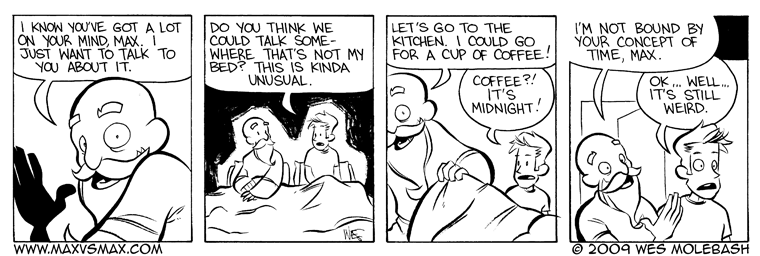
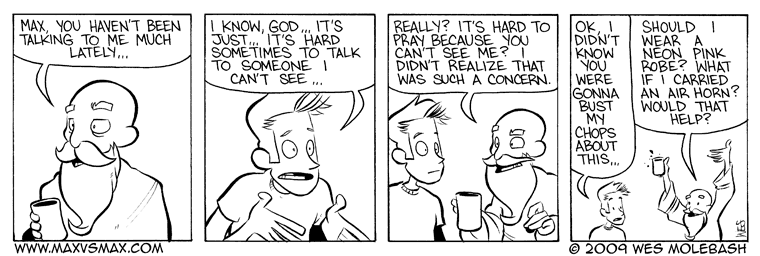
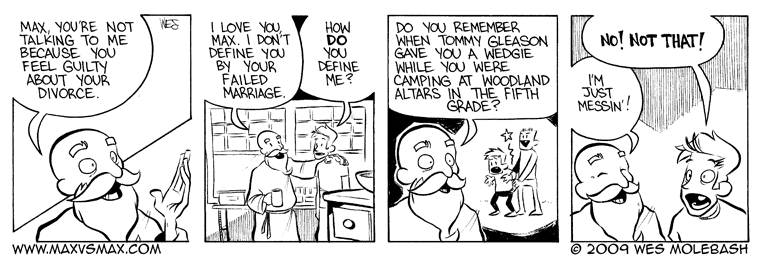
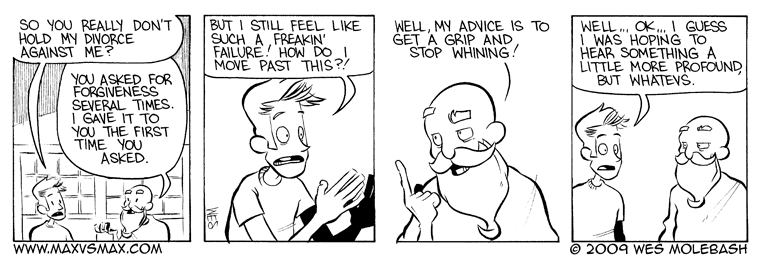
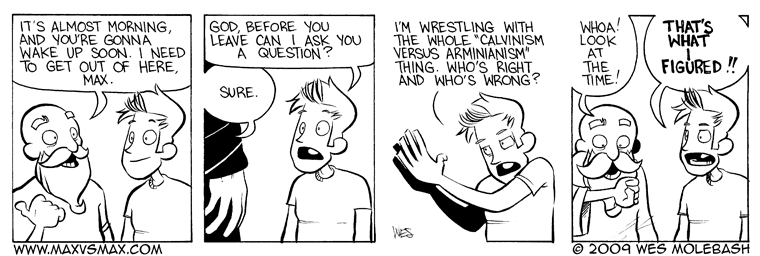
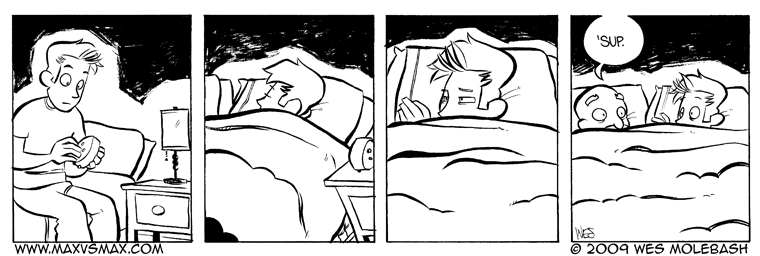
My typewriter monkeys finally arrived in Montevideo today after an airline luggage mix-up sent them to the farthest corners of Earth. They’re too exhausted to type out an entire post, so today’s post is borrowed from Max vs. Max, a webcomic by Wes Molebash. Deftly balancing humor and poignancy, these eight strips make up pretty much the best comic story arc ever. The story: A recent divorcee named Max awakes during the night to find a strange old man in bed with him. My thanks to Wes for his permission to use his comic; for more stuff from Wes, check out his latest comic project!

43. RPG Wisdom

Roleplaying games (more commonly known as RPGs) are hard. Some are notorious for being among the most difficult video games ever. The final battle of Final Fantasy VII has probably provoked more weeping than all of Shakespeare’s tragedies combined. Players of RPGs become exhausted by frequent battles, vexed by perplexing puzzles and frustrated by labyrinthine dungeons.

Yes, RPGs are hard. As a gift to fellow gamers everywhere, my younger brother and I have compiled a list of ten golden rules (not to be confused with platinum rules) for players of RPGs to follow.

(Most of these rules can also be applied to the Legend of Zelda games, even though they aren’t traditional RPGs.)

Without further ado, we are proud to present our RPG wisdom and prevent much weeping and gnashing of teeth among the gamers of Earth.

Save regularly

Nothing devastates a gamer like losing an hour or two of progress when she loses the game unexpectedly or the power goes out. Save regularly. Saving the game frequently does much to save a player from losing her confidence, calm and sanity.

Be wary of characters with shifty eyes

Characters with shifty eyes are not to be trusted. Beware of them.

Explore everywhere

Players often find treasures or golden opportunities in unexpected places. It never hurts to look.

Talk to everyone and read every sign

When my younger brother was growing up and got stuck in a video game, this was almost always my advice to him: “Have you already talked to everyone and read every sign?” Apart from granting access to extra quests, bystanders and signs often point players in the right direction to progress in the game.

Spend money wisely

This profound biblical principle translates beautifully to RPGs. Let us say a player reaches a town, enters the armor shop and finds a shiny silver helmet for sale—a helmet far better than his beat-up old copper helm. He shouldn’t buy it right away unless he really needs it. Items in RPGs become obsolete very quickly. Odds are that the next town the player visits will have a beautiful golden helmet—a far more useful item than the silver helmet—on sale. Even if he sells the silver helmet before buying the golden helmet, the player will probably lose money. Besides, he might find a silver or golden helmet in chest somewhere and keep his money. Unless players happen to be rich, they should use their money sparingly to purchase only what they really need.

Stay away from Tonberries

Tonberries are basically pure evil. Stay away from them. While you’re at it, make sure not to attack any cuccos either.

Do not flee battles unless absolutely necessary

Characters need experience to progress. They earn experience from battles. If they do not fight battles, they do not earn experience; if they do not earn experience, they do not progress. Some battles aren’t worth the effort and some are too risky, but most battles are worth the time it takes to finish them.

Don’t be shy about entering houses unannounced

No RPG character minds the player entering their house and looking through their stuff. The characters controlled by the player are usually legendary heroes of destiny. Legendary heroes of destiny have the right to burst into houses uninvited.

Never fight a boss on a full bladder

Trust me on this one. Use the bathroom before fighting an important boss. Players need all their concentration when fighting difficult boss battles, and a full bladder is exactly the sort of distraction they don’t need.

If a damsel is in distress, save her!

As in real life, good things come to those who help others. In RPGs, players who rescue princesses or mow lawns or find missing children are usually rewarded richly—in addition to being heroic and chivalrous, of course.

This concludes our list of wise and sagacious principles for mastering the deuced difficult games known as RPGs.

Oh, I forgot to mention something—always check behind waterfalls. There’s always good stuff behind waterfalls.

What’s your advice for mastering RPGs? Let us know in the comments!

42. The Advent Conspiracy

The Christmas season is upon us. The northern hemisphere freezes in the icy grip of winter; the southern hemisphere basks in summer sunlight. Both hemispheres are lavishly decorated with colored lights, Christmas trees and Coca-Cola advertisements. It’s a time for cookies and carols. It’s also a time for commercialism—a time for us cynics to sneer and say “Bah, humbug!”

I have mixed feelings about Christmas. I enjoy the traditions, the nostalgia, the delicious food, the beautiful lights, the exciting gifts and some of the music. I despise the unapologetic, matter-of-fact way companies use the holiday to make money. I’m also pained by the growing superficiality of Christmas. The birth of Christ has become an afterthought.

Nietzsche informed us that God is dead. I disagree, but suspect Christmas might be dying—slowly passing away in a blaze of colored lights and cacophony of seasonal music.

Many people are appalled at what the holiday of Christmas is becoming. Fortunately, some of them have decided to do something about it.

I’m always slightly wary of humanitarian organizations—it’s hard not to be a little suspicious of people who ask politely for your money and offer nothing tangible in return. The truth, however, is that most humanitarian organizations are doing amazing things to help people all over the world.

One of my favorite humanitarian organizations is Living Water International, which for several years has been guilty of a conspiracy, a conspiracy founded upon three simple facts.

1. Americans spend $450 billion on Christmas every year. Four hundred fifty billion dollars. Every year. That’s a lot of money.

2. Lack of clean water kills more people every day than almost anything else.

3. The estimated cost to make clean water available to everyone on Earth is about $20 billion. Yes, that is about 4.5% of how much money Americans spend on Christmas every year.

These are the facts. What do we do with them?

Enter the Advent Conspiracy.

The Advent Conspiracy is an initiative meant to raise as much money as possible to supply clean water to everyone on Earth, regardless of their geographical location, culture, race, ethnicity, religion or sexual orientation. How is that money raised? Well, people are encouraged to spend less money on Christmas—for example, making gifts or decorations instead of buying them—and giving what would have been spent on the holiday to the Advent Conspiracy.

This is something big. It’s something heroic and awesome and way better than buying stuff that will spend 99.97% of its existence gathering dust on a shelf or in a closet. It takes a little self-sacrifice, true, but it changes the world. The coffee mug or DVD or fancy shoes you choose not to buy becomes safe, pure water for one or three or ten people for the rest of their lives.

I don’t usually like churchy videos, but this one about the Advent Conspiracy is pretty cool.

More information about the Advent Conspiracy can be found here.

Have a wonderful, warm, meaningful, exciting Christmas season!

A note for those who are wondering about the fate of my typewriter monkeys: The airport administrators assure me that my monkeys are on their way to Montevideo and should arrive within a few days. I think they’re currently somewhere over the Indian Ocean at this moment. They had better get back soon. Typing out these posts myself is hard work.

41. International Travel

I type these words from the sunny city of Montevideo in Uruguay, relieved to have escaped the icy grip of another Indiana winter. I had intended to compose a long, thoughtful post today, but three things prevent me from doing so.

First: My access to the Internet is limited by a modem, which is in high demand among the other members of my family.

Second: My computer, Polyphemus, refuses to connect to the Internet at all. Stubborn machine.

Third: My typewriter monkeys, which I had shipped to Montevideo in a largish cardboard box, were the victims of a luggage mix-up. The airport administrators informed me earlier today that my monkeys are currently located in an airport somewhere in southern Vietnam. The airline workers are doing their best to return my monkeys as quickly as possible, but for now I have no choice but to update the blog myself. It’s actually kind of a tedious process. I hope my monkeys get back soon.

Anyway, I spent the last few days packing up my remaining possessions and transporting them (and myself) from Mishawaka to Montevideo, a trifling journey of about five and a half thousand miles.

I think I must be getting old and cynical. I used to love traveling, whether road trips or international flights. Gas stations and airports used to fill me with excitement. Now they fill me with a vague sense of dread. I’ve spent too many hours trying to sleep on airplanes to regard them with anything but dislike. It may be possible to get a good night’s sleep in an airline seat, but I have yet to do it.

I suppose I shouldn’t grumble. I have much for which to be thankful. Not only did I reach the right destination at the right time, but I arrived with all my luggage (sans typewriter monkeys). At no point did I miss a flight, leave behind a piece of luggage or repeat any of the other mistakes I’ve made on previous travels.

Well, I guess I should wait for my monkeys to arrive. I hope they’re having a good time in Vietnam.

40. To My Dear Friends at Bethel College, IN

Anyone is welcome to read it, but this post is intended for my dear friends at Bethel College, IN.

My time at Bethel College has been excellent: sometimes pleasant, sometimes unpleasant, always interesting. I’ve learned a good deal about English, pedagogy, writing, relationships, faith, coffee, culture, grammar and literature. I’ve also learned a good deal about myself, which has surprised me a little—at the beginning of college, I thought I knew this person named Adam Stück after wearing his clothes, drinking his tea and generally living his life for eighteen years.

One of the things I thought I knew about Adam Stück was that he was an introverted, solitary sort of person who wouldn’t find many close friends at Bethel College. He might develop friendships, but probably not any deep, lasting relationships. As a missionary kid, he had spent too many years moving around—or staying in one place as his friends moved around—to form many strong attachments.

I thought I knew Adam Stück pretty well, but I was wrong.

Here’s the thing.

I didn’t know that I, Adam Stück, would make quite a number of friends—or rather, that quite a number of people would graciously decide to make me a friend.

I didn’t know that my friends would give me coffee cups, coffeemakers, cookies, candy, brownies, pies, parties, tea, stuffed chickens, books about ninjas or pictures of Uncle Iroh.

I didn’t know that my friends would put up with my remarks that seemed witty until I said them or my long ramblings about my writing or my vicious tirades against Twilight and crazy fundamentalist protesters.

I didn’t know that my friends would be willing to share their lives with me, whether in long conversations or pleasant cups of tea or epic bouts of Super Smash Bros. Brawl.

I didn’t know that my friends would be so quick to hug me or so patient when I grumbled about being hugged.

To wit, I didn’t know that my friends would be so kind, loyal, honest, generous, patient, fun or just plain awesome.

But they were. And they are.

My friends, you deserve all the points in the world. Thank you for everything. God bless you. Keep up the awesomeness. Drink much tea. Keep in touch.

With that, I take my leave.