74. Guest Posts Welcome!

Update: This blog is finished, and no longer accepts guest posts. Thanks all the same!

John Donne once observed, “No blog is an island.”

I may possibly be misquoting him, but the basic principle is the same. Few people can survive apart from other people. Few blogs can exist independently from other blogs. Like most people, most blogs are part of a community.

I’d never have begun TMTF without inspiration from bloggers like Jon Acuff and Wes Molebash. Community can be extremely important for writers; bloggers are no exception. As I’ve said before, just because writing can be a lonely form of art doesn’t mean it should be.

I’d love to feature guest posts more regularly on TMTF. Quoth Uncle Iroh, “It is important to draw wisdom from many different places. If you take it from only one place, it becomes rigid and stale.”

TMTF has already featured great guest posts on creativity, literary dialogue and the things we find when we clean out our Bibles. I would be delighted to present guest posts on other humorous, useful or unusual topics.

What criteria are needed for a guest post to be featured on TMTF?

It should be about faith, writing, video games, literature, TV, movies, or meaningful personal experiences.

Possible topics for guest posts include creative writing tips, spiritual insights, literary musings or humorous observations about gaming culture. Posts about celebrity hairstyles, trigonometry or rubber bands will be instantly rejected.

It should be well-written.

Guest posts should be coherent, succinct and easy to read. Between four hundred to eight hundred words is the ideal length. Grammatical errors and spelling mistakes shall be met with the full fury of my righteous indignation.

It should be funny, insightful or both.

I try to make every post on TMTF entertaining or edifying. I don’t always succeed. That makes it even more important for guest posts to succeed where I fail!

It should be pleasant.

TMTF is not an edgy or controversial blog, and there are already enough disputes, arguments and insults on the Internet without adding more. The purpose of this blog is “to impart hope or understanding or inspiration—or at the very least a healthy laugh—to someone who needs it.” Guest posts should honor that purpose.

If a guest post meets the above criteria, TMTF will be honored to feature it.

How can guest posts be submitted?

Behold! TMTF now has a Contact page! If you’re interested in submitting a guest post, simply use the contact form.

I may not accept every single submission. Some guest posts, however well-written, may not be well-suited for TMTF. In some cases I’ll suggest changes to guest posts to make them more suitable. In all cases I’ll do my best to be respectful of the work submitted.

I’m going to be guilty of shameless self-promotion and admit my typewriter monkeys and I are always delighted to write guest posts for other blogs. If you’re looking for a guest post about faith, writing, video games, literature, life, the universe or everything, let us know using the Contact page!

73. Exotic Cuisine

Being a missionary kid can be both a blessing and a curse. MKs are privileged to enjoy all sorts of experiences unavailable to most kids, but they also suffer all sorts of difficulties most kids never have to endure.

For most MKs, the local cuisine can be either a blessing or a curse. Some exotic foods are awesome. Some are awful.

Regardless of whether or not they like international cuisine, missionaries and their children hold to a sacred missionary proverb: Where God leads me I will follow; what God feeds me I will swallow.

From the jungles of Ecuador to the suburbs of South Korea, I’ve been blessed to enjoy (and cursed to endure) all sorts of exotic foods. Fried leaf-cutter ants, stir-fried tapir meat, squid jerky, grilled squid, red bean ice cream—the list goes on and on.

If pressed, I’d probably name maracuyá juice as my favorite exotic fare. Maracuyá, also called passion fruit, is an ugly, often shriveled pomegranate-like fruit the size of a tennis ball. Despite its drab outer appearance and sour flavor, it makes an exquisite juice when prepared correctly.

My least favorite exotic fare might be kimchi, a popular dish in South Korea. I recorded my impression of kimchi in my novel. Here’s an excerpt:

The only thing I didn’t like was kimchi, a pungent dish consisting of cabbage soaked in some strong liquid (I suspected sulfuric acid) and fermented until its alcohol level equaled that of vodka. Had any of the kimchi fallen to the table, I would not have been surprised had the tablecloth caught fire.

While many MKs get to experience a vast range of unusual dishes, they miss out on a lot of treats most Americans take for granted: marshmallows, root beer and peanut butter cups, to name but a few. When my brothers and I were young, we viewed the United States of America not so much a country as the source of all the treats we couldn’t get in Ecuador.

There have been, I admit, certain exotic dishes I never had the opportunity to sample. I never tried cuy, an Andean specialty consisting of roasted guinea pig. I also missed out on chicha, a manioc- or corn-based alcoholic beverage popular in the jungles and highlands of Ecuador.

Someday, perhaps.

The Infinity Manuscript, Part 4: The Tale of the Emperor

The third part of this story can be found here.

The Emperor’s City was one of the world’s great wonders. As all rivers flowed into the sea, so all the beauty, wealth and power of the Orofino Empire found its way to the capital, making it the most lovely, prosperous and powerful city in the world.

Visitors to the Emperor’s City marveled at its walls and towers, parks and gardens, halls and palaces, avenues and byways, banners and statues. Of these statues, the greatest was the monument to the Emperor, His Excellency Cecil the Immortal. His image towered over the city: a silent promise of protection, prosperity and order.

The city was packed with refugees. Some had escaped the destruction of their homes by Jerem the Plague. Most had fled the creatures turned vicious by the Blight. The capital was the only place left in the Empire where the Blight had not reached. The Emperor had issued a strict edict: no animals were allowed into the city until they had been quarantined, inspected and approved.

The refugees were disdained by the city’s residents, who saw them as a burden on its economy and a blot on its society. With nowhere else to go, the refugees set up tents and shacks within the city walls. The strong and able worked whatever jobs they could find. The sick and weak begged. The dishonest and desperate turned to smuggling, prostitution and theft.

A few refugees claimed to have glimpsed Jerem the Plague, though their descriptions of him varied considerably. He was huge or small, ugly or handsome, pale or dark-skinned, bearded or clean-shaven, depending upon who told the story. The only detail on which all witnesses could agree was the color of his hair—a fierce, fiery red.

The Emperor had done his utmost to provide for the refugees. It was, as he told his advisers, like trying to divide a loaf of bread among a hundred guests. There was simply not enough to go around. Even so, most refugees held the Emperor’s name in honor and regarded his monument with pride. The statue of His Excellency Cecil the Immortal was the very image of majesty, strength and compassion. It stood like a colossal guardian, shielding the city and its people.

His Excellency Cecil the Immortal, Emperor of Orofino, was a pale, nervous, overweight man with shadows under his eyes. On the rare occasions he ventured outside, he confined himself to his garden. “Our Emperor is wise,” said his advisors. “He concerns himself wholly with his duties and expends no time or effort upon trifles like travel, leisure or social affairs.”

The truth was that His Excellency was afraid.

The Emperor ruled his Empire with the calm detachment of an expert card player. From the security of the Imperial Citadel he analyzed problems, considered solutions and took risks. Some risks paid off. Some did not. When he made mistakes, he never paused to contemplate their cost. His Excellency could not afford to be paralyzed by emotional attachments.

Thus the Emperor never ventured beyond the gates of his residence. He feared becoming too attached to any of his subjects. He feared confronting the cost of his mistakes.

Most of all, he feared Jerem the Plague.

The attendant entered the study to find His Excellency seated in an armchair before the fire. The Emperor’s study was his inmost sanctum, the most private place in the privacy of the Imperial Citadel. It had no windows, but a fireplace and a desk and shelves of books. Although His Excellency had reluctantly allowed flues to be installed for ventilation, even those tiny openings troubled him. There were times when he wanted to be completely cut off from the rest of the world, alone with his books and his memories.

“My sincerest apologies for disturbing you, Your Excellency,” said the attendant. “High Arbiters Sergio and Felix have arrived with your guests. We have seated them and served refreshments, per your instructions. They await your presence in the garden.”

His Excellency felt a stirring of hope for the first time in weeks. Although it was beneath his dignity, he grinned and pumped both fists in the air. Then, having regained his composure, he heaved himself out of his chair and followed the attendant out of the study.

The Emperor’s garden was a treasure kept in a locked chest: few apart from His Excellency were permitted to see it, and those who did never forgot its beauty. The garden was circular. Pavements ran like spokes in a wheel toward its center, where an exquisite fountain rose out of a pool. The water sparkled in the sun. Flowers nodded in the breeze. A few bees hummed to and fro.

The Emperor’s guests were lined up along one side of a long table on a shaded terrace overlooking the garden. His Excellency had provided formal attire for his guests: a satin dress for the lady and tunics for the gentlemen.

Upon reflection, His Excellency decided gentleman was too generous a term for two of his guests. One, a stout, hairy man in his thirties, was devouring pastries with considerable enthusiasm. The other, a lanky man with ginger hair, was lounging back in his chair with a glass of wine. They were the sort of people one expected to find in the shadier corners of disreputable pubs, and their formal tunics did not suit them.

The other two men at the table seemed much more refined. One was a young man who sat with perfect posture and ate with measured dignity. The other, a middle-aged man with gray hair, sipped a cup of coffee and gazed meditatively at the fountain in the garden.

The lady sat aloof from the men, eating grapes and giving a strong impression of rigid professionalism.

As His Excellency seated himself across the table from his guests, the High Arbiters took seats on either side of him.

“It is my honor to welcome you, friends of the Empire,” said High Arbiter Sergio. “I need not add that it is your honor to sit in the presence of His Excellency Cecil the Immortal. Few are so fortunate.”

“We are honored to serve His Excellency,” said the lady.

“Honored,” echoed the stout man through a mouthful of pastry.

“High Arbiter Felix and I have already explained the circumstances,” continued Sergio. “The Emperor tasked us with recruiting specialists for the mission at hand. Two he chose personally. The other three we selected after much careful consideration. I do not believe you are all acquainted with one another, and only two of you have previously had the honor of meeting His Excellency. This is an excellent opportunity for introductions.”

Motioning toward the stout man, Sergio added, “We begin with Theobald Loxley, known more widely as Mist the Plunderer.”

Theobald Loxley put down a pastry and leered amiably across the table at the Emperor.

“Forgive Master Loxley’s irreverence, Your Excellency,” said Felix quickly. “He cares little for authority. Indeed, he is perhaps the most notorious thief ever to disgrace the Empire. We concede, however, that his unique talents may be useful.”

“We obtained a pardon for him,” said Sergio. “Should he try to abandon the mission, his pardon will be revoked instantly and his sentence—execution by impalement, if I remember aright—carried out immediately.”

Loxley’s leer lost some of its jollity.

“The man beside Master Loxley is Nicholas Puck,” said Sergio.

The ginger-haired man put down his glass and inclined his head. “Just Nick, Your Excellency,” he said. “A peddler of information.”

“Silence,” snapped Felix. “Do not presume upon His Excellency’s patience.”

“Despite Master Puck’s inelegance, no one in the Orofino Empire—barring Your Excellency himself, of course—is better informed,” explained Sergio. “Master Puck is part of a vast network of informants spanning every city, town, village and outpost under Your Excellency’s command. When there is news, he is the first to know it.

“Next is Hector Fuori, a scout of remarkable experience and skill. He is young, but his superiors in the Imperial Army assure me there is no abler tracker to be found.

“This brings us to the two specialists whom you requested specifically, Your Excellency: Vivian Fey, the most distinguished Paladin in your service, and Malcolm Spike, whose exploits are legend.”

His Excellency Cecil the Immortal crossed his arms, grinned and spoke.

“It’s nice to see you, Spike.”

“I prefer the name Innocent, Your Excellency.”

Felix began to protest, but fell silent as the Emperor went on.

“You got it, Innocent. Shoot, I’ve missed you. It’s a relief to have you back.”

Innocent took a deep breath. “Forgive me, Your Excellency, but did you know High Arbiter Sergio threatened to massacre the residents of my town if I didn’t cooperate?”

“Why you—” thundered Felix, but the Emperor cut him short.

“Sergio was following my orders,” said His Excellency Cecil the Immortal. “I don’t think you get it, Innocent. We need you. There’s no way we’ll stop Jerem without you. He’s destroying this world. You know about the Infinity Manuscript, right? I didn’t have any choice. I didn’t want to execute anyone, but I would’ve if you hadn’t come quietly. You help us, you save this world. You don’t, the Infinity Manuscript burns and this world with it. What’s a town compared to that?”

Innocent was silent for a long time. “I don’t have any choice either,” he said at last. “I’ll help you. Then, perhaps, the Empire and the gods and the rest of the world will leave an old man alone.”

“Excellent,” exclaimed Sergio. “Now that the introductions are out of the way, there are but few things left for us to discuss. Your mission is to find and capture Jerem the Plague before he can destroy the final pages of the Infinity Manuscript.

“Jerem, like His Excellency, is immortal. You cannot kill him. When we chose you for this mission, our plan was for Master Puck to gather news of Jerem’s whereabouts, Master Fuori to track him down and Master Loxley to apprehend him.”

“What about these Paladins?” inquired Loxley.

“Paladins Fey and Spike will accompany you in order to overcome any difficulties that may arise. The Empire is no longer as safe a place as it used to be. The Blight has made travel a dangerous business. We send along the Paladins as a safeguard against untoward circumstances.”

“Paladin Fey has been appointed to lead the group as His Excellency’s personal representative,” said Felix. “She will deliver the final verdict in all decisions. All other members must follow her orders; to do otherwise will be considered treason. Paladin Fey will also be responsible for handling the group’s money and maintaining communications with His Excellency.”

“This concludes our meeting,” said Sergio. “The attendants will show you to your rooms. You will depart tomorrow after making whatever preparations you need. If you have any concerns, report them to Paladin Fey and she will relay them to His Excellency. The gods be with you. Goodbye, friends of the Empire.”

As the guests were led out of the garden, His Excellency heard Loxley’s voice raised in strident commentary: “Did you hear how the Emperor talked? He didn’t sound at all dignified. Not a bit! How’d he get to be immortal if he’s so ruddy informal all the time?”

The Emperor smiled. Then, with a return of his usual anxiety, he hurried back indoors. It was high time he returned to his study.

The story continues with the fifth part, The Tale of the Survivor.

72. TMTF Reviews: The Hollow

It’s been a while since TMTF reviewed anything, mostly because I keep forgetting.

“Hold on a second,” I told my typewriter monkeys. “Since when do we do book reviews?” They replied by pointing at the Literature part of the blog’s tagline—Faith, Writing, Video Games, Literature, Life, the Universe and Everything—to which I responded by throwing a copy of Animal Farm at them and telling them to get back to work.

Yes, the time has come for another exciting TMTF book review. Today we take a look at The Hollow, a mystery novel featuring Hercule Poirot.

Hercule Poirot, the brilliant Belgian with the inimitable mustache, is a legend of detective fiction. I love detective fiction: Sherlock Holmes, Father Brown, Edogawa Conan, Adrian Monk, Lord Peter Wimsey and other investigators amaze, amuse and delight me. I had previously read only one Hercule Poirot novel, and I decided to find out whether he deserves his reputation.

I was disappointed. As I read The Hollow, the greatest mystery was how a novel featuring a legendary detective could be so tedious.

The novel begins with the dull, day-to-day lives of several characters: Lucy Angkatell, a wealthy lady; Henrietta Savernake, a consummate artist; John Christow, a frustrated doctor; Gerda Christow, his longsuffering wife; and a number of others. One of them is unexpectedly shot beside a swimming pool. The rest become suspects. As they try to resume their usual lives in the wake of the murder, Hercule Poirot steps in to investigate.

There are good things to be said about the novel. Unlike much mystery fiction, it doesn’t make the mistake of treating the victim as just a plot device. The suspects’ lives are profoundly affected by the murder, and it’s interesting to watch as their true feelings toward the victim are gradually revealed after his death.

While the novel has its strengths, it also has many glaring weaknesses.

Apart from Poirot himself, there are hardly any likable characters in the novel. Most of them are painfully shallow, aloof, arrogant, pathetic, egotistical or self-pitying. I didn’t exactly rejoice when the victim shuffled off this mortal coil, but it was certainly a relief to have him gone.

Besides the annoying characters, the novel has two serious flaws.

First, the mystery and solution are unbelievably dull. There is no clever trick by the criminal; no clever explanation by the detective. The criminal shoots the victim. Late in the novel, the detective quietly stumbles onto the solution. There’s nothing to set apart the mystery from hundreds of similar mysteries. The mystery is eminently forgettable.

Second, the story apart from the mystery is equally forgettable. The mediocre mystery wouldn’t be so much of a problem if the novel were well-written and fun to read—but it’s not. As I’ve already mentioned, the characters are unlikable. The literary style is unimpressive. The plot feels insipid.

The Hollow is a book I could recommend only to the most devoted fans of detective fiction. For the casual reader of mysteries, I’d suggest a good Sherlock Holmes or Father Brown story. There are probably great Hercule Poirot novels out there somewhere, but The Hollow isn’t one of them.

Has anyone discovered a great Hercule Poirot novel out there somewhere? Let us know in the comments!

71. The Turnspike Emails: Sabotaging Prayer

It is the solemn duty of TMTF to present another diabolical email intercepted from the demon Turnspike to his colleague Goreflak. TMTF has previously succeeded in obtaining three of Turnspike’s emails, the latest of which can be found here.

My dear Goreflak,

Your latest email came as no surprise to me. Do not despair, my dear devil. What you are experiencing is nothing unusual. It is, in fact, something every tempter experiences sooner or later. As different Patients are assigned to us, it is inevitable that some of them turn out to be Christians. It is equally inevitable that some of these Christians pray to their God.

I admit this makes things difficult for us. Prayer is the great weapon our Enemy has given his people against us. In more general terms, prayer is one of the greatest gifts God has lavished upon his people.

Prayer enables Christians to build a relationship with our Enemy—as though the human vermin deserve a relationship with the Lord God Almighty himself! Prayer grants God opportunities to give his people peace and faith and other ghastly things. Prayer even allows Christians to make requests of God. How he panders to his people! He actually lets them ask for favors, like a father indulging his children! Disgusting!

I will not sugarcoat it, my dear devil. From Our Father’s point of view—which is, I need hardly add, the superior point of view—prayer is an abomination.

How, you ask, can we possibly make progress with our Patients when they insist on asking our Enemy for help? Fear not, my dear devil. We have many methods for sabotaging prayer. The most effective of these is, of course, to prevent Patients from praying: using distraction or guilt or misconceptions to turn them away from him.

This, however, is a topic for another email. For now, I will give you a simpler lesson.

To begin, I must teach you something extremely important. I repeat: extremely important. Much of what I will teach you about prayer hinges on this one fact. Pay attention, my dear devil.

Our Enemy wants prayer to be part of a relationship: a conversation between God and his people. We want prayer merely to be part of a religion: a recitation and nothing more.

Do you understand? Our Enemy wants prayer to be an activity requiring two parties: the speaker and the listener, your Patient and the Enemy. We want prayer to be something entirely different. We want prayer to be an activity requiring only one party: a performer babbling to himself.

Having explained the theory, let us put it into practice.

If you cannot prevent your Patient from praying, then make sure his prayers are as glib and meaningless as possible. Give him the idea that prayer is fundamentally different from all other kinds of communication. Fill his prayers with words and phrases he would never use otherwise.

I have kept a prayer from one of my former Patients. This prayer is one of the best examples of its kind I have ever seen.

Our Father who art in heaven, we thank you for this food. God, just bless the hands that prepared it and bless it to our bodies. Be with Jeff tonight, God. Shower him with your grace, God, and just keep your hand on him. In thy name we pray, Amen.

There are several things about this prayer that delight me. First, my Patient never used archaic phrases like who art and thy name in her usual conversations. She believed it was holier to use old-fashioned language in prayers. Second, she said God the way most people say um or uh. For my Patient, the name of the Lord God Almighty was just a word to fill in the pauses.

Most importantly, my Patient filled her prayer with meaningless expressions. My Patient was not asking our Enemy for help digesting food when she said bless it to our bodies. It was an expression she had heard, so she used it. When, speaking of her friend Jeff, she petitioned God to shower him with your grace and just keep your hand on him, she had no idea what her request even meant. It simply sounded churchy. In the end it meant nothing. The prayer was not a prayer. It was a mealtime ritual, like asking “May I please be excused?”

Make your Patient’s prayers meaningless, my dear devil. Keep him from suspecting even for an instant that talking to our Enemy might be anything like talking to another person. Persuade him to treat prayer as though it were just a daily ritual or habit.

Prayer is one of the foundations of the Christian life. Remove or weaken it, and the whole thing comes crashing down.

Keep me informed of your Patient’s progress, and make sure he progresses downward. You know the penalty for failure.

Your affectionate colleague,

Turnspike

The Infinity Manuscript, Part 3: The Tale of the High Arbiter

The second part of this story can be found here.

Much to his own surprise, High Arbiter Sergio liked the Hourglass Tavern.

True, the floor was covered in sand and the liquor was abominable, yet the establishment had its appeal. The back room, which Sergio had reserved for the meeting, was dim, cool and relatively clear of sand. After the banquet halls and elegant saloons to which he was accustomed, this decrepit tavern felt relaxed and comfortable.

Wood was an expensive commodity in Green Isle. The tables in the Hourglass were wrought of iron, topped with glass and laden with liquor jugs. Sergio noted with amusement that the tavern tables represented the whole of Green Isle’s industry. Apart from the export of iron and fire-nectar, the manufacture of glass was the only thing holding the town back from ruin.

It was a wonder that Green Isle continued to survive. It was a dull, dry, dreary town: a god-forsaken place, assuming the gods had ever shown enough interest in Green Isle to pay it any attention at all. Sergio had been surprised when the Emperor ordered him to visit Green Isle, and nothing short of staggered when the purpose for his visit was explained.

The Runaway Paladin had settled in Green Isle. Why a legendary warrior would choose such a miserable place to live, Sergio could not begin to imagine. The town had the rustic charm of decrepitude, but it was not a place in which anyone in his right mind would choose to settle permanently.

The door opened. A middle-aged man entered, lifting a tattered hat in greeting and glancing around the room.

“Welcome,” said High Arbiter Sergio, rising from the table and bowing. “We are alone, I assure you. Have I the honor of addressing Malcolm Spike?”

“Please call me Innocent,” said the man, taking the chair across the table from Sergio. “I’ve never liked Malcolm.”

“As you wish, Innocent. I would not deign to refuse an Imperial Paladin so small a favor.”

“Retired Paladin.”

Sergio smiled pleasantly. “You call yourself retired, but the Empire considers you a fugitive. May I remind you that Paladins cannot renounce their position without leave of the Emperor? You simply fled, leaving Orofino to mourn the disappearance of its greatest hero.”

“You flatter me, Favored Son of the Empire.”

“Please, Innocent, there is no need for formal titles. You may call me Sergio.”

“How very kind of you. Sergio, be honest. The Orofino Empire doesn’t miss me a whit. The desertion of Malcolm Spike was news for a week, then a new Paladin was appointed and that was an end of it.”

“The Empire has never forgotten Paladin Spike,” declared Sergio. “Tales of your valor are told from the taverns of the Emerald Coast to the palaces of the Emperor’s City. People everywhere speak wistfully of the Runaway Paladin, wondering why he deserted Orofino when her need was so great.”

A frown darkened Innocent’s face. This surprised Sergio. His extravagant compliments had been calculated to put Innocent at his ease, but they seemed to have done quite the opposite. Perhaps a different approach was required.

“I beg your pardon, Innocent. Have I said something amiss?”

“Not to be rude, but you’ve slipped from polite flattery to sycophantic nonsense. As you were so thoughtful to remind me, the Empire considers me a fugitive. I came tonight expecting to be threatened, apprehended or possibly beheaded, not to be praised.”

Sergio smiled, this time not so pleasantly. “If you would like to be threatened, apprehended or beheaded, I am happy to make necessary arrangements. I was simply under the impression that you would prefer praise to the other outcomes you mentioned.”

Innocent struck the table with the palm of his hand. The glass cracked.

For just an instant, Sergio was afraid.

Innocent withdrew his hand slowly from the table. His momentary resemblance to a fierce Paladin had faded. He was just a tired old man again. “I’m sorry,” he said softly. “I’ve spent four and a half years pretending the Empire doesn’t exist. It was a nasty shock to be confronted so suddenly with a High Arbiter. I shouldn’t have lost my temper.”

Sergio had regained his composure. “No, it is for me to apologize. It was never my intention to upset you.”

“Enough,” exclaimed Innocent. “We’ve had enough empty formalities. This may be difficult for you, but try to tell me the truth. Sergio, High Arbiter of Orofino, Favored Son of the Empire, et cetera, why in the name of all the gods have you come to Green Isle?”

Sergio had not achieved his position without a good deal of shrewdness. He knew it was useless to flatter Innocent further. Appealing to his sense of patriotism would anger him; giving vague hints would exasperate him; offering wealth or fame would irritate him. Perhaps the worst course was to threaten Innocent, for that would only make him laugh.

No, this was one of the rare cases in which the best course was to tell the truth.

“Very well, Innocent. You shall have the truth—all of it. First, shall we have a drink?” Sergio lifted a leather case onto the table and withdrew a bottle. “The liquor at this tavern is fit neither for man nor beast, so I took the liberty of bringing some wine. Ah, here are the wineglasses. The wine is a Delicia Red, three years old. Will you join me?”

“No thanks,” said Innocent. “I don’t drink liquor, except for the odd spoonful in a cup of coffee. The apothecaries say alcohol does unspeakable things to the liver.”

“It is not poisoned,” said Sergio. He filled both cups and took a long drink from one. “You are far too valuable to the Empire to be poisoned.”

Innocent laughed. His good humor seemed to be returning. “Well, I guess that sort of compliment is better than the ingratiating bunk you were spewing a few minutes ago. Even so, I prefer coffee to wine. Give me a minute to call the tavern-keeper, and then I’ll have the truth out of you.”

The tavern-keeper came and went. Innocent sipped his coffee, and Sergio began telling the truth.

“Five years ago, the Empire conquered this petty kingdom and put its royal family to death. A few of the locals rebelled and tried to drive us out. They were quickly neutralized. With the insurgents gone, the Emperor established Consuls throughout the land and declared it a province of the Orofino Empire.”

“History I have tried to forget,” said Innocent.

“Of course you have, Paladin Spike.”

“Innocent.”

“Are you? I seem to remember the locals bearing quite a lot of animosity toward you. After all, you led a division of the army that conquered their precious little kingdom.”

“You promised the truth, Sergio, not old history.”

“Very well. I will pass quickly over your desertion. Exactly six months after the execution of the royal family, you disappeared—something no one in the Imperial Army had ever done. Few had even tried. The penalty of failure was too steep. Deserters are put to death.”

“Yet here we are drinking at the same table. What a strange world the gods have made.”

“You are a special case, Innocent. I admit that under usual circumstances you would be tried and executed for the crime of desertion. However, the Orofino Empire is willing to grant you full pardon—”

“I assume this generous offer is conditional.”

“Not at all. You have already been pardoned.”

Innocent started.

“Yes, the Emperor signed your pardon himself. I have it here. He gives you your freedom as a gesture of goodwill, hoping you will be willing to render him a small service in return.”

“What service?”

Sergio leaned over the table. “Innocent, I am about to impart perhaps the most dangerous secret in existence. Whether or not you accept our request, you must never repeat anything I say here tonight. Do you agree?”

Innocent agreed.

“Excellent,” said Sergio. “You have doubtless heard rumors that the Orofino Empire is on the brink of collapse. The Blight is turning flora and fauna into monstrous hazards. There have been an unprecedented number of natural disasters: earthquakes, floods, tsunamis, volcanic eruptions and still stranger catastrophes. Many citizens have become refugees. Many refugees have become criminals. The Empire cannot deal with so many crises, and one crisis looms above all others.”

“Jerem the Plague.”

“The other crises are symptoms. Jerem is the disease. Let me explain. The gods made the world long ago, as the priests tell us.”

“I’m a little skeptical on that point, but don’t let my theological views hinder you.”

“The gods created the world by writing in a book. Like builders constructing a house brick by brick, the gods constructed our world word by word. The skies, the mountains, the oceans, the celestial lights—”

“The rhododendrons, the platypuses, those funny flowers shaped like shoes—”

“Yes, these too were written in the book of the gods. All existence depends upon that book. It is called the Infinity Manuscript: the book that holds the world.”

“A fine theory. If any of this is true, what happened to the book?”

“The gods entrusted the Infinity Manuscript to a wise man, who separated its many pages and hid them throughout the world to prevent their destruction. The book itself did not need to remain intact. Only the pages needed to be saved.”

“Where are the pages now?”

“That,” said Sergio grimly, “is what Jerem wants to know.”

Innocent was silent for a long time. “He’s burning the pages, isn’t he?” he said at last. “The Blight is spreading, natural disasters are tearing apart the world—it’s because the Infinity Manuscript is being destroyed bit by bit. If he burns all the pages, everything falls apart.”

“Thus the Orofino Empire extends forgiveness and friendship to its greatest Paladin,” said Sergio. “We are responsible for the fate of the world. Jerem must be stopped, and only a hero can stop him. You see, Jerem, like our beloved Emperor, is immortal.”

“The Emperor isn’t immortal,” protested Innocent. “That’s propaganda. ‘The Emperor lives forever’ is just a patriotic slogan.”

“Doubt the Emperor’s immortality if you will, but take it as fact that Jerem cannot be killed. He can only be captured, which is why the Empire is sending an elite team of specialists instead of an army. We plead with you, Innocent. Lead the search for Jerem.”

Innocent shook his head. “It’s absurd,” he said. “There’s no pattern or reason in anything you’ve told me. The Emperor and Jerem are immortal, you say. How exactly did they manage to attain immortality? Jerem wants to destroy the Infinity Manuscript, you say. For what purpose? Your story is full of holes.”

“It is what it is,” said Sergio, allowing just a little anger to seep into his tone. “I concede its peculiarity, but I stand by its legitimacy. Will you help us save the world?”

Innocent seemed to be thinking. “You’ve cleared my criminal record. You could’ve intimidated me with the threat of execution, but you gave up your leverage when you pardoned me.”

Sergio laughed. “Did I give up my leverage? Think about it, Innocent. Think about the Empire you once served. What do you think will happen if you leave Green Isle, hide in some other small town and resume your game of pretending to be just an innocent citizen?”

Innocent bowed his head. He looked more tired than ever. “There’s an army waiting to raze Green Isle, isn’t there?”

“You may have been pardoned, but this whole town is guilty of harboring a fugitive. The Emperor is willing to spare this god-forsaken place and its filthy residents on the condition you cooperate. If you do refuse to cooperate, Jerem will destroy the Infinity Manuscript, thereby ending the world. This town perishes either way. There is only one way for you to save it.”

Innocent finished his coffee and put down the cup.

“Well, I guess I’m in.”

The story continues with the fourth part, The Tale of the Emperor.
70. Talking Too Much

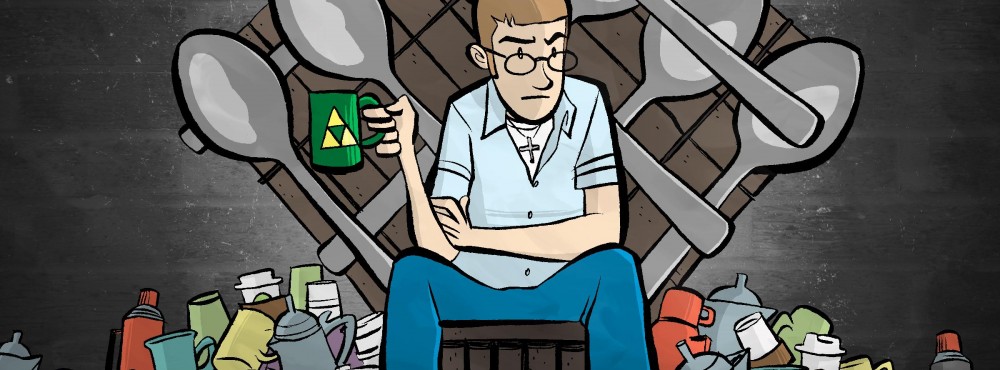
I talk too much.

This wouldn’t be a problem, except for one small detail: when I talk, most people feel obligated to listen. Some of my acquaintances have probably perfected the art of Tuning Out Adam, but the rest have no choice but to suffer politely through my ramblings, rants and dramatic monologues.

Even after I realized I talk too much, I didn’t think it was a serious fault. Pastors don’t preach sermons about the sin of talkativeness. The Lord Jesus didn’t warn against being too chatty. The Bible doesn’t have anything to say about rampant loquacity.

At least that’s what I thought.

Once, years ago, I contradicted a high school teacher about a passage of Scripture. A grim expression came over his face. He busted out a Bible. One of my classmates whispered, “Oh, Adam’s about to get Scripture-owned.” As it turned out, my teacher was absolutely correct. I was chastened, humbled and embarrassed.

Pretty much the same thing happened in regard to my tendency to talk too much.

Much to my discomfort, I kept finding verses in Scripture that suggest talking too much is a foolish thing to do.

Solomon had all kinds of things to say in the book of Proverbs.

“When words are many, sin is not absent, but he who holds his tongue is wise.”

“A man of knowledge uses words with restraint, and a man of understanding is even-tempered.”

“Even a fool is thought wise if he keeps silent, and discerning if he holds his tongue.”

New Testament writers were equally eloquent upon the subject.

“Do not let any unwholesome talk come out of your mouths, but only what is helpful for building others up according to their needs, that it may benefit those who listen,” wrote the Apostle Paul.

“Everyone should be quick to listen, slow to speak and slow to become angry,” wrote James the brother of Jesus.

Most discomforting were words spoken by the Lord Jesus himself: “But I tell you that men will have to give account on the day of judgment for every careless word they have spoken.”

Wait, I’ll have to give account for every careless word I’ve spoken? Every careless word I’ve ever spoken?

Dash it.

Once again, I got Scripture-owned.

One of my resolutions for this year is not to talk quite so much. Have I broken this resolution? Yes, yes I have. I’m still working on it.

69. That Time I Held a Severed Human Arm

For those of my readers who are squeamish, queasy or any of those other funny adjectives, this may be a good post to skip. You have been warned.

Long, long ago, when I was just a senior in high school, I took AP Biology, a college-level science course. It was fantastic. The other students and I were privileged to visit a cloud forest, travel to the Galápagos Islands, dissect fetal pigs and witness the dismemberment of a deceased human being.

Well, I suppose the removal of a single arm can hardly be called dismemberment, but I digress.

One fair morning I and the other students in AP Biology took a field trip to a local university. We were scheduled to meet a professor who would give us a guided tour of the human body using the university’s resident cadaver as a visual aid. (A cadaver is a corpse used for official purposes, such as police investigation or medical research.) The professor’s lecture would be a vital part of our scientific education, or so we were told by our teacher.

The plan was for us to enjoy Part One of the professor’s lecture in the morning, head back to school for our afternoon classes and return to the university the next day for Part Two.

We arrived at the university and filed into the laboratory to find the professor waiting for us. I don’t remember his name, so I’ll call him Dr. Frankenstein. A cadaver was stretched out on a slab. Dr. F’s assistant, whom I’ll call Igor, was bustling around the lab.

Dr. F had an interesting way of lecturing. The cadaver had been emptied of its organs; as in those Mummy movies, the organs were kept in jars. As Dr. F lectured, he took out the organs from their jars and put them back into the cadaver to show us where they belonged.

The lecture ended. Dr. F departed to teach a class, leaving Igor to put away the cadaver. As we watched, Igor removed the various organs from the cadaver and put them back in their jars. Then he detached the cadaver’s arm.

I was, I freely admit, a little shaken by this. Arms are usually attached more permanently. It was unnerving to see a cadaver disarmed—forgive the pun—so casually.

I was one of only two male students in my class. The other male student, whom I’ll call Socrates, was standing beside me when Igor pointed at him and asked, “Would you please help me put away the cadaver?”

Igor and Socrates hoisted the cadaver onto a stretcher, carried it into a back room and lifted it into its niche, leaving me to wipe the anxious perspiration from my brow and contemplate how close I’d come to the awful experience of carrying around a corpse.

The other students and I went back to school with our teacher. Next morning we returned to the university for the second part of the lecture. When we arrived, Dr. F was running late and Igor was still in the process of setting up the cadaver and its organ jars.

“Could you please help me get out the cadaver?” asked Igor, pointing at Socrates. I breathed a sigh of relief, only for Igor to add, “Oh, and could you reach into the niche and get the arm?”

The second request was very clearly directed at me. I had no choice but to reach into the niche (wearing gloves and a lab coat, of course) and retrieve the missing arm.

Alas, there is no photographic evidence of this event. I wish a photo could’ve been taken of me with the arm—one of those “Hey, look at this big fish I caught!” pictures—but the incident went unrecorded.

Dr. F arrived, gave the second part of the lecture and left. So did the other students and I, before Igor could request assistance from any of us.

I have many great memories from that AP Biology class. I’ve already written a post about one. Others I may post someday on this blog: That Time I Met a Wild Penguin and That Time I Saw a Hummingbird Wearing Go-Go Boots, to name but two.

However, of all the memories from AP Biology, That Time I Held a Severed Human Arm is one of my favorites. It’s certainly my favorite story to tell—as my longsuffering friends and relatives can testify.

The Infinity Manuscript, Part 2: The Tale of the Three Old Men

The first part of this story can be found here.

The Hourglass Tavern had little in common with its namesake, except in one respect: it was full of sand.

When a visitor to the Hourglass complained about the sandy floor, the tavern-keeper only shook his head and replied, “We tried keeping the Hourglass clean when we first opened it up, sir, but it was like plowing the sea. Every grain of sand we swept out blew right back in, don’t you know. Plowing the sea, sir.”

The Hourglass was one of two taverns in Green Isle. As a gesture of goodwill toward the citizens of the town, the Imperial Consul had sponsored the opening of a tavern called the Sea of Gold. Due to its high prices, the Sea of Gold catered exclusively to the upper class of Green Isle: a tiny clique of merchants, municipal officials and Imperial visitors.

The Cobbler, a toothless old man who lived on the outskirts of town, was one of many to complain about the Consul’s tavern.

“He must suppose we’re all rich folk here in Green Isle,” he told his friends, the Tailor and the Weaver, as they drank together in the Hourglass. “If the Consul’s trying to flatter the good citizens of our town, he’s making a fair mess of it. It’s only making poor folk feel poorer. You know why it’s called the Sea of Gold? A thirsty man needs a sea of gold to buy a drink there, that’s why.”

“Right you are,” said the Weaver, peering mournfully into his tankard. “I’m out of fire-nectar. Hand me the jug, Tailor.”

Grain being scarce in Green Isle, only two kinds of alcohol were readily available. The rich drank wine from the vineyards on the edge of the oasis. The poor—most of the inhabitants of Green Isle—drank fire-nectar, a rough liquor distilled from the sap of the cacti that grew in the desert. The Sea of Gold specialized in fine wines and boasted the best varieties of fire-nectar as a kind of local delicacy. The Hourglass served only fire-nectar.

The Cobbler, the Tailor and the Weaver, known in Green Isle as the Three Old Men, were patrons of the Hourglass. Little was known of them, though much was guessed. The Three Old Men did not have families or homes anywhere in the Empire. They had simply drifted to Green Isle, like battered driftwood to the beaches of a barren island, and become local curiosities.

Wherever they had come from, they had left their names behind them. They were addressed by their trades. Each of the Three Old Men performed his trade competently and made a comfortable living. When the day’s work was done, they left their workshops and took their usual place in a corner of the Hourglass.

The tavern-keeper liked the Three Old Men and the air of mystique they brought to his establishment. It was an unwritten rule of the Hourglass that the table in the back corner, the Table of the Three Old Men, was not to be occupied by any other customer during any hour of the evening.

The Tailor took a sip from his tankard. “I hear tell there’s a High Arbiter in town,” he remarked.

“I’d have thought it a false rumor, but I actually saw the bloke up at the Imperial Palace,” said the Cobbler. “Wonder what he’s here for. Green Isle’s not of any use to the Empire, except for filling her sandbags and hourglasses.”

The Tailor set down his tankard and addressed his companions solemnly. “It’s the Blight, it is,” he said. “Has to be. There were rumors of blighted wolves and vultures and cacti down southwest a ways.”

“Cacti?” inquired the Cobbler, grinning toothlessly. “The Blight’s turning cacti fierce, is it? I haven’t seen any wild cacti running amok here in Green Isle. Have you, Tailor?”

“There was a dispatch from the Imperial Laboratories yesterday,” said the Tailor. “The Blight’s affecting certain flora—that means plants, Cobbler, in case you didn’t know. Plants that get blighted fill with poison and grow thorns. Cacti, being a spiny sort of plant to start with, get a dashed lot spinier. Whatever poor bloke is pricked by a blighted plant dies in agony.”

The Weaver took a draft from his tankard. “I pray the Blight leaves our fire-cacti alone,” he said. “The gods alone know what the Blight would do to fire-nectar.”

“It’s alarming,” continued the Tailor, ignoring the Weaver. “It used to be the Blight just turned animals fierce.”

Fierce ain’t nearly strong enough a word,” exclaimed the Cobbler. “I think brutal more apt. Animals that get blighted turn, well, unnatural. Their teeth and claws and spines grow. They kill anything that breathes. Not to put to fine a point on it,” he concluded cheerfully, “beasts that get struck by the Blight turn into monsters.”

“Wonder what started it,” said the Tailor. “It’s been near three years that we’ve suffered the Blight. It started two years after the Imperial Conquest, I think.”

The Cobbler stopped grinning. “Aye, just two years after the fall of the Old Kingdom. I miss those days, lads, back when a king ruled over us and Imperial Consuls didn’t infest every town. The Empire’s a hard mistress.”

“Please let’s not talk about hard mistresses,” said the Weaver. “I’ve had enough of them to last me whatever life I’ve left.”

“You’re a dirty, dissolute scoundrel, Weaver,” said the Cobbler, grinning again. “I don’t know why the Tailor and I even let you drink with us. It’s bad for our reputation to be seen with such a notorious philanderer.”

The Weaver, who was accustomed to such insults, merely took another draft of fire-nectar.

“So the Old Kingdom fell to the Empire five years ago, and two years later the Blight started turning animals bad, and now it’s spreading to the plants,” said the Tailor. “I hear rumors of floods and earthquakes and gods alone know what other disasters rending the Empire. It’s a nasty state of things, to be sure.”

“You forgot something,” said the Weaver. “Jerem the Plague.”

The Cobber and the Tailor nodded. “Aye, he’s the worst of all,” said the Cobbler.

There was a screech of rusty hinges as the door to the Hourglass opened, admitting Innocent Freo and a sprinkling of sand.

“Innocent!” cried the Tailor, waving a hand. “Over here! Come and have a drink with us.”

The Three Old Men were divided in their opinions about Innocent. The Tailor liked him, believing him to be a fair-minded constable and a virtuous human being. The Cobbler thought of Innocent as merely a decent man. The Weaver, who was slightly afraid of Innocent, disliked him.

“It’s kind of you,” said Innocent, drawing up a chair.

The tavern-keeper, who shared the Tailor’s good opinion of Innocent, was at his side in a moment. “How may I serve you, Constable?” he asked, bowing.

“A large cup of coffee: three spoonfuls of milk, two of sugar and one of liquor. I could do with something strong this evening.”

“You seem on edge, my friend,” said the Tailor as the tavern-keeper scuttled away. “Is there anything the Three Old Men can do for you?”

“Just keep me company while I drink my coffee. I have to meet someone soon, but I’d rather not face him until I’ve had something to brace my nerves. Now, friends, please don’t let me interrupt your conversation.”

The Weaver glared at Innocent and said, “We were just talking about Jerem the Plague.”

“The Red Demon,” said the Tailor pensively. “The Paragon of Hell. No one has seen Jerem and lived to tell the tale, yet we have hundreds of descriptions of him. His body is said to burn with a red flame.”

“He has a beard of fire,” said the Weaver.

“I heard it was just his eyes,” said the Cobbler.

“No, it’s his beard,” insisted the Weaver.

“It’s probably his beard and eyes both,” said Innocent soothingly. “Please go on, Tailor.”

“They call Jerem the Plague because he wreaks devastation wherever he goes. Towns burned. Villages destroyed. Mountains of corpses. A real plague couldn’t do more harm than he.”

“They say Jerem is immortal,” said the Weaver.

“Nonsense,” exclaimed the Tailor. “Only the gods are immortal. No, Jerem is just a sorcerer with some kind of hell-magic.” The Tailor lowered his voice. “I have a theory,” he said, only to be interrupted by the arrival of the tavern-keeper with Innocent’s coffee. “I have a theory,” he repeated, glowering as the tavern-keeper retreated. “Jerem’s first crime was committed a little more than three years ago. The Blight appeared almost exactly three years ago. Do you understand? I think Jerem is the devil behind the Blight. He’s the bloke turning animals into monsters and plants into menaces.”

Innocent nodded gravely. “Perhaps,” he said, and sipped his coffee.

The Three Old Men continued chatting, only dimly aware that Innocent did not seem to be listening. At last Innocent finished his drink and stood.

“Thank you for your company,” he said. “I have a question for you before I go. I have a young friend looking for an apprenticeship: eleven years old, extremely good with his hands, takes great pride in his work. Do any of you have need of an apprentice?”

The Cobbler and the Weaver shook their heads, but the Tailor looked thoughtful. “Perhaps,” he said. “My old hands are getting a little shaky. I could use some help, provided he doesn’t need much pay.”

The necessary arrangements were made and Innocent prepared to go. “Must be waiting for me in the back room,” he murmured.

“Who’s waiting?” demanded the Cobbler.

Innocent smiled, though he looked a little shaken. “Just someone with whom I have business,” he said. “Good evening, friends.”

Innocent departed.

“Probably a woman,” muttered the Weaver.

The story continues with the third part, The Tale of the High Arbiter.

68. About Writing: Attitude

There was once a young man whom I’ll call Socrates.

(For the record, this was not the same Socrates as the one who pretended to tear out my heart or the one who gave me an RNA or the one who invented the Socratic method. This is a different Socrates.)

Socrates was a creative writer. A couple of years ago, we had a discussion about our writing projects. It turned out that we had both written fantasy novels and were in the process of revising our work. When Socrates heard about my novel, he offered to read it and offer feedback. I accepted his offer gratefully and gave him a manuscript of my novel.

A few days later, he handed me the manuscript of his novel and told me he was looking forward to hearing my criticism. This came as a surprise to me. I didn’t mind criticizing his novel, but he hadn’t asked for criticism and I hadn’t offered it. He simply gave me the manuscript and expected feedback.

It occurred to me that Socrates might have offered to read my novel only for the sake of obligating me to read his.

Nevertheless, I believed creative writers should stick together. If another creative writer wanted my criticism, I was happy to give it. Thus I plunged into the novel Socrates had written, marking his manuscript with mechanical pencil and thinking about what feedback to give him.

It was not a good novel. The novel had its strengths, of course, but it also had many weaknesses. The most glaring of these were myriad misspellings and grammar mistakes: the sort of errors a spellcheck program wouldn’t catch. Apart from typographical errors, the novel had a number of significant problems.

When criticizing a piece of writing, I believe it’s important to be honest and kind. Honesty can be carried to the extreme of disparagement. Kindness can be carried to the extreme of flattery. Neither disparagement nor flattery are helpful to a writer. As I read the manuscript of the novel, I tried to think of criticisms that would be helpful to Socrates.

I finished the manuscript and sent Socrates an email in which I commended the novel’s strengths, pointed out a few of its faults and suggested changes that could be made.

Socrates replied with an email in which he thanked me for my feedback, responded offhandedly to a few of my criticisms and promised to return the favor by giving me feedback on my novel. (He never did.) Regarding his own novel, he mentioned his intention to “go and work on it once more before I try to find a publisher.”

To be honest, I was left with rather a poor impression of Socrates as a creative writer. The mediocre quality of his writing had little to do with it. When I began writing, the quality of my writing was unspeakably awful. Every writer has to start somewhere, and that somewhere is usually pretty bad. As Jon Acuff once observed, the road to awesome always leads through the land of horrible.

No, my poor impression of Socrates came from his attitude toward writing. In our exchanges, I noticed several problems with his attitude—problems that are common among writers—problems of which I myself have often been guilty.

Writers shouldn’t use other people

It’s extremely important for writers to seek help from others. There is a difference, however, between seeking help from someone and using someone. In my exchanges with Socrates, it seemed that he offered to read my manuscript only to manipulate me into reading his. Writers should never consider other people mere tools or resources. The writer who criticizes my manuscript isn’t a feedback machine. The readers who follow my blog aren’t a statistic. These people are human beings with feelings and opinions and gifts. Treating them as mere tools or resources is wrong.

Writers should respect their readers enough to give them their best work

It’s not a huge deal, but I prefer not to read a manuscript full of typographical errors. I would have enjoyed the manuscript Socrates gave me much more had he taken the time to make sure it was at least written correctly.

Writers should be willing to accept criticism, especially when they ask for it

I received the impression from Socrates that he didn’t really care much for my criticism. I wouldn’t have minded much, except for two things. First, I had taken a lot of time to read his novel and give the best feedback I could. Second, he had asked specifically for my criticism. To ask for it, and then not to accept any of it, seemed a little rude. Writers shouldn’t blindly accept every bit of criticism they receive, but they should at least consider it—especially when they’ve asked for it.

Writers should help each other

Socrates offered to read my novel and give feedback, but he never did. Granted, he may have forgotten or been too busy, but our exchanges seemed unfairly one-sided. If writers accept help from others, they should also be willing to give help.

Writers should be realistic

When Socrates informed me that his plan for his manuscript was to “go and work on it once more before I try to find a publisher,” I had to shake my head. Even if his manuscript weren’t full of typographical errors, he would have had to revise it at least a few more times before it was even close to being presentable to publishers. Then he would have to begin the arduous process of finding a publisher: research the market, find an agent, write a novel proposal, find a publisher, sign a contract, submit the manuscript for editing, make necessary revisions, format the manuscript, promote the novel and so on. Writers mustn’t be daunted or discouraged by the difficulties of publishing, but they mustn’t be unrealistic either.

If it seems like I’m being pretty harsh toward Socrates and his attitude toward writing, I need to point out that I’ve made all of his mistakes myself. I’ve used people. I’ve given other people less than my best writing, been unwilling to accept good criticism and refused to help other writers. As for being unrealistic, I’ve been ridiculously naïve about the quality of my writing and the difficulty of publishing.

Here are two more mistakes I’ve made.

Writers shouldn’t assume their writing is awesome

Writers have a tendency to fall in love with their own writing because it’s exactly the kind of thing they enjoy reading. I like wry, thoughtful writing. I also like fantasy fiction. My novel happens to be a wry, thoughtful fantasy. It’s the sort of novel I would enjoy reading—but it may not be the sort of novel everyone else in the world would enjoy reading. Writers need to follow the Apostle Paul’s good advice: “Do not think of yourself more highly than you ought, but rather think of yourself with sober judgment.”

Writers shouldn’t assume their writing is awful

Writers also have a tendency to give up because they assume their writing is bad. Sometimes it is, and they need to keep practicing. Sometimes it isn’t, and they need to keep writing well. It’s difficult for writers to assess the quality of their own writing, which is why seeking help from others is so important.

It’s essential for writers to have the right attitude: to persevere, to be humble, to be willing to seek help, to be willing to give help and so on.

Have you struggled with any of these attitude problems? How do you deal with them? Let us know in the comments!