402. Five Blessings of Being a Single Guy

So, um, I seem to have misplaced today’s blog post. Mea culpa.

Today’s post wound up on I’m Bringing Celibacy Back, a blog that belongs to my friend Robby Rasbaugh. (He’s a really cool dude, and has awesome hair.) I’m Bringing Celibacy Back is a funny, sassy, well-written series of commentaries on marriage, singleness, Christianity, culture, and underrated Disney couples.

My latest post, “Five Blessings of Being a Single Guy,” can be read here!

They Have Their Exits

A Tragedy

Hector Cage sat alone in a padded room. “Shut up,” he growled, clamping his hands over his ears. “Shut up!” He closed his eyes and ground his teeth together.

“If I hear one more word—one more word—I’m going to scream,” he said.

He screamed.

The door opened. Dr. Lopez stepped into the room to find his patient howling at the ceiling. “Hector!” he said sharply. “What’s wrong?”

“I’ve told you and told you and told you, but you won’t listen!”

Dr. Lopez knelt next to the insane man.

“I’m not insane!” screamed Hector, scrambling away from the psychiatrist.

“I didn’t say that.”

“You didn’t. He did.”

The psychiatrist frowned. Hector was getting worse.

The madman giggled hysterically. “Of course I’m getting worse. Weeks in a padded room will do that to anybody. You try living here and see how you like it.”

Dr. Lopez extracted some coins, a pen, and a ring of keys from his pants pocket. After placing the pen behind his ear, he stuffed the rest back into his pocket and searched his coat for a notebook. He found one wedged behind his phone, and carefully fished it out.

Hector had not taken his hands from his eyes.

“You think I’m crazy,” he babbled, “but I can prove the Narrator exists. He said what you have in your pockets. Coins and keys, in your pants pocket. I didn’t look. I swear. He told me.”

Dr. Lopez shrugged. “Nobody said anything, Hector,” he said, speaking in the gentle, condescending tone usually reserved for children. “Are you sure you weren’t peeking through your fingers?”

“Phone,” murmured Hector. “In your coat pocket. I didn’t see it. You never took it out.”

The psychiatrist raised his eyebrows. “You’re a good guesser, Hector. I’m impressed.”

“Didn’t guess,” insisted Hector, shaking his head violently. “Narrator said it was there in your pocket.”

“So the Narrator talks to you,” said Dr. Lopez, taking the pen from behind his ear. He opened the notebook to a blank sheet.

“Not to me,” said Hector. “He narrates the story.”

“What story?”

This story. The story in which we’re characters. I hear him narrating.”

“That reminds me of Shakespeare,” said Dr. Lopez, trying to change the subject. “Shakespeare wrote, ‘All the world’s a stage, and all the men and women merely players.’ Tell me, Hector, have you ever read Shakespeare?”

The psychiatrist disliked Shakespeare, but wanted to steer conversation toward a neutral subject. The patient’s delusions were upsetting him. Hector needed to calm down.

“I do not,” said Hector, sulking. “I have every reason to be upset. Changing the subject won’t change that.”

Dr. Lopez felt an uncomfortable tightness in his chest. Damned heart problems. Why did Hector insist on being so difficult? To keep himself calm, the psychiatrist began sketching in his notebook. A butterfly was the most peaceful thing he could think of. Very slowly and deliberately, he drew a blue morpho in a corner of his notepaper.

“Very slowly and deliberately,” intoned Hector, whose eyes were still shut, “you drew a blue morpho in a corner of your notepaper. The heck is a blue morpho? Some kinda butterfly? Whatever it is, you drew it.”

The psychiatrist shuddered. “Another good guess. You’re good at guessing, Hector.”

“Lucky me,” said Hector.

Dr. Lopez fought to keep his temper. “Hector, I’m going to be honest. I don’t feel well today, and I’m not in the mood for games. I want to help you, but you’ve got to help me. You can start by—”

He stopped for breath, and realized how much the pain in his chest had grown.

“We’re just characters in a story,” said Hector. “You know it, don’t you? I think you just don’t want our story to end. You know that when it does, we won’t exist anymore, except in the memory of the reader.”

Breathing deeply, Dr. Lopez forced himself to calm down. “That’s an interesting idea, Hector, but I don’t believe it’s true.”

“Of course,” mused his patient, “our quaint little story might be a tragedy. It sure isn’t a comedy—hell, do you feel like laughing? Today’s parable might end in our deaths. Even if it doesn’t, we’ll end when it does. We’re screwed either way. The Author will get bored with us, make some new characters, get bored with them, and continue the morbid cycle of creation and abandonment, like a god with ADHD.”

The psychiatrist began to write with short, jerky strokes. The pain in his chest refused to go away.

“Tell me, Hector, what’s the difference between the Author and the Narrator?”

“They’re the same,” said Hector, as if explaining to a toddler that two and two made four. “Use your head, won’t you? Use it while you still can.”

Holding the notebook out of Hector’s sight, Dr. Lopez scribbled the date and the following words:

Patient: Hector Cage. Condition worsening. Still hearing voices. Metafictional delusion persists. Morbidly preoccupied with death and nonexistence—experiencing suicidal ideation? Keep on self-harm watch in Personal Safety Room. Probable diagnoses: depression, schizophrenia

“I do not have schizophrenia!” yelled Hector. “You’ve locked up the only sane man on Earth, and schizophrenia is your best diagnosis? And you think I’m crazy!” He pounded the wall with his fist, and then threw himself on the floor: a shattered wreck.

“I’m not a shattered wreck,” he sobbed to the ceiling.

Dr. Lopez took a few deep breaths. He felt very sick. “Listen, Hector,” he said as gently as he could. “You and I, we’re going to work through this. We’re going to—to—”

He stopped. The pain in his chest had spiked. He fought to breathe, and felt himself blacking out.

Hector sat up. “I guess this is a tragedy,” he said, suddenly calm. “Rough luck.”

Dr. Lopez crumpled to the floor.

Hector stood, wiping his eyes with the back of his hand. “I’ll get someone,” he sniffled. “Not that it matters.” He stumbled to the door and shouted for help. A nurse came running, and gasped at the sight of the psychiatrist sprawled over the padded floor.

“What did you do?!” she demanded.

“I told the truth,” said Hector. “Better call some help, hadn’t you? There’s a phone in his coat pocket.”

With that, he took off down the hallway.

Ten minutes later, Dr. Lopez was on his way to the emergency room. Nurses and aides gathered in the hallway, chattering with the euphoria of tragedy averted. “You’re a hero, Liz!” cried an assistant, hugging the nurse who called the ambulance. “You saved his life! Dr. Lopez would have died if you hadn’t found him in time.”

“His patient yelled for help,” said the nurse. “The guy ran off in the hubbub. They’re looking for him now, but I kinda hope he gets away. He saved Dr. Lopez—how bad can the guy be?”

“Not so bad, I guess,” replied Hector Cage from beneath a pine tree half a mile down the road. He sat in tall grass, breathing heavily, chewing a clover blossom, and looking up at the big blue sky.

“It’s funny how the madmen are the ones with a grip on reality,” he said. “Poor old Noah and Socrates and Jesus, and all those Minor Prophets. All crazy. Never mind. It doesn’t matter. I’m alive and free, free, free as a bird. No more padded rooms. Just I and the sky and the world at my fingertips.”

Hector spat out his clover, wiped his eyes, and closed them in tired resignation.

“Such a pity I won’t get to enjoy it.”


Author’s Note:

I wrote this one back in college, around five years ago. Those days are a brightly-colored blur. I don’t remember much about this story—I don’t remember much of anything, really—but I recall pondering the idea that a totally self-aware fictional character would probably be locked up as a lunatic.

Think about it. If your neighbor or coworker told you we were all just characters in someone’s story, would you believe her? I wouldn’t. In fact, I’d nope out of there as quickly as possible, and avoid all eye contact with that person in future.

I rescued this story from my personal archive: a dismal place, littered with false starts and abandoned ideas from high school and college. This story seemed salvageable, so I updated and edited it, because recycling is good for the environment. Planet Earth is the only one we’ve got, after all.

401. Operation Yuletide

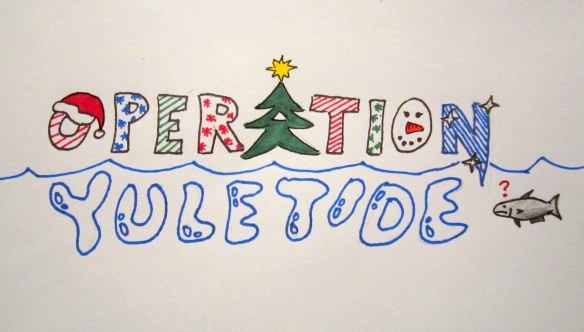
Operation YuletideWhat in the heck is Operation Yuletide?

Operation Yuletide is a Christmas charity fundraiser sponsored by this blog.

Another charity fundraiser? Didn’t you do one last Christmas?

Yes. Yes, we did.

Why are you doing another one?

Short answer: People need help.

Slightly-longer-but-still-pretty-short answer: A number of years ago, I heard about the Advent Conspiracy: a movement in which people raise donations for charities instead of asking for Christmas gifts. In other words, the Advent Conspiracy takes some of the money that goes toward holiday shopping and puts it toward helping people.

Helping people how?

The Advent Conspiracy benefits all kinds of charities. TMTF’s fundraiser, Operation Yuletide, is raising money through a Christian organization called Living Water International to provide clean water to people in impoverished areas.

PrintWater? Why water?!

Clean water is one of the world’s most valuable and desperately-needed resources. Safe access to clean water prevents disease, saves lives, enables better education, transforms communities, and brings hope to poverty-stricken areas.

Besides, fresh water is necessary for making coffee. Everybody deserves a cup of coffee, especially at Christmas!

Can’t you discuss anything without mentioning coffee? You have a problem.

I do not have a problem. I get up, I drink coffee, I feel better—no problem.

So this fundraiser, Operation Yuletide, is raising money to provide clean water to poverty-stricken people.

Yup. I named it Operation Yuletide because it’s giving clean water for Christmas. Get it? Yuletide, tide, water. It’s a pun!

I hate you.

We have a mascot and everything. Meet Oswald Grimm.

Oswald Grimm

That’s your mascot? Yeesh.

Oswald is one of Santa’s elves. Well, at any rate, he was. He’s between jobs. Look, Oswald Grimm is all I could afford, okay? This blog doesn’t exactly have a high budget.

Speaking of your blog, where does TMTF fit into all this?

We’re sponsoring the fundraiser, and providing rewards for people who donate.

What kind of rewards?

Well, um, pretty much all the same ones as last year. Donor rewards are divided into tiers. Here they are!

Give $1 or more: Droplet Tier!

Receive a public thank-you on this blog, and bask in the satisfaction of making the world a better place!

Give $5 or more: Trickle Tier!

Receive a personalized thank-you message, sent to the email address of your choice! How nice! All previous rewards are included.

Give $10 or more: Splash Tier!

Receive a personalized thank-you card, sent to the mailing address of your choice! A welcome change from bills and junk mail! All previous rewards are included.

Give $20 or more: Wave Tier!

Receive a brief video in which I thank you personally! Catch a rare glimpse of this blog’s introverted writer and his bespectacled face! The video will be sent as an email attachment or web link to the email address of your choice. All previous rewards are included.

Give $30 or more: Cascade Tier!

Receive an original blog post, or an original poem, on any subject you choose! Receive a guest post for your blog or satisfy your poetic fancy! You may feature this blog post or poem anywhere (or nowhere) on the Internet. All previous rewards are included.

Give $50 or more: Tsunami Tier!

Receive an original short story written to your personal specifications! You choose anything and everything: characters, setting, theme, plot, etc. Enjoy an original story, or bring your wildest, fan fiction-est ideas to life! You may feature this story anywhere (or nowhere) on the Internet. All previous rewards are included.

I can’t guarantee the donation page will track donor information, so send me a message via this blog’s Contact page after donating to make sure you get your rewards!

Let me get this straight. You’re bribing people to throw money at you.

Not at all. I’m thanking people for donating money to give clean water. All donations go to clean water projects sponsored by Living Water International. We at TMTF shan’t receive a penny! This is our little contribution to the Advent Conspiracy. We enjoy being conspiratorial.

Advent ConspiracyIf I donate, when can I expect to get my rewards?

You’ll get ’em as soon as I can finish ’em. I’m afraid I can’t offer any estimated delivery dates.

Does your fundraiser have a definite goal?

The goal is $700 USD.

Flipping heck, that’s a lot of cash—not to mention a weirdly specific number.

I wanted to aim for more than $500, but $1,000 seemed overoptimistic, so I settled on $700. I don’t know if we can reach it, but we can try!

How long will the fundraiser last?

Operation Yuletide will end shortly after Christmas. We’ve got one month to make the world a better, wetter place!

Didn’t you support two charities with last year’s fundraiser? Besides the clean water one, wasn’t there a charity for kids? Why aren’t you supporting it this time? Do you hate kids? You monster!

Hardly anyone donated to the kids’ charity last year, and its website wasn’t very user-friendly. Besides, it was a headache to manage two separate charities in a single fundraiser on top of the usual December craziness.

Fine. How can I support Operation Yuletide?

TMTF now has a button (or widget if you want to be technical) on the top right-hand side of the homepage that will take you to Operation Yuletide’s donation page.

Are you done rambling, or do you have any final thoughts?

Clean water saves lives. I can’t stress this enough. I believe that we, together, can do something to bring life and hope to people in desperate need this holiday season.

Please consider giving clean water this month, and spread the word! A murry Christmess merry Christmas to you all!

OPERATION YULETIDE IS GO!

Adam Turns into the Hulk and Rants about Black Friday

Caution: This blog post contains furious ranting. Sensitive readers, and readers averse to things being smashed, are advised not to continue.

It’s that time of year again. Today is the day I stay inside, bolt the door, drink tea, and reflect upon the injustices of the world. Of all these, one of the greatest is that Black Friday, America’s annual celebration of consumerism, takes place on the day after Thanksgiving.

Look, Black Friday has every right to exist. I may not like the event, but I don’t think it’s inherently bad. Black Friday is a great opportunity for businesses to make money, and an equally great opportunity for consumers to buy things cheaply. Everybody wins. There are few problems, except for the fact that Black Friday now eclipses the one day we set apart for being thankful.

Black Friday’s timing is the worst kind of irony. It’s infuriating. The whole thing… I mean… it’s so frustrating… it makes my stomach hurt…

BLOG SMASH!

HULK TIME! CAPS LOCK ACTIVATED!

BLACK FRIDAY HAS WORST TIMING OF ANY EVENT IN UNIVERSE. HULK WOULD SMASH BLACK FRIDAY, BUT CRAZED SHOPPERS ALREADY CAUSE ENOUGH DAMAGE.

HULK ADMIT BLACK FRIDAY ITSELF IS NOT BAD. EVEN ITS TIMING AFTER THANKSGIVING MAKE SENSE—PEOPLE HAVE DAYS OFF FOR HOLIDAY AND CAN SHOP FREELY. DAY AFTER THANKSGIVING IS ALSO START OF CHRISTMAS SHOPPING SEASON AND CONVENIENT DAY FOR BUYING THINGS.

DAY AFTER THANKSGIVING IS ALSO STUPID DAY FOR BUYING THINGS.

THANKSGIVING IS ONE DAY OF YEAR WE SET ASIDE TO BE THANKFUL. THANKSGIVING IS NOW OVERSHADOWED BY CRAZY CONSUMERISM. BEAUTIFUL HOLIDAY IS NOW CLUTTERED WITH AGGRESSIVE ADS FROM BUSINESSES TO BUY MORE AND SPEND MONEY AND GET STUFF. MESSAGE OF NOVEMBER MONTH IS NO LONGER “Relax, rejoice, and be thankful” BUT “You can buy a TV for 70% off at Wal-Mart—OMG, guys! Go buy it! Buy it now!”

THANKSGIVING IS NO LONGER QUIET DAY TO EAT AND BE THANKFUL AND SPEND TIME WITH FAMILY. THANKSGIVING IS NOW DAY OF PREPARATION FOR BLACK FRIDAY.

SOME STORES NOW EVEN OPEN ON THANKSGIVING DAY! HULK ASK AMERICA: IS NO THING SACRED?! YOU NOT SATISFIED TO ECLIPSE THANKSGIVING? YOU MUST STIR UP GREED AND FRENZY ON THANKSGIVING DAY ITSELF?!

BLACK FRIDAY IS DAY OF CHAOS AND VIOLENCE. PEOPLE GET ANGRY. PEOPLE GET HURT. PEOPLE HAVE DIED. HULK USUALLY MAKE POINT BY SMASHING THINGS, BUT SHOPPERS TODAY BEAT HULK AT HULK’S OWN GAME.

THIS DAY OF GREED, SELFISHNESS, VIOLENCE, STRESS, AND NOISE CASTS SHADOW OVER THANKSGIVING: DAY OF PEACE, REST, JOY, FEASTING, AND FUN. BLACK FRIDAY COULD BE ANY DAY BEFORE CHRISTMAS HOLIDAY.

HULK ASK AMERICA: WHY CHOOSE DAY AFTER THANKSGIVING FOR SHOPPING DAY? WHY DISTRACT FROM PEACE AND THANKFULNESS WITH WORRY AND GREED? WHY? WHY?!

HULK NOT UNDERSTAND. HULK NEVER UNDERSTAND.

HULK BEG PEOPLE EVERYWHERE. PLEASE. HONOR THANKSGIVING. REST. EAT. BE THANKFUL. AND IF YOU SHOP ON BLACK FRIDAY: BE KIND AND RESPONSIBLE.

HULK OUT!

Whoa, that was disorienting. Did I turn into the Hulk again? I blame the mutagenic effects of my wireless Internet connection—it may not be as dangerous as gamma radiation, but it sure does the trick. I suppose violent, unpredictable mutations are a cross we bloggers must bear. Well, I had better go put on a shirt.


This post was originally published on November 28, 2014. TMTF shall return with new content on November 30, 2015!

Jesus Christ and Admiral Ackbar

Then the Pharisees went out and laid plans to trap him in his words.

~ Matthew 22:15

Meet Admiral Ackbar.

Admiral AckbarThe Admiral is a minor character from a Star Wars film. Although he presumably has a life beyond the few scenes in which he appears, he is remembered for one thing and one thing only.

He proclaims, with a glassy-eyed expression of dazed astonishment, “It’s a trap!”

Admiral Ackbar, the ever-useful trap detector, was absent in the days of Jesus Christ. Fortunately, the Lord was shrewd enough to detect a trap without the advice of Star Wars characters.

Quite a number of people disliked Jesus, you see. Two religious groups, the Pharisees and Sadducees, hated the way his teachings upset the balance of things. They wanted him gone—disgraced—dead. These religious groups resorted to all kinds of underhanded traps to bring down the controversial upstart called Jesus Christ.

I find it hilarious, and extremely impressive, how the Lord Jesus dodged every trap with bravado and brilliance.

The Pharisees watched Jesus closely on the Sabbath, the divinely-ordained day of rest, to see whether he would heal a crippled man and thereby dishonor the day by “working.” Jesus didn’t heal anyone secretly. He was way too cool for that. Instead, he had the crippled man stand up in front of everyone and healed him in the most public way possible, pointing out that doing good on the Sabbath is more important than merely following regulations. (See Luke 6:6-10.)

It happened again and again. Even without Admiral Ackbar’s insight, the Lord Jesus never fell for a trap.

The priests demanded to know who gave Jesus his authority. If he claimed it came from God, they could accuse him of blasphemy. If he gave some other answer, or simply refused to reply, they could claim his teachings carried no weight.

Jesus answered this trick question with one of his own: “I will also ask you one question. If you answer me, I will tell you by what authority I am doing these things. John’s baptism—where did it come from? Was it from heaven, or of human origin?”

The priests were baffled: “If we say, ‘From heaven,’ he will ask, ‘Then why didn’t you believe him?’ But if we say, ‘Of human origin’—we are afraid of the people, for they all hold that John was a prophet.”

They couldn’t answer his question, so Jesus declined to answer theirs. (See Matthew 21:23-27.)

“Is it right to pay the imperial tax to Caesar or not?” demanded the Pharisees. If he answered “Yes,” they could accuse him of being a sellout to the Roman authorities. If he answered “No,” they could get him into trouble with those authorities.

He pointed out that Roman coins came from Caesar in the first place and said, “Give back to Caesar what is Caesar’s, and to God what is God’s”—an answer with which neither Romans nor Jews could find fault. (See Matthew 22:15-22.)

The Sadducees added a trap of their own, but Jesus kept his cool.

If a woman is married more than once, they asked, whose wife will she be in the afterlife? By this question, the Sadducees (who didn’t believe in life after death) meant to discredit Jesus and his teachings.

Jesus’ answer? There is no marriage in the afterlife. Take that, Sadducees! (See Matthew 22:23-33.)

One trap stands out among the others. It was a matter of life or death. A woman had been caught in an affair. According to Old Testament laws, she deserved to die. However, in Jesus’ day, Jews couldn’t sentence anyone to death without consent from the Roman authorities. (This is why Jesus was taken to Pilate, a Roman official, to be condemned to be executed after the Jews had already declared him worthy of death.)

If Jesus said the woman should die, he would break Roman law. If he said the woman should live, he would break divine law. There was no way out. It was a trap even Admiral Ackbar could not avoid.

Go ahead, said Jesus. Execute the woman according to Jewish law—but let someone who hasn’t sinned begin the execution.

With infinite calm, Jesus called their bluff. They could threaten to kill the woman—perhaps even watch her die—but not one of them could carry out the execution with a clean conscience. One by one, they slipped away. (See John 8:3-11.)

“Woman, where are they?” asked Jesus at last. “Has no one condemned you?”

“No one, sir,” she replied, perhaps trembling in fear and awe.

“Then neither do I condemn you,” declared Jesus. “Go now and leave your life of sin.”

I find it fascinating that Jesus gave tricky answers only to trick questions. When a Pharisee finally asked him a fair question, Jesus’ answer was honest and straightforward.

What, asked the Pharisee, is the greatest commandment in God’s law?

Love God and love others, answered Jesus.

That, dear readers, is not a trap.


This post was originally published on May 29, 2013. TMTF shall return with new content on November 30, 2015!

Strange American Turkey Rituals

As much as I like the United States of America, I’m confused and disturbed by some of its customs. (The traditions in my homeland of Ecuador seemed so much simpler.) For example, Americans will celebrate a festival of ritualistic gluttony known as Thanksgiving in just a few days.

We at Typewriter Monkey Task Force pride ourselves on our anthropological researches. Although we generally reserve our investigations for important matters such as geek culture and cartoons for little girls, we’re expanding our vision to cover American holidays. Our research is completely authentic, and presented in a factual manner utterly devoid of humor, sarcasm, or silliness.*

As I recovered from last month’s sinister pumpkin rituals, I heard disquieting rumors of a November celebration for which Americans gather to disembowel turkeys and observe brutal bouts of gladiatorial violence. Halloween was odd, but Thanksgiving truly takes the cake… or the pie in this case.

Let’s start with the turkeys.

Turkey sacrifice

I’m guessing this is some kind of ritual sacrifice.

According to tradition, many American families prepare a turkey for the Thanksgiving festival. The bird is slaughtered and disemboweled. Then, in a macabre twist, its innards are replaced with a mixture of dried bread and spices. Thus desecrated, the turkey’s carcass is placed in an oven, cooked, and then served as part of the traditional Thanksgiving meal.

I can only speculate that the Thanksgiving turkey is a sacrifice offered as an act of thanksgiving for a good year, hence the name of the holiday. Note that the bird is not immolated as a burnt offering. It is eaten instead by participants in the Thanksgiving festival. I can only infer that the turkey’s ceremonial function is similar to the wave offering prescribed for ancient Israel in the earlier books Old Testament: an offering dedicated, but eaten instead of burned.

The sacrificial turkey is generally served with foods such as mashed potatoes, gravy, ham, corn, bread rolls, pies, and sauerkraut. (I presume sauerkraut is eaten because it has ceremonial significance; I can hardly imagine anyone actually liking the stuff.) Collectively, these foods are called Thanksgiving dinner.

Thanksgiving dinner is often devoured with reckless enthusiasm. This annual display of gluttony occurs so widely that it may be ritualistic. Worship has taken many forms in different epochs and cultures: singing, dancing, praying, meditating, offering sacrifices, making pilgrimages, giving alms, and even inflicting self-harm. Could overeating be a form of worship unique to the Thanksgiving festival? Of course, these are just speculations.

The final custom we will examine is that of football.

This display of unbridled savagery baffles me.

This so-called game, a demonstration of unbridled savagery, baffles me.

This athletic event is not to be confused with the sport of the same name, known as soccer to Americans. Having done a little research, I have concluded that American football is a gladiatorial competition in which armored men ram into each other on a field. Their goal is to take, by means of extreme force, an elliptical object that seems to be the eponymous football. This football is carried by hand, not propelled by foot, rendering the origin of its name an incomprehensible mystery.

We conclude that Thanksgiving is an appalling display of gluttony, violence, and unexplained rituals. However, in the interests of anthropological study, we intend to sample Thanksgiving dinner this year. For science.

*Nah, we’re just kidding.


This post was originally published on November 24, 2014. TMTF shall return with new content on November 30, 2015!

That Time I Held a Severed Human Arm

For those of my readers who are squeamish, queasy or any of those other funny adjectives, this may be a good post to skip. You have been warned.

Long, long ago, when I was just a senior in high school, I took AP Biology, a college-level science course. It was fantastic. The other students and I were privileged to visit a cloud forest, travel to the Galápagos Islands, dissect fetal pigs and witness the dismemberment of a deceased human being.

Well, I suppose the removal of a single arm can hardly be called dismemberment, but I digress.

One fair morning I and the other students in AP Biology took a field trip to a local university. We were scheduled to meet a professor who would give us a guided tour of the human body using the university’s resident cadaver as a visual aid. (A cadaver is a corpse used for official purposes, such as police investigation or medical research.) The professor’s lecture would be a vital part of our scientific education, or so we were told by our teacher.

The plan was for us to enjoy Part One of the professor’s lecture in the morning, head back to school for our afternoon classes and return to the university the next day for Part Two.

We arrived at the university and filed into the laboratory to find the professor waiting for us. I don’t remember his name, so I’ll call him Dr. Frankenstein. A cadaver was stretched out on a slab. Dr. F’s assistant, whom I’ll call Igor, was bustling around the lab.

Dr. F had an interesting way of lecturing. The cadaver had been emptied of its organs; as in those Mummy movies, the organs were kept in jars. As Dr. F lectured, he took out the organs from their jars and put them back into the cadaver to show us where they belonged.

The lecture ended. Dr. F departed to teach a class, leaving Igor to put away the cadaver. As we watched, Igor removed the various organs from the cadaver and put them back in their jars. Then he detached the cadaver’s arm.

I was, I freely admit, a little shaken by this. Arms are usually attached more permanently. It was unnerving to see a cadaver disarmed—forgive the pun—so casually.

I was one of only two male students in my class. The other male student, whom I’ll call Socrates, was standing beside me when Igor pointed at him and asked, “Would you please help me put away the cadaver?”

Igor and Socrates hoisted the cadaver onto a stretcher, carried it into a back room and lifted it into its niche, leaving me to wipe the anxious perspiration from my brow and contemplate how close I’d come to the awful experience of carrying around a corpse.

The other students and I went back to school with our teacher. Next morning we returned to the university for the second part of the lecture. When we arrived, Dr. F was running late and Igor was still in the process of setting up the cadaver and its organ jars.

“Could you please help me get out the cadaver?” asked Igor, pointing at Socrates. I breathed a sigh of relief, only for Igor to add, “Oh, and could you reach into the niche and get the arm?”

The second request was very clearly directed at me. I had no choice but to reach into the niche (wearing gloves and a lab coat, of course) and retrieve the missing arm.

Alas, there is no photographic evidence of this event. I wish a photo could’ve been taken of me with the arm—one of those “Hey, look at this big fish I caught!” pictures—but the incident went unrecorded.

Dr. F arrived, gave the second part of the lecture and left. So did the other students and I, before Igor could request assistance from any of us.

I have many great memories from that AP Biology class. I’ve already written a post about one. Others I may post someday on this blog: That Time I Met a Wild Penguin and That Time I Saw a Hummingbird Wearing Go-Go Boots, to name but two.

However, of all the memories from AP Biology, That Time I Held a Severed Human Arm is one of my favorites. It’s certainly my favorite story to tell—as my longsuffering friends and relatives can testify.


This post was originally published on February 24, 2012. TMTF shall return with new content on November 30, 2015!

The Best History Lesson in the History of History

Never before has video game history been so awesome… or so darn catchy.

Fun Fact: Nintendo existed for nearly a century before it began producing video games. It dabbled in everything from card games to cab services before striking gold with franchises like Donkey Kong, Super Mario Bros. and Legend of Zelda in the eighties.


This post was originally published on September 18, 2013. TMTF shall return with new content on November 30, 2015!

Leviticus Is Really Bloody

Of all the books in the Old Testament, Leviticus has a reputation for being tedious. What nobody seems to remember is that it’s also really, really gory.

Rated M

The Holy Bible: Rated M for intense violence, blood and gore, and sexual content.

I’ve been revisiting Leviticus lately, and it’s a grim read. Among the dull regulations for religious rituals are rules for sacrifices, which involve slaughtering livestock, cutting them into pieces, burning them, and splattering their blood in all kinds of interesting and unexpected places.

I often picture places of worship in the Old Testament as peaceful, churchlike sanctuaries smelling of incense, where immaculately-dressed priests walk quietly and speak in whispers.

Examining what Scripture actually says gives quite a different picture.

Livestock were killed for a wide variety of offerings, and the priests did at least some of the slaughtering. I sometimes think of Old Testament priests as pastors, but they seem more like butchers. Israel’s places of worship were likely deafening with the frantic bleats of dying animals, pervaded by the smell of burning meat, and speckled with dried blood.

Revisiting Leviticus, and reading the Bible generally, challenges my faith. Christian culture hardly ever mentions, let alone dwells upon, the nastier bits of the Bible—and dang, the Bible sure can be nasty. It’s nicer to think about the Sermon on the Mount, or the Christmas story, or the pleasanter Psalms.

We so often have preconceived ideas of what’s in the Bible without ever taking a look, or bothering to think about what we find.

Do any of the Sunday school teachers who put up cutesy pictures of Noah’s Ark remember that the Flood drowned nearly every person on earth? Do any of the people who share inspirational verses from Job recall how his life was shattered, his health was broken, and his children were crushed to death? Anybody?

Leviticus troubles me. Yes, I know that “without the shedding of blood there is no forgiveness.” It costs something. In the end, forgiving us cost God everything in the death of Jesus Christ. I get that. All the same, I’m bothered by the thought of God commanding the incessant, daily slaughter of helpless animals as a form of worship.

These challenging chapters in Leviticus remind me that lot of things in Scripture trouble me, and some surprise me—and many give me unexpected comfort, peace, and hope. The Bible often refuses to match up to my expectations or the impressions some churches give of it.

The Bible is a book not to be judged by its cover, nor by incomplete impressions. Especially for those who call it God’s Word, the Bible is worth reading: even the tedious, boring, and bloody bits.

I suppose that includes Leviticus.


This post was originally published on September 22, 2014. TMTF shall return with new content on November 30, 2015!

Everything I Know about Creativity I Learned from The Legend of Zelda

Today’s post was written by Wes Molebash, blogger and cartoonist extraordinaire. Be sure to check out MOLEBASHED, his latest webcomic!

Like most people my age, I grew up playing the Legend of Zelda video game series. I loved every minute of those games, and Ocarina of Time played a defining role in my young adulthood.

Now I like to consider myself a “creative person.” What I mean by this is that I love to create art and I’m always scheming of my next “big” project. Ideas are cheap; art is work, and I’m absolutely in love with the creative process.

That being said, I realized the other day as I was toiling in my basement office that everything I know about creativity was learned from playing the Legend of Zelda video games.

For instance:

It doesn’t matter how small you are or what tools you are using

In several of the Zelda games, Link starts his journey as a little boy who wields a measly wooden sword and a Deku shield. A DEKU shield! No one is afraid of a Deku shield. But he doesn’t let this stop him. He goes straight into his first dungeon and defeats the baddie with his slingshot David-and-Goliath-style. The journey has begun. He’s received his first taste of victory, and he’s off to the next dungeon.

So what does this tell me about the creative process? Simple: It doesn’t matter how skilled you are or how big your platform is or how expensive your tools are, just create! Don’t be hindered by your limited experience or lack of resources. I know famous cartoonists who draw awesome cartoons on three-thousand-dollar computer tablets. I also know a lot of amateur cartoonists who draw awesome cartoons using Ticonderoga No. 2 pencils and Sharpie markers. Take the resources you have and use them to the best of your ability.

Every obstacle has a weak spot—exploit it!

The Legend of Zelda series has been around since the eighties and it continues to follow a familiar formula: go into dungeons, collect maps and compasses and special weapons, and fight seemingly indestructible beasts who all have a glaring Achilles heel. Does the beastie have one huge, rolling eyeball? It’s a safe bet that you’ll want to shoot some arrows into the beast’s ocular cavity. Does the baddie occasionally stop to roar for a prolonged period of time? I’d grab some bombs and make it rain inside that guy’s maw. No matter how big the monster is, his weak point is right there in front of you begging to be struck.

The same holds true with our creative obstacles. They seem impossible to topple, but—the fact is—they’re quite easy to destroy! If I had to guess, I’d say that 99% of our creative obstacles can be toppled by simply CREATING. Are you having a hard time motivating yourself? Get out your tools and create. Do you have some naysayers telling you that you suck at life? Tune them out and create. Are you swimming in a sea of rejection letters from agents and publishers? Take the critiques and criticism with a grain of salt and create.

It really is that simple. Once you get started it’ll be hard to stop. The weak spot of your obstacle is right there staring you in the face. Exploit it.

You’re going to get better

As I said above, when Link starts his journey he is just a little boy with a crappy sword and shield and three hearts in his life meter. However, as he continues his quest he gets better. He collects more weapons. He becomes more resilient. He ages. By the end of the game he’s got the Hyrule Shield, the Master Sword, some rad magic powers, a pair of flippers that help him swim and hold his breath under water, a bunch of sweet weapons in a bag that would be impossible to carry in the real world, and eighteen hearts in his life meter. He finally ends up at Ganon’s door and he’s ready to—as they say in the UFC—“bang.”

The same is true for your creative endeavors. The more you create, the better you’ll get. You’ll also acquire new tools and awesome advice from other creators. Most importantly, you’ll gain experience. No longer will you feel completely daunted by project proposals, pitches, and rejections. It’s all part of the process and you’ll get better and better at those things.

So wipe your brow, keep creating, and—when you need to take a break—dust off your N64, pop in Ocarina of Time, and wander around Hyrule Field for a spell.

What have you learned from video games? Let us know in the comments!


This post was originally published on November 18, 2011. TMTF shall return with new content on November 30, 2015!