59. Emoticons

Emoticons—those short combinations of letters, numbers and punctuation marks that sort of resemble little faces if you look at them sideways—have crept over the Internet like an army of tiny pictographic soldiers.

When I was a student teacher, some of my students even used emoticons in their homework. This annoyed and perplexed me greatly. Apart from being childish and unprofessional, putting emoticons in hand-written assignments seemed pointless. I can’t imagine why my students made the effort to write out emoticons when they could have just drawn little faces.

Though I seldom use emoticons, I have nothing against them. They’re an interesting development of written English, and they can give informal writing a certain charm.

For the sake of Internet People everywhere, I’ve compiled (with a little help from Dave Barry) a list of useful emoticons.

Typewriter Monkey Task Force is proud to present…

The Official TMTF List of Eminently Practical Emoticons for Convenient, Everyday Usage!

: )         Happy person

: (         Sad person

: – )       Happy person with a nose

: – (       Sad person with a nose

: — (     Person who is sad because he has such a big nose

: /          Frustrated person

: D        Overjoyed person

. (         Person who ran with scissors

X D        Amused person

<l : )      Gandalf the Grey

:’ (         Weeping person

: P        Cheerful person

:V: (      Person with an alligator on her head

:-3         Cat

; )          Wry person

: o )       Clown

XO        Person who is afraid of clowns

: o          Slightly surprised person

8 O        Very surprised person

: ) ?        Captain Hook

: I           Person who has eaten too much

: ) ~D     Person about to drink a calming cup of Jasmine tea

: ^ (        Cyrano de Bergerac

O Internet People, it is now up to you to use these emoticons with creativity, discernment and wisdom.

Just don’t use any of them on homework assignments, all right?

What emoticons did I miss? What are your favorites? Let us know in the comments!

56. About Writing: Self-discipline

According to one of his biographies, Douglas Adams, the author of The Hitchhiker’s Guide to the Galaxy, was notoriously bad at meeting the deadlines set by his publishers. “I love deadlines,” he once said. “I like the whooshing sound they make as they fly by.”

When he absolutely couldn’t put off submitting a manuscript any longer, he locked himself in a hotel room, played the same music over and over, drank gallons of coffee and worked feverishly on the manuscript until it was done. This unusual writing process probably explains why his novels are so bizarre. In addition to being somewhat unorthodox, his writing process must have been highly uncomfortable.

I can sympathize with Douglas Adams. I realized this morning that today is the deadline for a new post for TMTF and I had forgotten to compose one.

Many writers fall prey to procrastination. It’s easy to put off writing until past the deadline. If there’s no deadline, well, it’s easy to put off writing indefinitely. Writing requires a considerable investment of time and effort. It can be exhausting. Without definite goals or serious deadlines, many writers are quick to become distracted from their writing.

Writers sometimes make the opposite mistake, setting so many goals and expectations that writing becomes discouraging, fatiguing and stressful.

It can be difficult for writers to be self-disciplined without straying into one of two extremes: legalism or laziness.

What’s the solution? If you’re a writer, how can you be both productive and relaxed without becoming anxious or lazy?

That’s entirely up to you.

Writers are different. My idea of self-discipline is very different from Douglas Adams’s idea of self-discipline. His methods wouldn’t work for me, and mine probably wouldn’t have worked for him.

In the end, it’s up to each writer to find ways to maintain self-discipline.

Some writers set themselves a daily goal of writing a certain number of words or writing for a certain number of hours. Some writers work only when they’re in a creative mood. Some writers simply start writing and stop when they can’t write anymore.

It also helps writers to find ways to minimize distractions.

Some writers focus best while listening to music; others are distracted by music and prefer silence. Some writers enjoy working in crowded areas; for example, J.K. Rowling wrote much of the Harry Potter series in crowded cafés during the day. Other writers dislike company and opt to work in solitude; for example, J.R.R. Tolkien wrote The Lord of the Rings alone in his study at night.

All writers are unique, and must find their own unique ways of remaining focused, relaxed, productive and self-disciplined.

I’ll keep striving for self-discipline, and maybe I’ll have the next post for TMTF ready by the deadline.

Maybe.

46. About Writing: Style

Jon Acuff tweeted something insightful the other day about literary style: “The only way to find your voice as a writer is to write. Fear says you need to find your voice BEFORE you write. Don’t listen.” A somewhat less positive opinion was once expressed about style by some writer or other: “Style is a terrible thing to happen to anybody.”

Literary style can be defined as the distinct voice of a writer. If the term voice is a little vague, it’s because it includes too many aspects to be covered in a single convenient word. An author’s voice consists of many elements: tone, the attitude of the writer; diction, the words the writer uses; syntax, the way the writer arranges those words; and more. Even basic elements like grammar and spelling make up a writer’s style—consider the immortal passage in Mark Twain’s Huckleberry Finn in which the narrator declares: “Aunt Sally she’s going to adopt me and sivilize me.”

So what exactly is this vague thing called style? The term voice isn’t very precise. Rather than try to pin down an exact definition, let’s get stylish and look at a few examples.

Let’s take a simple sentence: The boy ran around the corner and ran into his grandpa’s large stomach. Fairly bland, eh?

All right, let’s say the same thing as Huck Finn might: The young’un turned the corner and run slap into his grandpappy’s belly. The style is more colloquial, but the same basic information is conveyed.

What if our character is more sophisticated—say a butler like Jeeves from the stories by P.G. Wodehouse? Jeeves might express the situation thus: The lad careened round the corner and collided with the impressive bulk of his grandfather’s ample middle. Once again the sentence means more or less the same thing, but the style gives off a completely different vibe.

Style is a key component of storytelling. A mystery writer must describe complex situations in a way that keeps the reader engaged without becoming too confusing or hard to follow. A comedy writer must—obviously—be funny. A romance writer must convey the nuances of that most complicated of relationships, the romantic courtship, in a manner that’s vivid and believable. (I’m guessing about the romance writer, since most romances make my stomach hurt.) Apart from the unique, individual style of each writer, each literary genre demands a certain kind of writing.

What about that unique, individual style? If you’re a writer, how in blazes are you supposed to find your own voice?

You’ve probably guessed it if you’ve read my first post about writing, but the answer lies in reading and writing. Writers tend to imitate the styles they enjoy reading and refine their own style as they write.

An author isn’t limited to a single style, of course. Writers tailor their style to suit the sort of work they’re doing. For example, my style when I compose posts for TMTF tends to be conversational. My style when I write Solidarity reports, however, is plain and precise: a systematic, minimalist style I picked up from a couple of journalism classes in high school and college. Then there’s my style when I write fiction, which tends to be wry. I enjoy using dry humor, even in stories with melancholy events.

Style is often the thing that sets a writer apart and makes him or her truly memorable—or at the very least, fun to read.

What literary styles do you enjoy reading? Let us know in the comments!

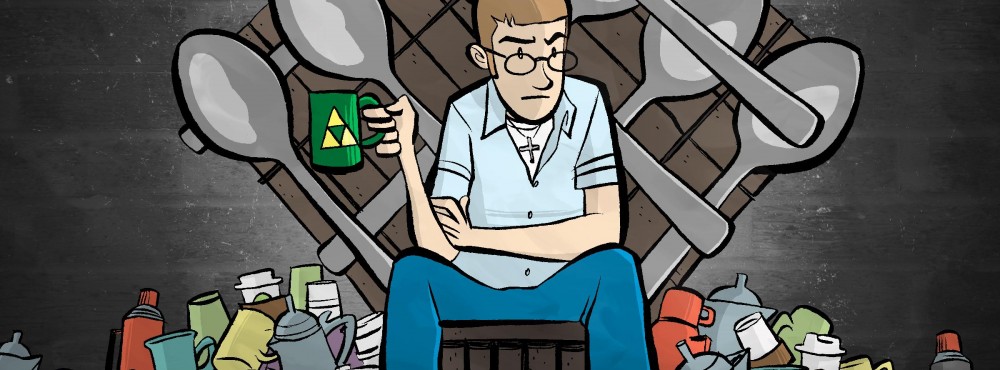
37. Everything I Know about Creativity I Learned from The Legend of Zelda

Today’s post was written by Wes Molebash, blogger and cartoonist extraordinaire. It came at the perfect time, since The Legend of Zelda: Skyward Sword is coming out in a couple of days. Check out his website for more awesome artwork and insights on creativity!

Like most people my age, I grew up playing the Legend of Zelda video game series. I loved every minute of those games, and Ocarina of Time played a defining role in my young adulthood.

Now I like to consider myself a “creative person.” What I mean by this is that I love to create art and I’m always scheming of my next “big” project. Ideas are cheap; art is work, and I’m absolutely in love with the creative process.

That being said, I realized the other day as I was toiling in my basement office that everything I know about creativity was learned from playing the Legend of Zelda video games.

For instance:

It doesn’t matter how small you are or what tools you are using

In several of the Zelda games, Link starts his journey as a little boy who wields a measly wooden sword and a Deku shield. A DEKU shield! No one is afraid of a Deku shield. But he doesn’t let this stop him. He goes straight into his first dungeon and defeats the baddie with his slingshot David-and-Goliath-style. The journey has begun. He’s received his first taste of victory, and he’s off to the next dungeon.

So what does this tell me about the creative process? Simple: It doesn’t matter how skilled you are or how big your platform is or how expensive your tools are, just create! Don’t be hindered by your limited experience or lack of resources. I know famous cartoonists who draw awesome cartoons on three-thousand-dollar computer tablets. I also know a lot of amateur cartoonists who draw awesome cartoons using Ticonderoga No. 2 pencils and Sharpie markers. Take the resources you have and use them to the best of your ability.

Every obstacle has a weak spot—exploit it!

The Legend of Zelda series has been around since the eighties and it continues to follow a familiar formula: go into dungeons, collect maps and compasses and special weapons, and fight seemingly indestructible beasts who all have a glaring Achilles heel. Does the beastie have one huge, rolling eyeball? It’s a safe bet that you’ll want to shoot some arrows into the beast’s ocular cavity. Does the baddie occasionally stop to roar for a prolonged period of time? I’d grab some bombs and make it rain inside that guy’s maw. No matter how big the monster is, his weak point is right there in front of you begging to be struck.

The same holds true with our creative obstacles. They seem impossible to topple, but—the fact is—they’re quite easy to destroy! If I had to guess, I’d say that 99% of our creative obstacles can be toppled by simply CREATING. Are you having a hard time motivating yourself? Get out your tools and create. Do you have some naysayers telling you that you suck at life? Tune them out and create. Are you swimming in a sea of rejection letters from agents and publishers? Take the critiques and criticism with a grain of salt and create.

It really is that simple. Once you get started it’ll be hard to stop. The weak spot of your obstacle is right there staring you in the face. Exploit it.

You’re going to get better

As I said above, when Link starts his journey he is just a little boy with a crappy sword and shield and three hearts in his life meter. However, as he continues his quest he gets better. He collects more weapons. He becomes more resilient. He ages. By the end of the game he’s got the Hyrule Shield, the Master Sword, some rad magic powers, a pair of flippers that help him swim and hold his breath under water, a bunch of sweet weapons in a bag that would be impossible to carry in the real world, and eighteen hearts in his life meter. He finally ends up at Ganon’s door and he’s ready to—as they say in the UFC—“bang.”

The same is true for your creative endeavors. The more you create, the better you’ll get. You’ll also acquire new tools and awesome advice from other creators. Most importantly, you’ll gain experience. No longer will you feel completely daunted by project proposals, pitches, and rejections. It’s all part of the process and you’ll get better and better at those things.

So wipe your brow, keep creating, and—when you need to take a break—dust off your N64, pop in Ocarina of Time, and wander around Hyrule Field for a spell.

What have you learned from video games? Let us know in the comments!

36. About Writing: Community

Along with visual arts—drawing, painting, sculpting and so on—writing is probably one of the loneliest forms of art.

Most art demands the involvement of more than one person. Most music, whether instrumental or choral, requires a group of people. Theatrical productions usually feature multiple performers; even shows with only one actor require a stage crew. Films demand legions of musicians, editors, producers, sound technicians, makeup artists, prop designers, camerapersons and special effects artists.

Writing is different. The craft of writing can be collaborative, but, unlike other forms of art, it doesn’t have to be. It can be as simple as a writer sitting in front of a computer or notebook and putting her thoughts into words. Whole novels can be written without a single piece of advice or criticism from another person.

However, just because writing can be a lonely form of art doesn’t mean it should be.

Two of my favorite authors, J.R.R. Tolkien and C.S. Lewis, were part of a writing group called the Inklings. They met every week in a pub or private room in Oxford, drank beer, smoked pipes, talked about literature and told jokes. Most significantly, certain members of the Inklings read aloud whatever manuscripts they happened to be working on, and other members offered their criticism.

Of course, not all criticism was encouraging. Hugo Dyson once responded to a passage from a manuscript of The Lord of the Rings with, “Oh no, not another f—ing elf!” (Several versions of this quote have been attributed to both Dyson and Tolkien’s son Christopher.) Much of the criticism was positive, however, and famous works such as The Lord of the Rings and Out of the Silent Planet were influenced by the Inklings.

I believe we can learn something from the Inklings. Speaking from personal experience, writing shouldn’t be a solitary craft. Criticism and encouragement from others are invaluable.

We writers tend not to be very good judges of our own work. We tend to make one of two mistakes when evaluating our own writing: we think it’s superb when it’s really not that good, or we think it’s awful when it’s really not that bad. It’s tremendously useful and helpful to receive criticism from other people.

When finding other people to judge our writing, it benefits us to choose people with different skills and interests. Let’s suppose someone writes a young adult novel. The obvious people from whom to seek criticism are young adults—they’re the ones for whom the book is written, after all. However, it will also be helpful to submit the manuscript to other kinds of readers: a fellow writer to point out weak passages, an English teacher to correct grammar mistakes, an experienced reader to check for plot holes.

When I finished The Trials of Lance Eliot, a fantasy novel, I submitted manuscripts to all kinds of people: a high school student, a number of amateur writers, a professional author, numerous college students, several college professors, my elderly grandparents and several others. I received many kinds of criticism, ranging from in-depth literary analysis to superficial proofreading to simple statements of like or dislike—and it was all helpful.

Apart from useful criticism, community offers something writers can never provide for themselves: encouragement.

Pretty much every writer ever has suffered from self-doubt. I can’t count the times I’ve stared at words on my computer screen and thought, “Dash it all, I’m no good at this.” So much of what has kept me going as a writer has been the encouragement I’ve received from my readers.

It’s easy for writers to become fatigued, but a single encouraging remark can go a long way to keep writers motivated. Encouragement and positive criticism reassures writers that, despite their mistakes and faults, they’re doing something right. Their efforts are not a colossal waste of time.

Criticism should always be honest. “An honest answer is like a kiss on the lips,” as the author of Proverbs reminds us. Flattery isn’t helpful to writers. At the same time, it’s beneficial to writers to be encouraged: “An anxious heart weighs a man down, but a kind word cheers him up,” to quote another proverb.

Writers shouldn’t accept all criticism unthinkingly. In the end, they and no others know what sort of work they want to write. However, writers shouldn’t reject any criticism without considering it first. Quoth the author of Proverbs, “Listen to advice and accept instruction, and in the end you will be wise.”

Art comes out of community. Very, very few artists are sufficient unto themselves. Writers are no exception. Almost every writer can benefit from becoming part of a community of readers and writers, receiving useful criticism and being reassured their attempts to write are worth something.
20. About Writing: Characterization

There’s a common idea that a good story is the description of a series of events. I disagree. I believe a good story is the depiction of the effect of a series of events upon the characters involved. We connect emotionally with characters, not plotlines.

The quest to destroy the Ring in The Lord of the Rings wouldn’t be nearly so thrilling if we weren’t rooting for Sam and Frodo. We wouldn’t care much about the strange events in A Christmas Carol if they didn’t work together to redeem old Scrooge. The Twilight novels would be even worse if some readers didn’t become emotionally invested in Bella and that sparkly excuse for a vampire.

What makes characters interesting, unique and memorable? What makes some characters likable and others detestable? How can a single author create dozens of characters that aren’t all the same?

Here are a few thoughts on good characterization.

Different characters should have different ways of speaking

Every major character should speak differently. A self-important character might speak in long, windy sentences packed with large words. A reserved character might use short, simple sentences. Officious, dignified characters tend to use fewer contractions than casual, easygoing characters.

Some characters have an accent that can be rendered phonetically through spelling. Topsy in Uncle Tom’s Cabin, for example, exclaims “Dunno, Missis—I spects cause I’s so wicked!” instead of the more prosaic “I don’t know, Miss—I suspect because I’m so wicked!” Some characters tend to use a particular phrase or set of words. For example, the eponymous protagonist of The Great Gatsby addresses almost every man he meets as old sport.

Although every character’s speech should be unique, be careful not to overdo it. Too many dialogue gimmicks are distracting to the reader. A character’s way of speaking must be natural as well as unique.

Excessive physical description should be avoided

Too much physical description is often a sign of poor writing. The reader doesn’t need to know every detail of a character’s appearance. It’s almost always best to give an impression of a character, noting the most striking features, instead of a meticulous description. Honestly, how often do we notice or remember a person’s appearance upon meeting her for the first time? We might notice her ironic smile or twitchy hands, but probably not her exact height and eye color.

In my experience, it’s best to give just few memorable details about a character’s appearance—giving the reader a general picture of the character—and move on with the story.

Different characters should have different mannerisms

Sherlock Holmes has a lot of memorable habits that define his character. He plays the violin. He smokes a pipe. He occasionally doses himself with cocaine or morphine. He has odd housekeeping habits, such as conducting chemical experiments and decorating walls with bullet holes.

His peculiar mannerisms all point to a particular kind of character: a gifted man with few opportunities to use his gifts. Since he considers most investigations beneath his ability, he compensates by using his gifts for miscellaneous pursuits (such as violin and chemistry) and distracting himself with drugs. His mannerisms aren’t random; they indicate a very specific type of character.

Mannerisms—whether an obsession with coffee, a fear of spiders or a habit of eating dessert first—make characters memorable and reveal a lot about them.

Characters should change

Well, most characters should change. Every now and then there will be someone like Aslan or Tom Sawyer whose character is built upon unchanging constancy. However, like real people, most characters are influenced by the events around them. If someone survives a gunfight or breaks up with a fiancée, I guarantee he will be changed by the incident. Fictional characters are no different.

Real people change and grow; so should fictional characters.

Clothes should reveal something about a character

There’s a reason Hamlet wears black. Jay Gatsby wouldn’t be quite the same without his elegant shirts. And can anyone imagine Gandalf without a tall, pointed hat?

Clothes don’t have to reveal something about a character—some characters, like real people, wear whatever clothes are handy—but something can often be learned about a character by the way she chooses to dress.

What have I missed? What’s your advice for good characterization? Let us know in the comments!

17. Rampant and Irresponsible Capitalization

Christians like to capitalize things.

Don’t believe me? Let’s have a bet. Wait, we probably shouldn’t gamble about something related to Christianity. (I’m pretty sure there’s a passage in Hebrews that forbids gambling about religion.) How about I dare you instead of placing a bet? All right, I dare you to go to church next Sunday and see how many Christian words are capitalized.

A lot of people—even some non-Christians—capitalize divine pronouns (pronouns used to refer to God) in order to show reverence or respect. C.S Lewis, a man for whom I have utmost admiration, capitalized divine pronouns. He also capitalized Heaven and Hell because they are places, like London or New York City, and should therefore be capitalized as proper nouns.

C.S. Lewis was consistent in his capitalizations and could give good reasons for them. It seems many people, however, are guilty of rampant and irresponsible capitalization. I may just be cynical, and I’m definitely a literary snob, but it seems sometimes as though American Christians capitalize words related to Christianity just to make them seem holier.

For example, hymns and worship songs never refer to God and his mercy. It’s evidently more holy to capitalize the divine pronoun and refer to God and His mercy. And if we capitalize mercy, which is a divine attribute, it makes the hymn or worship song even holier. I mean, God and His Mercy is clearly holier than God and his mercy, isn’t it?

So sermons are full of Grace, Goodness, Predestination, Prophecy, Agape, Apostles, Epistles, Pre-Millennialism, Mid-Millennialism, Post-Millennialism and the Millennium Falcon. All right, maybe not that last one. At least not in any sermons I’ve heard.

Anyway, there have come to be so many capitalizations that capitalization is becoming meaningless.

If a word is capitalized, there should be a good reason for it. I capitalize Gospel to distinguish the good news of Jesus Christ from the music genre. I capitalize Church to set apart the worldwide community of God’s people from the fancy building down the street. I capitalize Prophets to differentiate between a section of the Old Testament and the plural form of a common noun.

Unlike C.S. Lewis, I don’t capitalize heaven or hell or divine pronouns. There’s absolutely nothing wrong with capitalizing these words, but it doesn’t seem necessary. I don’t think God cares much about capitalization. He cares more about love and obedience and mercy.

Should divine pronouns and spiritual words be capitalized? Should there be more sermons about the Millennium Falcon? Let us know in the comments!

14. Shameless Self-Promotion

I want to be a writer. I’m studying to be an English teacher, and I’ll probably spend much of my life in a classroom, but writing is my true passion.

Why become an English teacher instead of a professional writer? It’s extremely difficult to make a living as a writer, particularly a writer of fiction. Most novelists have full- or part-time jobs. As much as I’d love to spend eight hours a day writing fiction, it’s probably not going to happen.

Even so, I do hope to become a novelist. I’ve finished a novel, a wry fantasy about an Oxford student who is summoned to another world by a magician who had been trying to summon a completely different person. The novel, The Trials of Lance Eliot, is currently in search of a publisher, like a ship drifting through stormy seas in search of a safe harbor.

I’m tremendously excited about my novel, but there’s something else I’m not excited about at all: self-promotion.

Publishers expect authors to promote themselves through websites, book signings, public readings and so forth. Most authors must sell themselves in order to succeed. That bothers me. I can’t claim to be a particularly humble person—the truth is that I struggle with vanity and conceit—but I can honestly admit to being a modest person. I don’t like making a fuss about myself, my writing or anything remotely connected with me.

A few months ago a friend sent me a link to a quirky online graphic novel titled Ratfist. (It’s a zany superhero comic with surprisingly profound philosophical themes; if you’re interested, you can check it out here.) The cartoonist, Doug TenNapel, comments on each page of the novel, and one of his statements made me stop and think.

“I have no problem with shameless self-promotion. It’s not for my good, it’s for you. I like making stuff. It’s not as fun to make stuff if people don’t see it. Entertainers entertain.”

This comment helped me see self-promotion from a different perspective. There’s not much point in making stuff (in my case, novels and blog posts) unless people see it. People won’t see it unless someone promotes it. No one else will promote it unless I pay them. Since I’m a poor college student, that leaves me with only two options: be modest and write stuff that few people will read, or promote myself and write stuff that more than a few people will read.

That said, I’m going to ask a favor of you. Yes, dear reader, you. I’d be honored if you’d give TMTF a shout out. Do you like the blog? Awesome! Let us know what you like about it! Do you think the blog is the worst thing since Rebecca Black’s music? Slightly-less-but-still-somewhat awesome! Let us know what you don’t like about it! Whether you mention TMTF on your blog, your Facebook page, your Twitter account or in some other way, the Typewriter Monkey Task Force and I would be very grateful.

I write TMTF to share my passion for the things I’m passionate about: the goodness of God, the eccentricity of gaming culture, the humor of everyday life and a thousand other things. The purpose of this blog is to impart hope or understanding or inspiration—or at the very least a healthy laugh—to someone who needs it. I’m really excited about TMTF and my other writing projects. But there’s not much point in writing unless someone actually reads it. As that Julian Smith guy from YouTube so often says, “I made this for you!”

So please consider giving TMTF a good word on your blog or Facebook page or Twitter account! Always feel free to comment on blog posts! (My typewriter monkeys love comments on their work.)

You are the reason I write, dear reader. Whether or not you choose to give this blog a mention, thank you for being awesome and giving me a reason to write.

3. About Writing: Three Platinum Rules

I love writing. Along with making tea, twirling broomsticks and obliterating all competition in Mario Kart, writing is pretty much my only significant skill.

There are innumerable bits and pieces of advice for writers. However, three all-important rules demand attention. Three golden rules. Not just golden rules, but platinum rules. Diamond-studded platinum rules.

I believe these platinum rules are the most important things for a writer to know.

Read

It’s impossible to become a good writer without reading. Impossible. How-to guides, classes and seminars can be useful, but nothing helps a writer as much as reading books.

Let me give an example.

One day I resolve to learn to play tennis. In order to master the sport, I spend hours listening to a professional tennis player give advice. That advice might be helpful, but I won’t be able to pick up a tennis racket immediately and win every match. It will take practice—a lot of practice—for me to learn to play well. Advice can take me only so far. At some point I must actually step onto the court and play.

It’s exactly the same with reading and writing.

Most of what I know about writing comes from reading. By reading fiction, I learned the mechanics of storytelling: plot development, characterization, settings, symbolism, style and the rest. By reading both fiction and nonfiction, I learned proper spelling and grammar.

Best of all, I learned these things intuitively. I didn’t try to learn anything—as I read, I simply developed a feel for writing.

However, a vague feel for writing isn’t enough. It must be refined. That’s where the second platinum rule comes in.

Write

Most people can’t sit down to a piano and play the third movement of Beethoven’s Moonlight Sonata without a lot of practice. In the same way, most people can’t sit down to a computer, typewriter or notebook and write a masterpiece without a lot of practice.

Don’t be discouraged if your writing isn’t perfect. I’ve never been completely satisfied with any of my own writing, and my early attempts at fiction were unspeakably horrible.

Reading and writing are essential for any writer, but there is one more platinum rule.

Have fun!

Writing should be fun! There’s satisfaction, joy and exhilaration in putting ideas, reflections and stories into a form that can be read and appreciated by other people.

If writing becomes a dull chore or heavy commitment, remember you’re under no pressure to write. Not everyone is gifted to be a writer.

When I was growing up, I desperately wanted to be a good artist. I sketched and took art classes and read how-to books, but nothing worked. To this day I have the artistic skill of a five-year-old—and that’s okay.

I’m not gifted to be an artist, but I am gifted to be a writer of fiction, brewer of tea, twirler of broomsticks and wicked good Mario Kart player. If you’re gifted to write, awesome. If you’re not gifted to write, learn what your gifts are.

If your gift is writing, read and write and have fun!