78. Machetes and Sabers and Swords, Oh My!

I’ve previously mentioned my passion for swords, knives and other lethally sharp objects. Most male members of the human species have a predilection for bladed weapons, I suspect.

My family has a Mennonite background. Mennonites are known for their pacifistic beliefs (and really good cooking). In spite of our heritage, we’ve amassed a formidable collection of blades over the years.

Our current assemblage includes several machetes, an antique cavalry saber, an antique gaucho knife, a set of samurai swords, a throwing knife, a hatchet and a replica of Bilbo’s sword Sting from the Lord of the Rings films. This collection doesn’t include a number of machetes and knives we’ve lost, left behind or given away over the years.
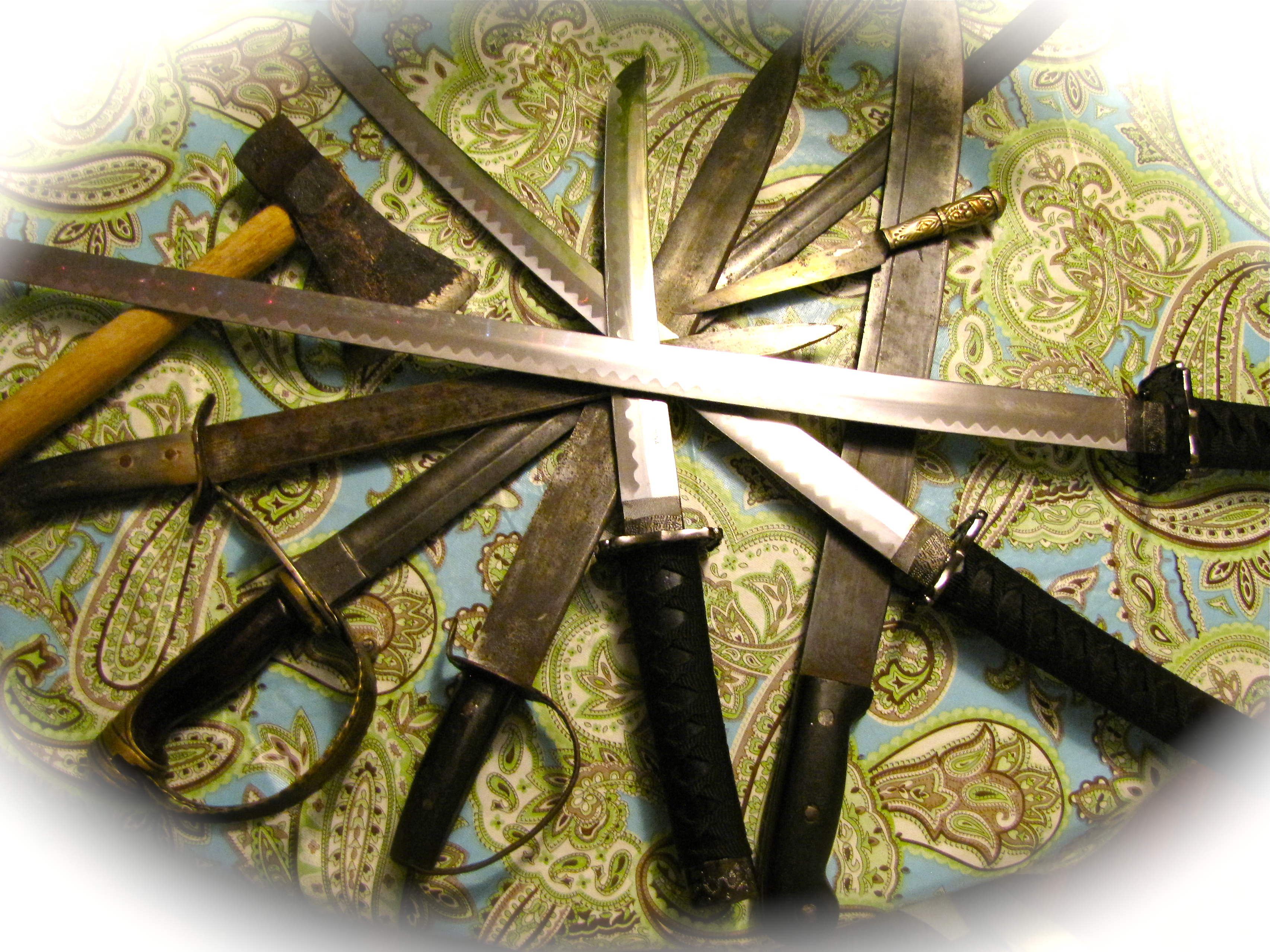
Some of the blades aren’t just for show. My old man uses the gaucho knife to slice apples. The machetes were used regularly in Ecuador, whether for cutting grass (we didn’t have a lawnmower) or chopping wood. The cavalry saber is no longer wielded in battle, but it gives whoever happens to be holding it an air of authority. It’s hard to argue with someone brandishing a cavalry saber.

My old man is particularly skilled with blades, able to snap a stick in half by throwing a machete from a distance of several feet. He says the technique is using for killing snakes in the jungle. I’ve never seen my old man kill a snake—such creatures are pretty rare in the urban areas where my parents have worked for the last decade—but woe to the foolish serpent who crosses my father’s path when he’s got a machete handy.

Our arsenal of blades was surprisingly inexpensive to assemble. The most pricey item was probably the cavalry saber, purchased from a fellow missionary for fifty dollars. Machetes are a dime a dozen—all right, more like twelve dollars for one—in Ecuador. I bought the samurai swords for twenty dollars from a college roommate.

I think we’ve spent our money wisely. The Lord Jesus himself advised his disciples to invest in bladed weapons.

(Disclaimer: I may possibly be taking the verse slightly out of its original context.)

I wanted to make a sword during That Time I Was a Blacksmith, but I never managed it. Making S-hooks and tent pegs was hard enough—a sword would have been practically impossible.

(I laughed bitterly during that episode of Avatar: The Last Airbender in which a character with no experience as a blacksmith forges a beautiful sword in a single night.)

Although I will never make my own sword, I will continue to enjoy and appreciate the blades my family and I acquire.

Swords are awesome. I’m holding a cavalry saber, so don’t even try to argue if you disagree.

77. That Time I Tangled with Barbed Wire

Many missionary kids have learned the folly of strolling carelessly through the jungle, and some even have the scars to prove it.

The jungles in Ecuador are beautiful: dazzling waterfalls, crystal-clear streams, bright flowers and lush vegetation. However, visitors to the jungle must not become too distracted by its beauty. The jungle is a wild place, full of potential threats.

No, I’m not talking about piranhas, jaguars, poisoned darts or ancient temples full of death traps. The true dangers of the jungle are much more insidious and sinister: ticks, amoebas, parasitic worms and mosquitoes. I particularly detest mosquitoes, those messengers of Satan, which buzz and bite and sometimes carry deadly diseases.

The jungle is also full of sharp objects waiting to pierce unwary feet. Unwary visitors to the jungle are confronted by thorns, spines, sharp rocks, rusty nails and even barbed wire. Only a fool walks through the jungle without watching his step.

I was always careful to watch my step. The problem was that sharp objects in the jungle are sometimes found in places other than the ground underfoot.

When I was just a kid, I went camping in the jungle with my old man and big brother. The place to which we went was called Aguas Claras, or Clear Waters. On our way there we stopped at a cacao plantation to visit the parents of a pastor with whom my parents worked. (For those who don’t know, cacao beans are the main ingredient of chocolate.)

My old man, a true missionary, stayed for hours talking. Having long since become accustomed to my parents talking for hours with people I didn’t know, I went off exploring alone. Fortunately, it was an interesting place to explore. There were groves of cacao trees nearby and a river with stones for throwing. I also found a couple of paths through the jungle.

I don’t remember why I decided to run along one of those paths. My brother may have been chasing me, or I may have been letting off steam. Whatever the reason, it was a mistake. Stretched across the path at eye level was a long strand of rusty barbed wire.

Have you ever run into a clothesline? I don’t remember the exact details of my tangle with the barbed wire, but I imagine it must have been something like colliding with a taut clothesline while running at full speed.

We were many miles from any kind of medical facility, so the gash in my left cheek was never stitched up. Some weeks after the incident, my old man tried to console me about the scar by pointing out that I now had something in common with both Indiana Jones and the evil lion from The Lion King. I didn’t need to be consoled. As far as I was concerned, a scar—especially a facial scar—was pretty much the coolest thing that could ever happen to a missionary kid.

My left cheek is still scarred more than a decade later. I’m not sure whether to be relieved or disappointed that the scar isn’t very noticeable. I suppose I should simply be thankful I didn’t lose an eye.

The moral of the story? Be aware of your surroundings if you ever visit a jungle, and consider wearing goggles.

75. Stoic or Stupid?

I don’t think I would make a very good Viking.

I hate cold weather. I lack any kind of vicious bloodlust. Most importantly, I can’t grow a beard. Thus it is proved. Adam would not make a good Viking.

Regardless, I possess one quality that would make any Viking proud: quiet stoicism.

When confronted with trials and tribulations, I don’t usually talk about them. Whether depression or headache, discouragement or insomnia, sadness or soreness, I keep my problems to myself.

In some ways, quiet stoicism isn’t such a bad thing. I know people who could probably use a little stoicism: the sort of people who regularly insist on describing all of their frustrations in painstaking detail. One reason I don’t talk much about my problems is that I don’t want to annoy anyone.

In other ways, however, quiet stoicism is kind of stupid.

To be honest, one of the reasons I keep my struggles to myself is to give the impression that I don’t have any. It’s hard to be vulnerable. It can be embarrassing. The easiest option is sometimes to be stoic and tough out my problems alone.

The trouble is that some problems are too big for anyone to tough out alone.

As much as I’d like to pretend I’m totally self-sufficient, I’m not. There are times I need someone to give me advice, encouragement or criticism. There are times I need someone to listen to me. There are times I need someone simply to be there.

Not long ago, I realized I’d made such a habit of trying to deal with my problems alone that I was forgetting to ask God for help when difficulties arose. It wasn’t a deliberate, “I’ll take care of this little complication, God, and ask you to handle the really big problems” kind of decision. In fact, it wasn’t a decision at all. Asking for help simply didn’t occur to me.

Stoic or not, forgetting to ask the Lord God Almighty for help is stupid. He doesn’t merely allow us to ask for help when we need it. He flat-out commands us to ask for help when we need it!

Paul wrote, “Do not be anxious about anything, but in everything, by prayer and petition, with thanksgiving, present your requests to God” (Philippians 4:6).

Peter added, “Cast all your anxiety on him because he cares for you” (1 Peter 5:7).

Quiet stoicism can be a virtue. I’m a reserved person, and I don’t plan to tell everyone about every problem. I think it’s good sometimes to work through problems patiently.

In the end, though, ain’t it better to ask for help?

73. Exotic Cuisine

Being a missionary kid can be both a blessing and a curse. MKs are privileged to enjoy all sorts of experiences unavailable to most kids, but they also suffer all sorts of difficulties most kids never have to endure.

For most MKs, the local cuisine can be either a blessing or a curse. Some exotic foods are awesome. Some are awful.

Regardless of whether or not they like international cuisine, missionaries and their children hold to a sacred missionary proverb: Where God leads me I will follow; what God feeds me I will swallow.

From the jungles of Ecuador to the suburbs of South Korea, I’ve been blessed to enjoy (and cursed to endure) all sorts of exotic foods. Fried leaf-cutter ants, stir-fried tapir meat, squid jerky, grilled squid, red bean ice cream—the list goes on and on.

If pressed, I’d probably name maracuyá juice as my favorite exotic fare. Maracuyá, also called passion fruit, is an ugly, often shriveled pomegranate-like fruit the size of a tennis ball. Despite its drab outer appearance and sour flavor, it makes an exquisite juice when prepared correctly.

My least favorite exotic fare might be kimchi, a popular dish in South Korea. I recorded my impression of kimchi in my novel. Here’s an excerpt:

The only thing I didn’t like was kimchi, a pungent dish consisting of cabbage soaked in some strong liquid (I suspected sulfuric acid) and fermented until its alcohol level equaled that of vodka. Had any of the kimchi fallen to the table, I would not have been surprised had the tablecloth caught fire.

While many MKs get to experience a vast range of unusual dishes, they miss out on a lot of treats most Americans take for granted: marshmallows, root beer and peanut butter cups, to name but a few. When my brothers and I were young, we viewed the United States of America not so much a country as the source of all the treats we couldn’t get in Ecuador.

There have been, I admit, certain exotic dishes I never had the opportunity to sample. I never tried cuy, an Andean specialty consisting of roasted guinea pig. I also missed out on chicha, a manioc- or corn-based alcoholic beverage popular in the jungles and highlands of Ecuador.

Someday, perhaps.

70. Talking Too Much

I talk too much.

This wouldn’t be a problem, except for one small detail: when I talk, most people feel obligated to listen. Some of my acquaintances have probably perfected the art of Tuning Out Adam, but the rest have no choice but to suffer politely through my ramblings, rants and dramatic monologues.

Even after I realized I talk too much, I didn’t think it was a serious fault. Pastors don’t preach sermons about the sin of talkativeness. The Lord Jesus didn’t warn against being too chatty. The Bible doesn’t have anything to say about rampant loquacity.

At least that’s what I thought.

Once, years ago, I contradicted a high school teacher about a passage of Scripture. A grim expression came over his face. He busted out a Bible. One of my classmates whispered, “Oh, Adam’s about to get Scripture-owned.” As it turned out, my teacher was absolutely correct. I was chastened, humbled and embarrassed.

Pretty much the same thing happened in regard to my tendency to talk too much.

Much to my discomfort, I kept finding verses in Scripture that suggest talking too much is a foolish thing to do.

Solomon had all kinds of things to say in the book of Proverbs.

“When words are many, sin is not absent, but he who holds his tongue is wise.”

“A man of knowledge uses words with restraint, and a man of understanding is even-tempered.”

“Even a fool is thought wise if he keeps silent, and discerning if he holds his tongue.”

New Testament writers were equally eloquent upon the subject.

“Do not let any unwholesome talk come out of your mouths, but only what is helpful for building others up according to their needs, that it may benefit those who listen,” wrote the Apostle Paul.

“Everyone should be quick to listen, slow to speak and slow to become angry,” wrote James the brother of Jesus.

Most discomforting were words spoken by the Lord Jesus himself: “But I tell you that men will have to give account on the day of judgment for every careless word they have spoken.”

Wait, I’ll have to give account for every careless word I’ve spoken? Every careless word I’ve ever spoken?

Dash it.

Once again, I got Scripture-owned.

One of my resolutions for this year is not to talk quite so much. Have I broken this resolution? Yes, yes I have. I’m still working on it.

69. That Time I Held a Severed Human Arm

For those of my readers who are squeamish, queasy or any of those other funny adjectives, this may be a good post to skip. You have been warned.

Long, long ago, when I was just a senior in high school, I took AP Biology, a college-level science course. It was fantastic. The other students and I were privileged to visit a cloud forest, travel to the Galápagos Islands, dissect fetal pigs and witness the dismemberment of a deceased human being.

Well, I suppose the removal of a single arm can hardly be called dismemberment, but I digress.

One fair morning I and the other students in AP Biology took a field trip to a local university. We were scheduled to meet a professor who would give us a guided tour of the human body using the university’s resident cadaver as a visual aid. (A cadaver is a corpse used for official purposes, such as police investigation or medical research.) The professor’s lecture would be a vital part of our scientific education, or so we were told by our teacher.

The plan was for us to enjoy Part One of the professor’s lecture in the morning, head back to school for our afternoon classes and return to the university the next day for Part Two.

We arrived at the university and filed into the laboratory to find the professor waiting for us. I don’t remember his name, so I’ll call him Dr. Frankenstein. A cadaver was stretched out on a slab. Dr. F’s assistant, whom I’ll call Igor, was bustling around the lab.

Dr. F had an interesting way of lecturing. The cadaver had been emptied of its organs; as in those Mummy movies, the organs were kept in jars. As Dr. F lectured, he took out the organs from their jars and put them back into the cadaver to show us where they belonged.

The lecture ended. Dr. F departed to teach a class, leaving Igor to put away the cadaver. As we watched, Igor removed the various organs from the cadaver and put them back in their jars. Then he detached the cadaver’s arm.

I was, I freely admit, a little shaken by this. Arms are usually attached more permanently. It was unnerving to see a cadaver disarmed—forgive the pun—so casually.

I was one of only two male students in my class. The other male student, whom I’ll call Socrates, was standing beside me when Igor pointed at him and asked, “Would you please help me put away the cadaver?”

Igor and Socrates hoisted the cadaver onto a stretcher, carried it into a back room and lifted it into its niche, leaving me to wipe the anxious perspiration from my brow and contemplate how close I’d come to the awful experience of carrying around a corpse.

The other students and I went back to school with our teacher. Next morning we returned to the university for the second part of the lecture. When we arrived, Dr. F was running late and Igor was still in the process of setting up the cadaver and its organ jars.

“Could you please help me get out the cadaver?” asked Igor, pointing at Socrates. I breathed a sigh of relief, only for Igor to add, “Oh, and could you reach into the niche and get the arm?”

The second request was very clearly directed at me. I had no choice but to reach into the niche (wearing gloves and a lab coat, of course) and retrieve the missing arm.

Alas, there is no photographic evidence of this event. I wish a photo could’ve been taken of me with the arm—one of those “Hey, look at this big fish I caught!” pictures—but the incident went unrecorded.

Dr. F arrived, gave the second part of the lecture and left. So did the other students and I, before Igor could request assistance from any of us.

I have many great memories from that AP Biology class. I’ve already written a post about one. Others I may post someday on this blog: That Time I Met a Wild Penguin and That Time I Saw a Hummingbird Wearing Go-Go Boots, to name but two.

However, of all the memories from AP Biology, That Time I Held a Severed Human Arm is one of my favorites. It’s certainly my favorite story to tell—as my longsuffering friends and relatives can testify.

67. Abandon Hope, All Ye Who Enter Here

I once made a journey through HEL.

HEL had nothing to do with eternal damnation, though it sometimes felt like it. HEL was an (eminently appropriate) acronym for History of the English Language, one of my college courses. For the record, it was a good class. It was also really, really hard.

Although my journey through HEL was a good deal more comfortable than Dante’s stroll through the Inferno, it was not without its difficulties. My fellow students and I learned a little history, a little linguistics, a little philology and a little grammar. We also memorized a number of old literary passages, including the Lord’s Prayer in Anglo-Saxon (which sounded eerily like some kind of evil incantation) and the prologue to Chaucer’s Canterbury Tales in Middle English.

We often joked about giving our professor a bronze plaque on which were inscribed the words Abandon hope, all ye who enter here. He could put the plaque above the doorway to the classroom, we mused, and inspire students to new heights of academic diligence.

On the day of the final exam, one of my fellow students cackled demonically upon entering the room and said, “Welcome to HEL!” After a pause he added in his normal voice, “Whoa, I hope I never have to say that again.”

The class taught us a number of interesting things. Did you know, for example, that awesome and awful, which have completely opposite meanings, originally meant the same thing? Both words designated something that evoked a sense of awe. Awesome eventually came to represent things that inspired awe and amazement: Chuck Norris’s beard is a good example. Awful eventually came to represent things that inspired awe and horror, like natural disasters and teen pop stars.

I’m glad I journeyed through HEL. It gave me a better understanding of the origin, development and mechanics of the English language—and the English language is kinda what I’ve chosen to do for a living.

HEL also gave me a new appreciation for the words we speak and write every day, not to mention greater sympathy for poor old Dante.

66. Taxes

As we all know, February is a month for love, romance and taxes.

Taxes wouldn’t be so bad if they were simpler to pay. I don’t mind giving money to the government. No, what bothers me is that giving money to the government requires so many hours of tedious paperwork.

Despite the complications, I continue to pay taxes every year. After all, Jesus paid his taxes. There’s a great story in Matthew 17 in which Jesus sends Peter fishing, promising that the first fish he catches will have a coin in its mouth with which to pay the temple tax.

My first reaction to this story is, “Of course Jesus paid his taxes, and so should I.”

My second reaction is, “Man, Jesus had it easy. I wish I could just hand over my tax money and be done with it. I wonder what miracle Jesus would use to pay his taxes today.”

Another reason I pay taxes is to prevent the US government from arresting me for tax evasion. There are many places in the world I’d like to visit, but prison isn’t one of them. Besides, if I were arrested and put on trial, the legal paperwork would be even worse than tax paperwork. It’s sort of like Scylla and Charybdis from The Odyssey. A person must decide which misery is less miserable.

When I pay taxes, the process typically involves a large amount of tedious fact-checking, a moderate amount of careful estimating and a small amount of wild guessing.

In addition to my usual federal and state taxes, I also pay the Federal Secretarial Animal Assistant Tax (also called the FSAAT) for my typewriter monkeys.

I never ask my monkeys to help me with my taxes. In addition to their other faults, they are extremely bad at mathematics. I’m much better at math than any of my typewriter monkeys, despite having an English degree. (For those who don’t know, an English degree is not so much a sign of being good at English as a sign of being bad at mathematics.)

Besides being poor mathematicians, my typewriter monkeys are also unmotivated to do tax paperwork. They have the stubbornness of mules and slothfulness of… well… sloths.

At least I don’t have the misfortune of employing typewriter sloths. Indeed, I must count my blessings.

I’d also better think about doing taxes soon.

64. The Fear of Not Being Perfect

Do you ever suffer from the fear of not being perfect?

I do.

In fact, the fear of not being perfect has been one of my greatest struggles.

My Thursday Afternoon of the Soul, a year and a half of intense depression, occurred partly because I was constantly afraid that I wasn’t good enough.

One of the greatest lessons I’ve learned impacted me so deeply because I was focused on trying to be perfect instead of trying to help others.

I’ve still got my fair share of qualms, struggles and insecurities, but I’m no longer afraid that God will abandon me if I make too many mistakes.

(That’s a really good thing, ’cause I make lots of mistakes.)

I’m still trying to reconcile myself to the fact that certain areas of my life are less than perfect. Some things are beyond my control: my tragic inability to grow a beard, for example. Other things, things over which I have a little more control, frustrate me because I want them to be perfect and they aren’t.

I wonder how many people have given up on something because they weren’t perfect.

I wonder how many violin players have stopped practicing because their performances never sounded exactly right. I wonder how many painters have thrown away their brushes because they were tired of finding flaws in their paintings. I wonder how many poets have quit writing poetry because their poems were met with criticism or disinterest.

Sometimes it’s best to give up on something. If a hobby is costing extravagant amounts of time, money or effort, and clearly going nowhere, perhaps it’s wise to let it go. But I think we sometimes kill our dreams before they have a chance to grow.

For example, when I write, my greatest hindrance is the nagging conviction that writing is just a colossal waste of time. An insidious little voice whispers, You’re investing so much time and effort in your writing, and for what purpose? Your writing is full of faults. Nobody will read it. Your novel is clichéd. Nobody will buy it. Your blog is pointless. Nobody will like it. There are tens of thousands of better writers out there. You should spend your time doing something worthwhile.

I think pretty much every person has heard that voice. Some people listen to it. Some people refuse to listen.

Blogger Jon Acuff is one of the people who has refused to listen. “The road to awesome always leads through the land of horrible,” he wrote. “Go be horrible at something. It’s the only way to be awesome at everything.”

Web cartoonist Wes Molebash is another such person. “There will be many obstacles on your road to success,” he wrote, “so don’t build your own.”

Amateur animator JKR is yet another such person. “Don’t worry about failing,” he wrote. “You’re going to, and it’s okay. Just learn from whatever you don’t get quite right.”

Perseverance, I keep telling myself, is a much better quality that perfectionism.

I recently saw Steven Spielberg’s film adaptation of The Adventures of Tintin, and one of its characters offered a wise piece of advice.

“There are plenty of others willing to call you a failure,” he said. “Don’t you ever say it of yourself.”

63. That Time I Worked in a Haunted House

I really wanted to title this post That Time I Was a Zombie or That Time I Was a Killer Clown, but those titles would have been misleading. I was neither zombie nor killer clown. I was merely a tour guide in a haunted house full of them.

Years ago, when I was a senior in high school, it fell to me and some of my classmates to put together a haunted house as a fundraiser for our class. The idea was simple: lead groups of jittery customers (we preferred to think of them as victims) through the basement of our school, scaring them as much as possible along the way. Each customer would pay for a ticket, and the proceeds would go our class fund.

It was an important fundraiser, so my classmates and I formed a Haunted House Committee weeks in advance and began planning. We met during our lunch break, discussing gory details over sandwiches and slices of pizza.

It was decided early on that our haunted house would feature killer clowns. Clowns, even of the non-killer variety, are freakishly scary. Zombies were the next suggestion, and they were quickly added to our list of Freakishly Scary Things Needed For Our Haunted House.

Several members of the Haunted House Committee were horror movie aficionados. They insisted on adding authentic little touches, such as puddles of blood and a heap of intestines. The blood was fake; the intestines were genuine, having previously belonged to a pig butchered at a local market.

While I appreciated the enthusiasm that went into planning these ghoulish details, I didn’t like them. They were rather too macabre for my Puritan sensibilities. Besides, I wound up slipping in one of the blood puddles during the fundraiser and acquiring several colorful bruises.

On the night of the fundraiser, our victims—our customers, I mean—lined up with their tickets ready. I had been chosen to play the role of a tour guide. In retrospect, I’m thankful not to have been a zombie or a killer clown, since those unfortunate ghouls had to wear thick makeup.

I had two responsibilities as a tour guide.

First, I had to lead our customers safely through the haunted house.

Second, I had to give the impression of a person who was verging on insanity after having been locked for hours in a haunted house full of killer clowns and zombies.

The second responsibility was a good deal more fun than the first.

The haunted house through which I led our customers was a masterpiece of creepy interior design. Apart from the aforementioned intestines and blood puddles, there were overturned desks and torn scraps of paper littering the floor. A hangman’s noose dangled from the ceiling. The mirrors were scrawled with grotesque lipstick drawings.

My favorite part of the haunted house was a corridor with a cloud of dense smoke from a fog machine. The tour guide’s flashlight became useless in the smoke; its beam stabbed through the obscurity without illuminating anything. A strobe light flashed at the end of the corridor, revealing scenes of carnage: desks, textbooks, papers and bodies strewn over the floor.

After leading a group of customers through the haunted house, I had to retrace my steps from the exit back to the entrance to meet the next group. This was, without question, my favorite part of working in a haunted house. The zombies and killer clowns, so terrifying in the presence of customers, smiled and laughed and gave each other high-fives when the customers were gone. There was an atmosphere of cheerfulness, companionship and solidarity among my classmates that contrasted quite sharply with their ghastly costumes and gloomy surroundings.

Despite a few mishaps—a customer running into a glass door and shattering it, for example—our haunted house was a success. The only downside was having to clean up afterward. We remained until the early hours of the morning, cleaning up bloodstains and picking up paper scraps, like murderers trying to get rid of the evidence.

After removing all traces of our haunted house and restoring the basement of our school to its original, less creepy condition, we went back to our homes and slept like the dead.

I felt about as lively as a zombie upon waking up the next day. My side ached from where I had bruised it after slipping in a blood puddle, and my throat was sore from all the screaming I had done in the character of an insane tour guide. It took time, tea and cough drops, but I eventually recovered.

Working in a haunted house was a memorable experience. I enjoyed it, and I hope never to do it again. I will leave it to the younger generation to carry on the tradition of putting together haunted houses.

Just a word of caution: Be wary of makeup and blood puddles.