I’ve heard of pistol shrimp, but this is ridiculous—and by ridiculous, I mean awesome. What better way is there to prepare fried shrimp than shooting it out of acannon? That’s right: there is none. The shrimp shotgun wins.
This culinary triumph is part of a Japanese ad for high-speed Internet service or some such, but the specifics hardly matter. What matters is that shrimp is cooked with kitchen artillery, large machinery, and billowing flames.
(Yes, I know the video above was staged. Don’t ruin the moment.)
The animation above, produced by Mechanical Apple and presented by Disney, is basically three minutes of heartwarming charm. Like many of my favorite short animations, Motorbike doesn’t need words to tell its story, just soft music and softer colors.
The first time I watched the video, I was struck by its similarities to the Professor Layton games: the music, pastel colors, and comic-strip character designs seem familiar. My impression of the video the second time around was that reminds me strongly of Kiki’s Delivery Service and Studio Ghibli’s other films.
Either way, Motorbike is ridiculously charming.
I encourage you, dear reader, to set aside the woes, worries, trials, troubles, and problems of your life for three minutes, and spend those minutes on a motorbike in the sunshine.
I’m no expert on logical fallacies, but that doesn’t stop me from being annoyed by them. The Not-a-Game Argument is one of the worst. (I’m sure it has a proper name, but I haven’t bothered checking.)
Nintendo recently added some indie games to its online store. One of them, Gone Home, is an interactive story in which the player pieces together a narrative by wandering around a mansion and examining things. There are no bad guys to fight and no obstacles to overcome. It’s not a particularly video game-y video game.
The gaming community is not the friendliest, and some gamers have apparently been outraged by Gone Home. How dare its developers call it a game! It’s just a simulation, a story told passively, an affront to the artistic integrity of video games—including, I suppose, all the sophisticated and highly artistic games dedicated to shooting stuff.
Is Gone Home a video game? I’m not sure it matters. The problem with the Not-a-Game Argument is that it sidesteps the real questions. Is Gone Home good or bad? Is it art? Does it tell a good story? The Not-a-Game Argument refuses to ask these questions. It says, “I don’t like Gone Home, therefore it’s not a game and doesn’t have to be taken seriously. All arguments in its favor are invalidated, and can be ignored, because it doesn’t fit my personal specifications for a video game.”
The Not-a-Game Argument can be applied to anything. I can tell a Twilight fan, “I think the Twilight books are rubbish. Because you like them, your literary opinions must all be wrong.” I can tell an atheist, “I believe your worldview is incorrect, therefore I can ignore all of your views.” The Not-a-Game Argument is just a flimsy excuse for dismissing opinions we dislike.
Whether or not Gone Home is really a game, it’s worth taking seriously. Atheism, the Twilight books, and nearly everything else deserve consideration regardless of whether we end up agreeing with them. Not every conclusion is right, but every argument deserves to be heard.
In other news, Leo in the video above has perhaps the most soothing voice I’ve ever heard. It’s the polar opposite to Gilbert Gottfried’s harsh, grating tone. Gilbert and Leo should get together sometime and read poetry aloud.
“Meaningless! Meaningless!” says the Teacher. “Utterly meaningless! Everything is meaningless!”
Ecclesiastes 1:2
My devotional reading lately has taken me to Ecclesiastes. It has comforted me to revisit one of the Bible’s least comforting books, which is also one of my favorites.
Ecclesiastes is not a cheerful book. It’s certainly not a popular one. (Every time I walk into a church or Christian bookstore and see decorations inscribed with inspirational verses, I look for quotations from the Teacher. I never find any.) The main points of Ecclesiastes are basically that we will die, we won’t accomplish much of lasting significance, and we may as well resign ourselves to it.
I’ve already shared some thoughts on Ecclesiastes, so I won’t add much here. The book is beautifully poetic and brutally honest. I suppose that’s why I love it. Ecclesiastes asks big questions about life, the universe, and everything. It offers no false optimism. The Teacher finds few answers. In the end, he confesses his failures to understand and points his readers toward the God who understands everything.
Christians sometimes give the impression that Christianity solves everything, answers all questions, and leaves no room for struggles. Ecclesiastes admits that it just ain’t so. The Teacher lived in a world like ours—a world that often doesn’t seem to make sense. It’s comforting to know I’m not the only person who sees it that way.
The old saying about making lemonade when life gives you lemons is rather trite. It’s certainly important to keep a positive attitude, but the fact is that some problems have no easy fixes. Not all lemons can be turned into lemonade. Sometimes it’s best not to be satisfied with the lemons life throws your way. Instead of resigning yourself to lemons, try changing things for the better.
Alternatively, you could invent combustible lemons and burn life’s house down.
Cave Johnson’s rant is one of many fantastic monologues from Portal 2, which may be one of the greatest video games ever made. Even if you aren’t the sort of person who plays games, I recommend giving it a try.
Although Halloween and its strange rituals baffle me, I decided to join the festivities this year and don a costume. I was a ninja this year for Halloween; see the photo above. What’s that? You can’t see me? Of course you can’t. I told you: I was a ninja this year for Halloween.
(No, I didn’t really dress up for Halloween this year.)
The phrase moon music suggests compositions like Claude Debussy’s “Clair de Lune” or Beethoven’s “Moonlight Sonata.” For the geeks out there, however, it may call to mind a miserly cartoon duck and his adventures on the Nintendo Entertainment System.
The DuckTales video game should have been a disaster. More often than not, licensed games (i.e. games based on an existing intellectual property) are poorly-designed attempts to squeeze more money out of a media franchise. Seeing as DuckTales was never more than a decent cartoon in the first place, its game should have been an abject failure.
DuckTales turned out to be a masterpiece of the 8-bit era, and a resounding commercial success. I suppose Scrooge McDuck of all people (or poultry) really knows how to rake in the cash.
One of the game’s most enduring legacies is its moon music. “The Moon Theme” is among the most widely recognized game melodies of its time. Although the original version is a bit shrill, it’s quite complex for a song using the NES’s primitive sound chip. It makes me think of Schroeder from the Peanuts comics plinking out Beethoven’s masterpieces on a toy piano. The song also reminds me of the soundtracks to the old Mega Man games, which were made by the same developer.
When DuckTales was remade recently as DuckTales: Remastered, “The Moon Theme” was all over the game, not just in the Moon stage; I counted two or three arrangements of the song in the game’s end credits alone. One might even say… it eclipses the other songs in the soundtrack. (Pun intended. I’m so, so sorry.)
A few days ago, I recalled a work titled Chris Chrisman Goes to College and thought, “It was a decent book, but it had a great cover.” It boasted a superb caricature of Karl Marx, Sigmund Freud, and Charles Darwin. Man, those guys had sweet beards.
When I was in high school, my favorite teacher had me read a bunch of books exploring various worldviews from a Christian perspective. I tackled thoughtful books by guys like Peter Kreeft, Philip Yancey, and James W. Sire.
It was Sire whose book featured the outstanding picture above of three famous nineteenth-century thinkers (and a chimpanzee). Chris Chrisman Goes to College was, if I remember correctly, a fictionalized account of a sheltered Christian going to college and facing new ideologies. It wasn’t a bad book, but it didn’t make nearly as much of an impression on me as its delightful cover.
Marx, Freud, and Darwin are an interesting triumvirate. Each of these bearded gentleman crafted an ideology that rocked the world. Marx revolutionized politics by laying foundations for socialism and communism. Freud revolutionized psychology with his daring and controversial ideas. Darwin revolutionized scientific study with his naturalistic theories.
To wit, for better or worse, these guys really made a splash.
I can’t pretend to be very knowledgeable about these thinkers, their philosophies, or their legacies, but there’s at least one thing of which I’m absolutely certain.
When a globetrotting family friend recently shared tales of thieving penguins, it reminded me of something I had long forgotten. A few years ago, a college friend showed me this footage of penguin crimes. I hadn’t known penguins were so nefarious. They seemed so cute, fluffy, and innocent.
It’s worth noting that one of Batman’s greatest foes is known as the Penguin. Coincidence? Clearly not!
Be wary of penguins, dear reader. Watch your wallet and hold your children close! There’s no trusting the white-collar criminals known as penguins.
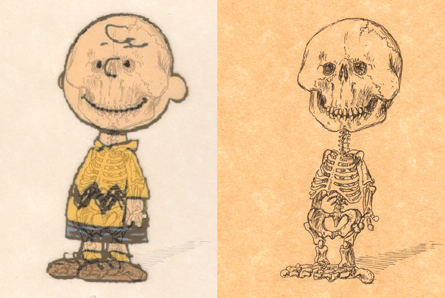
I’m no expert on human anatomy, but I’m pretty sure Charlie Brown’s neck wouldn’t support his head. He’s always seemed a bit… top-heavy.
The same is true for Mabel Pines, and her neck isn’t the only problem—I’m pretty sure those legs wouldn’t carry her weight. Speaking of which, I consider it a miracle that Doctor Eggman can stand at all. His slender needle-legs wouldn’t hold up his mustache, let alone his, um, bulbous physique.
Yes, I’m overthinking things. Cartoons aren’t supposed to be realistic. Character designs are highly stylized. I get that, and I like cartoony proportions. (Would Snoopy from Peanuts be one-half as adorable with a proportionately-sized head? I didn’t think so.) All the same, I find myself occasionally scrutinizing cartoon characters and wondering which bones would be the first to break.
Consider the following image of Charlie Brown, courtesy of Michael Paulus.
For someone frequently addressed as “blockhead,” Charlie Brown’s gargantuan dome is quite spherical. No way on God’s green earth would a few spindly vertebra hold up a skull like that.




 Typewriter Monkey Task Force