Unknown's avatar

About Adam Stück

Adam is a writer and blogger who loves coffee, Jesus, video games, friends, tea, literature, family, and sandwiches.

9. I Can Do Everything through Him Who Gives Me Strength? Seriously?

Just a few days ago two of my housemates discussed over lunch what sort of psychological breakdown I might have. One of them thinks I would ramble incoherently and gesticulate wildly for about ten minutes, then slip into a catatonic state while clutching a cup of tea. The other thinks I would focus all of my concentration on a Legend of Zelda game, emerging from my video game-induced stupor only to sip tea.

I was gratified that both of my housemates recognize my passion for tea, and sincerely hope I never have to find out which of their theories is correct.

The truth is that I felt uncomfortably close to breaking down yesterday. There was never any danger of a genuine psychological breakdown, but I felt more than once as though I’d reached the end of my strength. It’s not a nice feeling.

I’m student teaching at a local high school, teaching two regular classes and assisting in a classroom with at-risk kids. Teaching can be wonderfully fun and rewarding. It can also be terribly exhausting and stressful. I sometimes find myself thinking wistfully of becoming a manuscript editor or pursuing some other career that doesn’t involve classroom management.

I was walking to a classroom today when a familiar quotation came to mind: “I can do everything through him who gives me strength.” That’s dear old Paul, of course. It’s one of those verses from the New Testament I’ve heard so many times that I no longer think about it.

Today, however, I paused and thought about it. Paul lived a stressful life. He faced excruciating hardships: “Five times I received from the Jews the forty lashes minus one. Three times I was beaten with rods, once I was stoned, three times I was shipwrecked, I spent a night and a day in the open sea, I have been constantly on the move. I have been in danger from rivers, in danger from bandits, in danger from my own countrymen, in danger from Gentiles; in danger in the city, in danger in the country, in danger at sea; and in danger from false brothers. I have labored and toiled and have often gone without sleep; I have known hunger and thirst and have often gone without food; I have been cold and naked. Besides everything else, I face daily the pressure of my concern for all the churches.”

My student teaching suddenly doesn’t seem so bad.

Paul suffered so much pain and discomfort and stress. What did he have to say for himself?

“I have learned the secret of being content in any and every situation, whether well fed or hungry, whether living in plenty or in want. I can do everything through him who gives me strength.”

Paul is writing about the Lord Jesus, of course.

It finally hit me today that I’ve been trying to do this thing on my own. I’ve been worrying about how I must survive the next six weeks and how I must teach these kids and how I must show them God’s love.

I don’t have to worry about the weeks and months and years ahead. I’m not alone. There is a secret to being content in any and every situation: I can do everything through Christ who gives me strength. It’s not some sort of trite religious propaganda or esoteric spiritual mystery. I need to stop trying to handle everything on my own, and trust that God will help me when I can’t help myself.

That’s an obvious lesson, right? The problem with obvious lessons is that they’re so easy to forget.

The Lord told Joshua, “Be strong and courageous. Do not be terrified; do not be discouraged, for the LORD your God will be with you wherever you go.”

It’s just as true for me today.

Do you know what else? It’s just as true for you today.
8. An Unapologetic Apology for Video Games

I like knives. To be honest, I like sharp objects in general: knives, daggers, sabers, katanas, broadswords, machetes, claymores and pretty much every other kind of blade devised by mankind.

(It would be more politically correct to say humankind, but in this case mankind is probably more accurate since men are the ones responsible for most of the blades in the world.)

Used correctly, knives can be useful for everything from peeling oranges to creating works of art. Used incorrectly, knives can kill and hurt and destroy. Knives are inherently neither good nor bad. Whether they’re good or bad depends on how they’re used.

I’ll return to the exciting subject of knives in a moment, but I should mention first that I’m student teaching at a local high school. The other day I glanced through a book for teachers about the problems of apathy and disrespect in the classroom. I was a little disheartened when the book blamed video games for the lethargy of unmotivated students.

Why was I disheartened?

Because it’s often true.

Video games can be addictive. Some are horribly violent. Many are painfully shallow or stupid. Finally, while I’m no expert in psychology, I think the satisfaction of accomplishing goals in video games can become an unhealthy substitute for the satisfaction of accomplishing goals in real life. Why bother working hard at school when you can save—or conquer—the world in a video game?

Video games can definitely be harmful. So can knives. But knives can also be beneficial, and I think video games can be too.

There are two kinds of apologies. First is an expression or remorse or regret. Second is a justification or defense. This post is the second kind of apology.

If you will, consider the following.

It’s not fair to judge an entire medium by a few bad examples

Yes, there are video games like Grand Theft Auto and God of War that glorify violence, profanity and sexual depravity. There are also books and films and songs that are just as bad or even worse. We don’t condemn all books or films or songs because some are bad. Why then do we assume all video games are harmful because some happen to be?

Video games are a unique form of storytelling

I’ve read many books and played many games. To be honest, some of those games are a lot better than some of those books. The Final Fantasy games, for example, consistently provide fantastic settings, clever plots, superb characterization, interesting themes and (in the later titles) good writing and acting.

Some games even give players the freedom to influence the story by their decisions: the player and the storyteller become partners in bringing the story to its conclusion.

Video games have artistic value

There are people—including some game developers—who would challenge this assertion, but I think video games can be a valid form of artistic expression. Graphic design, animation, writing, music and acting are acknowledged to be forms of art.

Video games bring together some or all of these artistic forms and add the unique element of gameplay, the finely-tuned mechanics that allow a player to interact with the game. How is that not artistic?

Video games are fun

‘Nuff said.

Video games can be thought-provoking

Although we expect them to be intellectually vapid, video games can be quite profound. Final Fantasy Tactics Advance, for example, has some fascinating moral dilemmas: Is a harmless illusion better than a painful reality? At what point does a person have the right to make decisions for another person?

The Final Fantasy series deals with all sorts of serious moral, political and ecological themes, and there are many other games that wrestle with issues of equal importance.

Video games bring people together

The stereotypical gamer is a lonely misfit with pale skin and no social experience. However, as is often the case, the stereotype is usually wrong. Most of the gamers I’ve met are cheerful, well-adjusted people. In my own experience, video games have actually strengthened friendships by giving friends something to do together. It’s hard not to enjoy spending time with other people when you’re tossing green shells at each other in Mario Kart or trying to knock each other off the screen in Super Smash Bros.

Is there more to a meaningful friendship than video games? Of course. Can video games be part of a meaningful friendship? Absolutely.

Video games inspire creativity

I’ve seen beautiful artwork inspired by video games and listened to amazing arrangements of video game music. There are many online comics centered on the oddities of games and gaming culture; some of them are really fun to read.

Video games have inspired many creative people to exercise their creativity, and that’s a very good thing.

What are your thoughts? Are video games a good thing? Are they evil? Let us know in the comments!

7. The Death Cupboard

Nobody takes my tea without my permission and lives.

That’s not to say I won’t share. I love sharing tea with friends, but woe to the fool who takes my tea without my consent!

All right, I’m exaggerating a little. I may not summon the full force of my mighty wrath if you take my tea, but I’ll certainly be a little irritated.

It’s not that I mind people drinking my tea. To be honest, I’m secretly pleased when people ask for tea; it’s always a pleasure to serve a fellow tea-drinker. It’s that I feel vaguely insecure when my possessions vanish without warning.

At the beginning of my sophomore year of college, I moved into a house with seven other young men and immediately realized my tea was in danger of falling into the wrong hands—by which I mean any hands that weren’t mine. I also had baking supplies and coffee and an emergency stash of ramen noodles, all of which would become public property unless I did something to defend them.

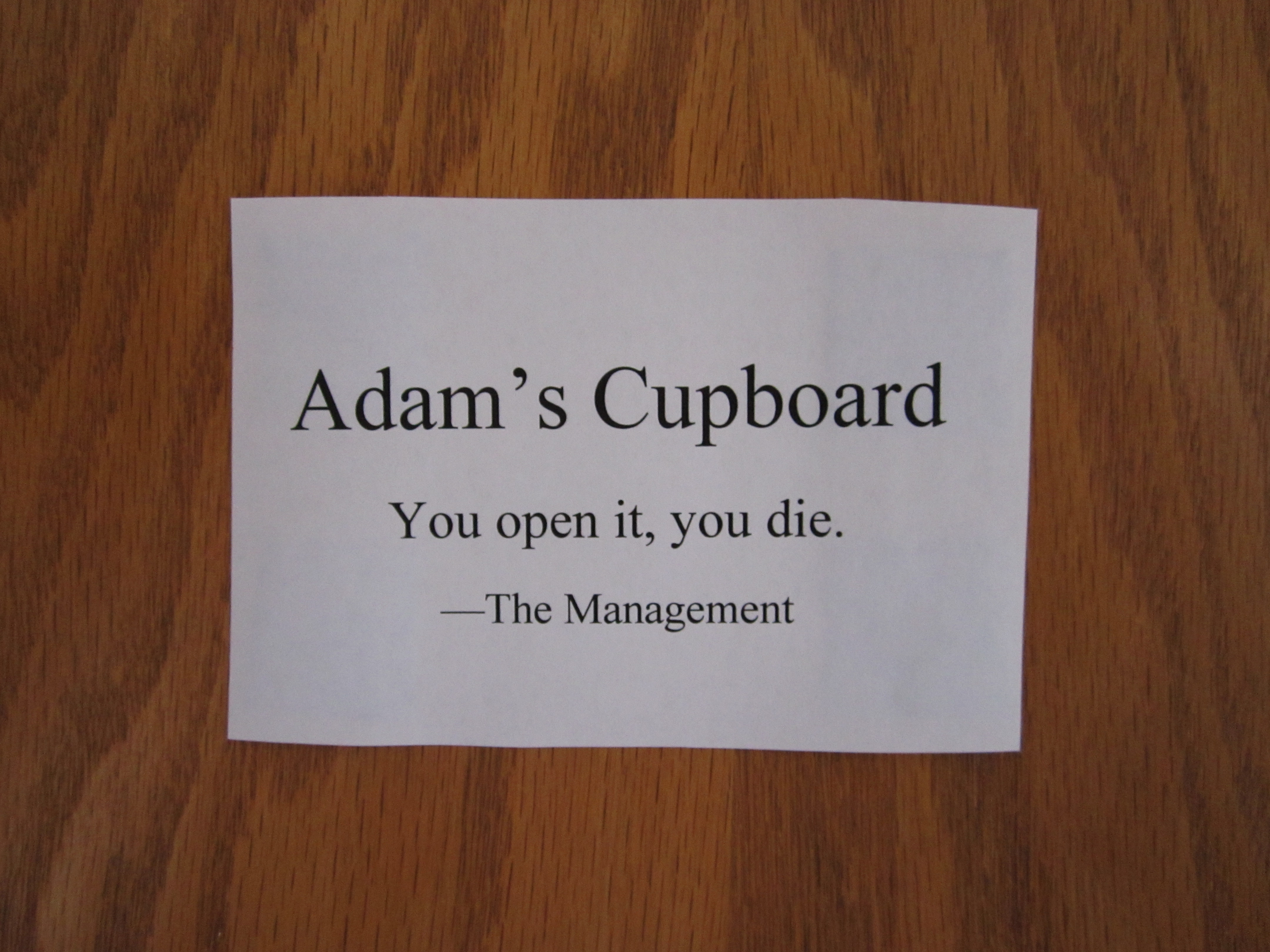
I promptly annexed a kitchen cupboard and filled it with my eatables and drinkables. But what was to keep bandits from raiding my cupboard and carrying off my cherished tea? I gave the problem considerable thought and devised an ingenious solution.

I put up a sign.

Well, that was a mistake.

Several of my housemates and a number of visitors made a point of opening my cupboard just to annoy me. It became known as the Death Cupboard. However, even though the cupboard was opened regularly, my plan was sort of a success. No one took my tea without asking permission.

Since death apparently wasn’t a convincing enough penalty to keep people from opening my cupboard, I later revised the sign to read, Adam’s Cupboard. You open it, Adam unfriends you on Facebook. –The Management.

Well, that didn’t work either. People continued to open the Death Cupboard and I never had the heart to unfriend them. No one took my tea, though, so I guess I can’t complain.

The people who opened the Death Cupboard were quick to point out they didn’t die. Little do they know the day of their doom is coming. They opened Adam’s Cupboard, and they will die.

Eventually. You know, in sixty or seventy years.

When that day comes, I’ll shake my old gray head and mutter, “Ah, if they hadn’t opened the Death Cupboard back in the fall of ’09 they might still be alive today.”

6. Five Books that Should Be Made into Movies

Stephen Spielberg and Peter Jackson are currently collaborating on a film adaptation of The Adventures of Tintin, perhaps the greatest graphic novel series ever. Jackson is also adapting The Hobbit, the amazing prequel to The Lord of the Rings, into not one but two movies.

(Fun fact: Andy Serkis, best known for his performance as Gollum, will star in both the Tintin and the Hobbit films as a drunken sea captain and the aforesaid slimy creature, respectively.)

With these excellent books receiving their long-overdue transition to movie screens, I couldn’t help but wonder what other books would make good films. Here are five novels that would make, in my humble and totally biased judgment, amazing movies.

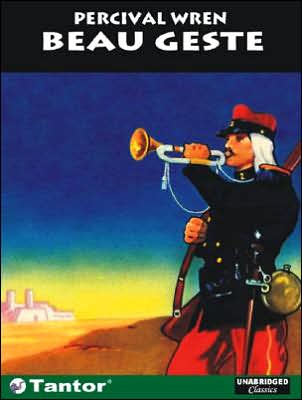
5. Beau Geste by Percival Christopher Wren

If you’ve ever read Peanuts, you may be familiar with Snoopy’s occasional daydream that he’s a member of the French Foreign Legion leading his troop, a line of little yellow birds, through the desert in search of Fort Zinderneuf.

This is a reference to Beau Geste, a classic adventure novel. It tells the story of three brothers who join the French Foreign Legion and embark on a quest involving an inexplicable mystery, a priceless gem, a terrifying battle and two silly Americans. Several film adaptations were made of Beau Geste many years ago, and it’s time for its triumphant return to cinema.

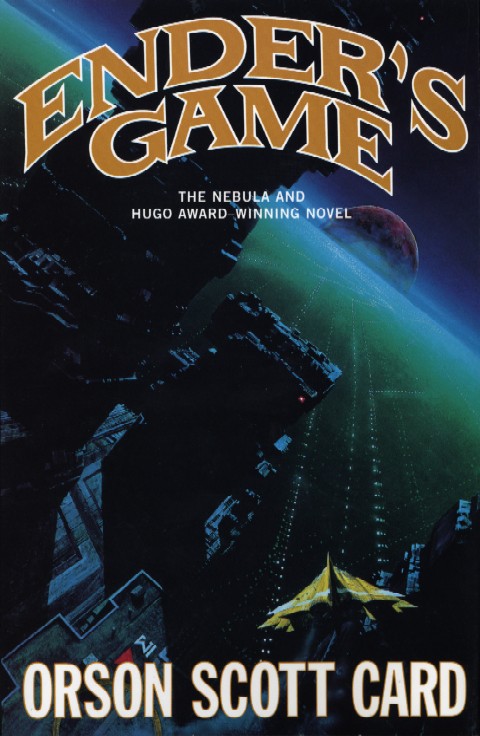
4. Ender’s Game by Orson Scott Card

I keep hearing rumors of an Ender’s Game movie being made, but for years it has stubbornly insisted on not being made. A science fiction masterpiece, Ender’s Game is the story of Andrew “Ender” Wiggin, a child prodigy who’s recruited into Battle School to become a military commander and save humankind from the hostile extraterrestrials called the Buggers.

The movie could incorporate elements from Ender’s Shadow, a companion novel telling the same story from the point of view of the child called Bean, who is more intelligent and sarcastic—and therefore, to my sensibility, more likable—than Ender. An Ender’s Game film would offer epic space battles, great characterization and absolutely no teenage romance.

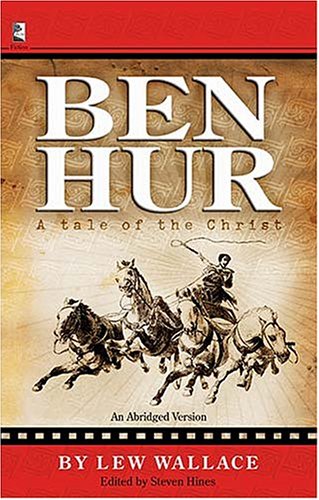
3. Ben-Hur by Lew Wallace

This novel has been adapted into a film at least twice. The first time, it became one of the greatest classics of the silent movie era. The second time, it won eleven Academy Awards. Ben-Hur has sword fighting, political intrigue, a chariot race, a battle at sea and a bitter yet handsome young man whose thirst for vengeance is dramatically conquered by mercy.

Ben-Hur is the tale of a man betrayed by his closest companion and condemned to life as a galley slave. He eventually earns freedom and wealth, and resolves to use them (and his mad chariot-racing skills) to punish his treacherous friend. The novel strives to tell this exciting story in the most boring way possible, but a modern movie adaptation would be epic.

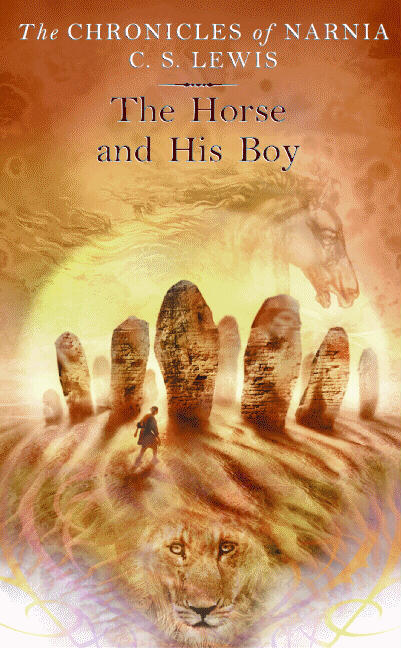
2. The Horse and His Boy by C.S. Lewis

I read a lot of books as a child. Of all the books I read, about only one did I think, “Man, I wish they’d make this into a movie.” That book was The Horse and His Boy, the third book in The Chronicles of Narnia. It’s been my favorite since I first read the Narnia series, and I’m pretty sure I read somewhere that it was also the author’s favorite.

They keep making books from The Chronicles of Narnia into movies, adding gratuitous romances and battles. The Horse and His Boy is the only book in the series that doesn’t need extra romances or battles. There’s already romantic tension between two of the main characters. There’s also a battle, and an exhilarating chase on horseback, and a harrowing journey along a mountain precipice—dash it, it’s been more than a decade since I first read the book and I’m still saying, “Man, I wish they’d make this into a movie.”

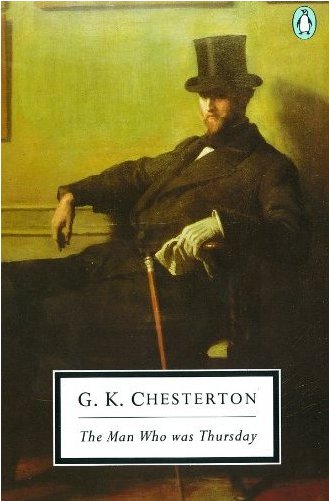
1. The Man Who Was Thursday by G.K. Chesterton

Mystery novels are intriguing, fantasy novels are spellbinding, literary novels are thought-provoking, but no book has ever kept me hooked quite like The Man Who Was Thursday.

The Man Who Was Thursday is the incredible story of a poet-turned-detective who joins a great council of anarchists in order to bring them to justice. The anarchists are named after days of the week; the title refers to the appointment of the detective to the post of Thursday. The scene in which we meet the anarchist council is terrifying. We’re alarmed by Muslim extremists who blow things up for religious reasons, but the anarchists in The Man Who Was Thursday are a good deal more frightening—they blow things up for no reason. The author of the novel also has a fantastic trick of introducing something that seems impossible and terrifying, and later explaining it in an instant with the addition of one simple fact: like someone hitting a switch in a dark room and instantly flooding it with light. Of all the novels that could be made into a really good movie, this is the one I’d most like to see.

What books would you like to see made into movies? Let us know in the comments!

5. Anime Hair

In my middle school days, it seemed that everyone had spiked hair. Well, by everyone I mean many of the boys. I did know a girl with spiked hair—it was actually quite a good look—but the fashion was almost exclusive to the males of the species. I even tried spiking my hair once, a dreadful mistake that I’m still trying to block out of my memory.

It would be much more convenient to have naturally spiky hair. People have naturally wavy or curly hair. Why not naturally spiky hair? Sadly, spiky hair is not a gift God has given humankind. Perhaps spiky hair is a gift we lost when we sinned against God at the beginning of the world. Could Adam and Eve have had naturally spiky hair in the Garden of Eden?

I guess I’ll save that theological question for another time.

Spiky hair seems to be a requisite for anime, or Japanese animation. This prompts a number of questions. Do anime characters take time to style their hair, or is it naturally spiky? If it’s naturally spiky, what are the theological implications? Are characters with spiky hair holier than characters without spiky hair?

Another common tendency of anime hair is to be creatively colored. Anime characters have black, brown or blond hair like the rest of the human race. They also have blue, green or purple hair. Explanations are never given for these unusual colors. Viewers are left to assume that anime characters either dye their hair or possess highly irregular genes.

I read somewhere that the trend toward odd hair colors began with manga, or Japanese comics. These comics were printed without colored ink, restricting a character’s hair color to black, white or a shade of gray. The covers of the comics, however, were printed in color. In order to visually distinguish characters as much as possible, comic artists gave their characters vividly colored hair. This tendency toward unnatural colors passed from manga to anime, thereby accounting for the brilliant shades of pink and indigo that brighten the hair of certain characters.

The really striking thing is how natural spiky or vividly colored hair seems in Japanese anime. Viewers tend not to think twice about a character with spiky blue hair.

Of course, there are a lot of strange things in Japanese anime that viewers tend not to think twice about. Like the characters (usually females) with furry ears and whiskers who possess a vague resemblance to cats, and the innate ability of some characters to produce large hammers from thin air, and the inexplicable ubiquity of pandas.

Strong Bad was right. Japanese cartoons are weird, man.

4. The Awful Problem of Pain

It’s Friday, and one of my students began singing Rebecca Black’s “Friday” in class today, and it made me think of the problem of pain.

The existence of pain is probably my biggest doubt about Christianity.

If I weren’t a Christian, I think I’d be an atheist with the existence of pain as my chief weapon against crazy religious people. “How can you claim,” I would thunder, “that God loves everyone and is all-powerful if he lets thousands of innocent children starve to death every day? Your God lets religious hypocrites hurt people in his name. Your God just watches instead of doing something as men and women kill each other. How can you say he’s good and almighty? You can’t have it both ways, you crazy religious person!”

(I’m actually really glad I’m not an atheist, because I’m pretty sure I’d also be kind of a jerk.)

It would be awesome if every Christian received The Complete Compendium of Answers to Every Moral and Theological Question Ever. That way, when perplexed by the problem of pain, I could just turn to page 374 and read God’s authoritative answer to the question of why bad things happen.

However, Christians don’t have The Complete Compendium of Answers to Every Moral and Theological Question Ever. (The Bible is God’s Word, but—as many dissenting theologians can testify—it doesn’t answer certain questions.) We’ve had to study the Bible and reflect upon our own experience in order to come up some possible answers.

One possible answer has to do with free will. If God gives us free will, the ability to do whatever the deuce we want, we can choose to ignore his good instructions and wreak havoc on his creation. Another possible answer has to do with personal growth. We do tend to shine our brightest when we’re dealing with our tragedies—or helping others deal with theirs.

Whatever God’s reason for allowing pain in the world, one thing is clear. It’s a good enough reason that he didn’t hesitate to suffer because of it. Jesus Christ came into the world and endured not only an excruciating death but every other pain, humiliation and discomfort known to humankind, from the pain of rejection and betrayal among his friends to the minor nuisances of blisters and bad breath. The problem of pain didn’t deter Jesus.

These reflections are abstract, but I still find them comforting—most of the time. The real problem comes when someone else is suffering and wants to know why God lets it happen. What answers can be given to someone in pain?

“I know you’re hurting, but God loves you.”

“Where’s the proof of that?”

“I know you’re hurting, but this tragedy is making you a better person.”

“So God’s punishing me because I’m not good enough, is that it?”

“I know you’re hurting, but Jesus suffered too.”

“Why the heck should I care?”

“I know you’re hurting, but you can’t blame God for human error.”

“Just shut up.”

What’s the conclusion of the matter? Why does God allow pain and brokenness and Rebecca Black’s “Friday” to exist in the world?

I wish I knew.

3. About Writing: Three Platinum Rules

I love writing. Along with making tea, twirling broomsticks and obliterating all competition in Mario Kart, writing is pretty much my only significant skill.

There are innumerable bits and pieces of advice for writers. However, three all-important rules demand attention. Three golden rules. Not just golden rules, but platinum rules. Diamond-studded platinum rules.

I believe these platinum rules are the most important things for a writer to know.

Read

It’s impossible to become a good writer without reading. Impossible. How-to guides, classes and seminars can be useful, but nothing helps a writer as much as reading books.

Let me give an example.

One day I resolve to learn to play tennis. In order to master the sport, I spend hours listening to a professional tennis player give advice. That advice might be helpful, but I won’t be able to pick up a tennis racket immediately and win every match. It will take practice—a lot of practice—for me to learn to play well. Advice can take me only so far. At some point I must actually step onto the court and play.

It’s exactly the same with reading and writing.

Most of what I know about writing comes from reading. By reading fiction, I learned the mechanics of storytelling: plot development, characterization, settings, symbolism, style and the rest. By reading both fiction and nonfiction, I learned proper spelling and grammar.

Best of all, I learned these things intuitively. I didn’t try to learn anything—as I read, I simply developed a feel for writing.

However, a vague feel for writing isn’t enough. It must be refined. That’s where the second platinum rule comes in.

Write

Most people can’t sit down to a piano and play the third movement of Beethoven’s Moonlight Sonata without a lot of practice. In the same way, most people can’t sit down to a computer, typewriter or notebook and write a masterpiece without a lot of practice.

Don’t be discouraged if your writing isn’t perfect. I’ve never been completely satisfied with any of my own writing, and my early attempts at fiction were unspeakably horrible.

Reading and writing are essential for any writer, but there is one more platinum rule.

Have fun!

Writing should be fun! There’s satisfaction, joy and exhilaration in putting ideas, reflections and stories into a form that can be read and appreciated by other people.

If writing becomes a dull chore or heavy commitment, remember you’re under no pressure to write. Not everyone is gifted to be a writer.

When I was growing up, I desperately wanted to be a good artist. I sketched and took art classes and read how-to books, but nothing worked. To this day I have the artistic skill of a five-year-old—and that’s okay.

I’m not gifted to be an artist, but I am gifted to be a writer of fiction, brewer of tea, twirler of broomsticks and wicked good Mario Kart player. If you’re gifted to write, awesome. If you’re not gifted to write, learn what your gifts are.

If your gift is writing, read and write and have fun!

2. Confessions of a Literary Snob

I have a confession to make: I’m a literary snob. This wouldn’t be so bad if my literary judgments were confined to the Twilight books, but my snobbishness goes where even angels fear to tread.

Yes, I’m talking about modern worship music.

It’s Sunday morning. Having quaffed my morning coffee and dressed less shabbily than usual, I’ve come to church to worship God and learn from Scripture. But I look at the bulletin and feel a pang of annoyance.

The first song on the list: “How He Loves Us.”

I stifle a groan. Not “How He Loves Us.” Not again.

The song begins.

“He is jealous for me, love’s like a hurricane, I am a tree bending beneath the weight of his wind and mercy.”

Bending beneath the weight of his wind? What is that even supposed to mean?

“When all of a sudden, I am unaware of these afflictions eclipsed by glory and I realize just how beautiful you are and how great your affections are for me.”

Dash it all, that’s got to be the worst poetry I’ve ever heard.

“So we are his portion and he is our prize, drawn to redemption by the grace in his eyes.”

That’s bad writing, but at least it’s coherent.

“If grace is an ocean we’re all sinking.”

That is not coherent. Drowning in an ocean doesn’t even come close to being an appropriate metaphor for divine grace.

“So heaven meets earth like a sloppy wet kiss and my heart turns violently inside of my chest.”

Something is turning violently inside me, but it’s not my heart. How exactly is heaven like a sloppy wet kiss? I haven’t seen such bad writing since Eoin Colfer likened sparks of magic to “mystical beavers repairing storm damage.”

Then, in a blinding instant, I realize I’m being a literary snob when I ought to be worshiping the Lord God Almighty.

Am I the only Pharisee guilty of literary snobbishness? Does anyone else have something to confess? Let us know in the comments!

1. That Time I Was Attacked by a Tomato

The inaugural post of a blog is a great and sacred thing. It sets the standards and expectations for all of the posts to come. I gave considerable thought to this all-important first post. Perhaps, I mused, I should share some beautiful spiritual reflection, or a profound literary insight, or some glorious commentary on the meaning of life.

I decided instead to write about That Time I Was Attacked by a Tomato.

To be fair, the attack wasn’t unprovoked. I suppose it could even be called self-defense. During my time at Bethel College in Indiana, I’ve worked at a sandwich restaurant called the Acorn. It was my morning shift and I was slicing tomatoes without any suspicion that one of them might resist.

Workers at the Acorn use a slicer that shoves tomatoes through a frame of razor-sharp blades. The blades divide the tomatoes into even slices, which are stored in plastic containers and eventually put on sandwiches. Every now and then a tomato will be too mushy to be sliced neatly by the blades. Such tomatoes generally split open and send forth little jets of juice.

On the day of the incident, I tried to slice a tomato and it exploded.

I wasn’t expecting any of the tomatoes to go off like grenades, so I was rather stunned. One of my fellow workers described the scene thus: “I looked over at you, and there was juice and seeds dripping from your face!” Another worker just hopped up and down and exclaimed, “Eww! Eww! Eww!”

Tomatoes aren’t the only things that have attacked me at the Acorn. I never considered making sandwiches a dangerous job, yet my time at the Acorn has been fraught with violence.

For example, a friend whom I’ll call Socrates made a point of pretending to tear out my heart every time we worked together. He would then pretend either to take a bite out of the still-beating heart or to squeeze it into his drink.

Socrates once recruited another worker to assault me with crumpled-up papers as I was taking my supper break. A volley of paper balls pelted me as I sat innocently eating a sandwich, and I looked up to see Socrates and his accomplice preparing the next barrage of artillery. With only the table for cover, there wasn’t much I could do to defend myself.

I was also jumped by a raccoon. When I say jumped, I mean it both literally and figuratively. I was taking a stack of cardboard out to the recyclables dumpster when something like a furry gray basketball launched itself at me from an open hatch in the dumpster’s side. It landed at my feet and I realized it was a raccoon. It paused for a moment, peering up at me and presumably wondering whether I was worth the trouble of biting, and then sauntered away.

Why do things attack me at the Acorn? Why is making sandwiches so perilous?

I have no idea.